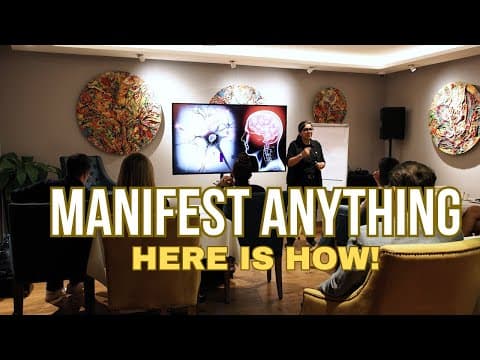
[0:00]We all have read this book. How many of you have not read this book? I think in this crowd I have to just ask the reverse. How many of you have not read this book? Oh, you haven't. Okay, so much about. Okay, so there's a movie as well, called Secret, and then this book is written by Ronda Barnes. You have read it. Yeah, I've seen the I've seen the movies, yeah. Yeah, yeah, yeah. And they've done another version of it also. Right, right, right. And then there is, yeah, the next version of it as well, and then the next version of it as well. But this was the original film or the original book which gave rise to this whole manifestation hola, right? Not many people were talking about the manifestation before the secret. And what does it say? Everything that comes into your life, you are attracting into your life. And it's attracted to you by virtue of the images you're holding in your mind. It's what you're thinking. Whatever is going on in mind you are attracting to you. So I'm just going to pull out some nuggets and then we will decipher each of it in the neuroscience context of it. You are like a human transmission tower, transmitting a frequency with your thoughts. If you want to change anything in your life, change the frequency by changing your thoughts. This is the second, and I've bookmarked all of these interesting things because all of this is nothing but neuroscience. Your current thoughts are creating your future life. What you think about the most or focus on the most will appear as your life. Your thoughts become things. Please remember all of this. We will cut down each and every portion of it very tty in a small little fashion. The law of attraction is a law of nature. It is as impartial as the law of gravity. How many of us can escape law of gravity? Possibly, I think there are some places where the law of gravity, I think one, right, in the Bermuda or somewhere where there is no law of gravity, but most places you can't escape that. Nothing can come into your experience unless you can summon it through persistent thoughts. How powerful written words, right? But if we want to look at it in the neuroscience ways, let's see the principles. Let's practice. We will do some fantastic checklist and then, of course, we will bring a little bit of quantum science into it, and then we will do a group meditation in the end. We'll pick up one person, if you all are game, who wants to manifest something, and for 21 days, another 21 days, and another 21 days. 66 days it takes for a brain circuit to well align and for something to happen as material this. So we will all do for that one person. Are you all game into it? Every day, we will think for that person's manifestation. So, who would want to be the hero for that manifestation? Anybody has the intense desire to manifest something very quickly? 66 days? Yes, one of your kids. Okay, fantastic. So, we are all going to have you help that kid. Okay. Or all are okay with that? So we will keep that thought in mind. We will practice all that we are learning today and help you guys out, okay? Of course, with a prayer, with gratefulness, with gratitude, with all the humbleness that we will help you. All right. So how many of you don't believe in this formula? E is equal to MC square. It was said by Einstein. What was the formula? Energy, mass into. And mass are interconvertible. Energy and matter or energy and mass are interconvertible. What is a thought?
[3:22]Yes, thank you for saying that. And what is manifestation? Whatever you want, your money, your whatever you people ask for, right? Money and love and kid and everything, what is that? Material. Thank you. So if you have the right thoughts, then don't you think so you can convert into a material this, and both of them are interconvertible? As simple as that, right? So energy and mass are definitely interconvertible. Everything is energy. Your thought begins it. Your emotions amplifies it and your action increases its momentum. Please remember that. There are three things which we keep doing all the time, and sometimes we are aware, sometimes we are not aware. First thing is thought, and then of course is emotion, and then is action. There are many, many people who do actionless thinking, and there are many people who do thinkingless actions. Right? So if everything is aligned, if everything is perfectly matching, and that is why it is so important for us to understand metacognition. What is metacognition? Thinking about thinking. And today we will use that principle of what is that, what, who is thinking? How are we thinking? What is happening in the brain as our first principle? And we have the workshop time until 12:00, but because of the exercises and all, I'll go through five steps, and then five steps of practice, but we should be able to finish around 11:45, and I'll have 15 minutes for the question answer. All right. So let's start with this first one. I love this statement. I am a brain, the rest of me is an appendix. Appendix is like one little vestigial useless organ that you have, right? But when it pains, yes, you definitely go to a hospital. Why is this such a profound this? Because of the properties of the brain that we have. How many number of the brain cells that one single brain has? Guess? Trillions is a little too much, yes, billion. How many billions? I don't know, 8 billion. 10 billion. Yes, 100 billion neurons. And every single day of my time, 24x7, if I count, it is going to take me 36 long years to count all the cells. What is the memory of the brain? Single brain. If I were to download all of that and put it into CPUs, I will have to stack up Burj Khalifa and still it will not be enough. 2.5 petabytes, and one petabyte is a million gigabyte. If I were to take one brain cell, because each brain cell has a little tail, if I were to combine all the tails of every single 100 billion neuron, I'm going to start traveling from Dubai, reach Calgary two times. 150,000 km. Don't you think so this is all too powerful? Most brain, most brain, okay? Most brain's blueprint is laid by the age of three. So 0 to 3, most important period in your parenting life. After that, it's just the size which is increasing all the sensory phenomenon, okay, all the sensory phenomenon, whatever you can see, touch, feel, everything is happening between 0 and 7. 0 and 7 is like a complete sensory laid map. And then, parents are fighting, and then they say, oh, children don't listen to that. Children do listen to that. It's just that they don't have motor. There is no output. But that is the power what the brain has. Any of you are parents already? They are to be. Okay. Do you guys believe in that when you're 0 to 6, and that is called the critical period of growth from the neuroscience perspective. You can do anything, anything that you want between 0 and 6. And they are absolutely this. So let's do this exercise to understand how powerful this thinking is. So I want you to take your hands like this, okay? And then join your wrist, put your hand like this in the Namaste Mudra, okay, or Namaskar Mudra, and check the middle fingers. Either the fingers would be equal or one will be taller than the other. Just shout out whatever it is. Just look at it from a equal. Wonderful. Equal. Okay. Equal. Equal. Sir, for you? In that is seems taller. Okay, keep that in your mind if left is taller. Equal, equal. Left is taller. Please keep that in your mind. Remove your hands. Now what you're going to do is you're going to pick up any finger for the people where it is equal. Left or right, I don't care. Make it taller in your mind. If you want right, make it taller in your mind. No. You can just remove your hands. In your mind, repeat it. Right is getting taller or left is getting taller. For you, make them equal. Okay? Continuously think, make a picture, make an image of that. See that your hand or your finger is already taller. Keep doing that mentally. Repeat, repeat. You've chosen your finger. Yes. All right. Keep doing that. Keep doing that. By the way, this is no hypnosis, okay? Because I am not a hypnosis expert. So it is not going to happen through hypnosis. All right. Let's do it again. That's amazing. That's good for you. You did it, you did it. What about you? You did it. You did it as well. What about you? Yeah, slightly taller for you. Right one, right? That was your chosen one. Yeah, that is. Yes, yes, yes. It also works. 80% of the times, this is a successful experiment. It is a neurophysiology experiment. It is not hypnosis, okay? When we took calipers, and when we actually measured it, there was a micro millimeter change in the finger. How can that happen? What is the phenomena, what is happening? There's a very simple phenomena which is happening, which is called, and I like to say it as a rapper psychoneurophysioimmunoendocrinology. Psycho, mind, neuro, brain, immuno, immune system, physio, and that is very important from your energy healing, and endocrinology hormone. You can shift the energy. You can shift the physiology. You can shift the body's this. Everything through the power of the mind. 80% of the times this is a success. So it's a very, very famous neurophysiology experiment. And this is an energy and emotion map.
[9:35]Everything that you're thinking is not just limited to your thinking. It is translated also in the body. And this is an energy scale, so everything which is red and yellow is high. Everything which is blue and black is low. Now look at anger. How many of you the times when you get angry, you do this. You'll obviously do that. This is your first response, because all your energy is all right here. When it's love, it's all over the place, right? And look at happiness. Even love is not enough to get that entire happiness through, but happiness, yes. And look at uh fear. Obviously, all the fear, I am fearful, you know, it's all we say here, heart and this. By the way, there is a new study which says 40,000 neurons in the heart. So brain cells in the heart. And then there is a connection, obviously, and then gut, we all know, right? The brain, gut excess. Gut is the most important part because 70% of the serotonin, which is one of the chemicals, is actually contributed by gut bacteria. So you need to take care of your bacteria, and then of course, there is dopamine, there are so many other neurochemicals which comes in. All right. Let's see what is this. Ice cream is good. Ice cream is good. And how many of you think ice cream is good? Yes, of course, but this is it. This is not ice cream is good. Now, what just happened was there are two systems in the brain, system one and system two, and this was a study which was done by Dr. Daniel Keman. He has a famous book, he's a Nobel Prize winning author for that book. And there are two systems. You all use sometimes right now what is called the system one, effortless. Nobody of you thought that this could be something else other than ice cream is good. This is what we keep doing in life. Whatever comes by, we have the system one, effortless, completely, you know, just easy, quick response, no need for reason, no need for concentration, no need for intention. Most times autopilot of our life is system one. Something happened wrong. I'm angry, I'm sad, I'm completely broken. Why can't I change or reframe the thoughts? Why can't I reframe the entire perspective of it? No, because that's an effort, and which our brains don't like. Because we have had the this of survival as our necessity. The brain consumes the most oxygen in the brain, 20% almost, with his very big for a little brain like that, and then consumes the most energy as well, comparatively, you know, as compared to your other organs. But it is the laziest. It does not like to do anything. It likes to run in that autopilot and system one thinking most of the times. Let's do another experiment. I need two volunteers, and I need one timekeeper. Who's going to be a timekeeper? You want to be timekeeping? Okay, fantastic. You have a stopwatch there. I want one and one, two volunteers. That point. Okay, one and two. Okay. Yes. So I'll give you the first task, okay? In the first task, very simple, and you're going to do the time mapping or matching, whatever it is. And then we'll see who wins. Okay. So, what I'm going to show you right now, you're just going to speak out the words as is. Okay? Just speak out the words as fast as possible. Yes. Start. Green, blue, blue, blue, red, red, red, green, blue, red, blue, red, green, green, blue, green, blue, red, red. Fantastic. How many seconds was that? 5 seconds. Okay. Okay, 5.95. Wonderful. You are going to say the colors. Okay? Here you go. One second. Yeah. Yeah. One. Start. Red, green, blue, red, red, blue, blue, blue, yellow, red, yellow, yellow, red, green, blue, blue, blue, red, red.
[13:42]Okay, he messed up a few times. How many minutes? 21. Okay. So this is exactly what is happening when you want to have a focused, concentrated, attentive, and this is a very simple test which we use for attention. Because it sounds very easy. Any of you other people want to try? It sounds easy, but it is not. So you did a fantastic job. You want to try? Okay. Start. Right, green, red, red, blue, blue, blue, yellow, red, yellow, yellow, green, green, red, blue, red, yellow, green, green, blue. Ah, very good. Then the last she stumbled, but good job. How much is that? Okay. So this is this is the system one and system two. Now we are all evolved as brains, but we still have three brains in our current brain. There is one brain which is at the back, which is called the brain stem. Many years back I always remember this example, we went to a exam, you know, there was a neuropathology exam, and we were three candidates. We entered into the room, the professor was sitting with a brain. So I was the first candidate in and the professor said, what is this? I said, brain. He says get out. Second candidate walks in and the same question, what is this? The brain. Get out. Third candidate, same thing. And we all three were sitting outside and saying what was happening? That was a brain. And then the professor called us after the exam and said that was a cow's brain. You should have watched it carefully and then we said, what was happening there? Because the brainstem was this big and the frontal cortex was this small. And we have just the reverse. We have a very big frontal cortex and a small little brain stem here. So three brains, essentially, we are carrying. One is the brain stem, one is the limbic system, or the limbic cortex right here, and then the entire brain, which is called the Neo Malian cortex. So we go from Reptilian cortex to Paleomallian cortex. That's a difficult name to remember, so for this entire thing, we are going to say it as a limbic system, and then we are going to say it as the frontal system, okay, or the prefrontal cortex. All the three systems are happily active right now in our systems, but majority of us, majority of us are only here. When I say this, most of the times we are in the survival mode. Most of the times, it's fight, flight, fear or freeze for us. Most of the times, everything is a threat, because we are survival seeking organisms. We are not into the evolution. We always want to protect from the threat. We always want to save ourselves. We always want to survive. And that's a Reptilian nature. How many times have you seen a lizard meditating? A lizard which is there and then, you know, oh, wow, what a what a state of meditation the lizard. It is not possible, because they don't have the other brain to even think about that. It's all about survival, fear. I want to search my food. I want to go here. I want to go there. That is the nature of the Reptilian. Exactly the same. Reptilian brain in us is always pushing our things out, or saying, this is not possible. Doubts, fears, all the emotions of anger, sadness, not happening. This is it. That is it. All that is happening there. So essentially, we have three systems. And this is the most, most, most important part to remember in this entire thing that this threat system relates to this limbic system, and then there is some people who have the drive system coming from this part of the brain. And then we have a soothing system also, which is part of it, because there are people, or there are animal systems. Have you guys seen elephant? They are so caring for their young ones. If you go near your young one, when the mother elephant is there, you had it, right? Because that is where they have this soothing system very active, and then a protection system which is highly active. Most of us, most of us are into this thing. Although we are not supposed to be there. Because that's an animal brain. You have a small little prefrontal cortex, a large limbic system, and then we are here. We have a small limbic system and the prefrontal cortex is here. Most studies that we did for the successful people, for the peak performers, top performers, we found this very well developed. We found that the both the left and the right side was just actively connecting to each other. What we call coherence. Let me see if I have a brain, it was super developed. It was very well developed. And there was a lot of cross talks which was happening as well between the two sides. So this is how the brain looks, and this is the part of the brain which we are focusing on, which we are talking about, okay? The prefrontal cortex. Now, what is happening in your life? I just want you to think a little bit. Any problem comes in, any situation comes in, anything that happens, we have only two things to do. Either we react or we respond. Look at in your life, how many times are you reacting versus responding? If you're reacting more than responding, which system is active for you? Limbic system. Exactly. If you're responding more, which means your prefrontal cortex is active. Now I'm going to show you this particular slide, which is super, super important. If you are in the limbic brain, then you're always in this fight, flight, freeze mode, but if you develop your prefrontal cortex, look at this. You develop empathy. You develop insight. You develop body regulation, morality, intuition, attuned communication, and fear modulation. Limbic and. Yes, precisely. Precisely, that is the question. How do you think we can develop it? Uh, well, by thinking positive. And manifestation, uh, like gratitude. That's not always easy. It is certain that uh, that's a situation, we are used at least for myself, used more to use that limbic. I can say that, even though I know everything that I should do, but that point. Precisely. Most of us end up with that point. It's the first step, and that's why you brought up a very, very important and interesting point. The very, very first step into anything, anything at all, even before you develop, starts with an A. What is that? Awareness. The brain.
[19:56]The first thing. At least be aware that that was your limbic response. Be aware that that was not a prefrontal cortex response. How many times you just say somebody, and then you come home and realize, oh, I should not have said that. I should not have done that. That PFC kicks in much later. That's a system two, which is taking a lot of time for you to come in. You've already done the damage by that time, right? How many relationships go completely crazy just because of your limbic activation. So, good point. The first thing is awareness, and then by the end of today's class, you'll know how to develop that, right? And if you develop that, manifestation would be a part of it. It's a package deal, right? Manifestation will come. Okay, so what you just did was watched one part of the beautiful neuro manifestation course. We have been doing this in many countries with many, many different people, and I have been always excited to deliver this course and these modules, because this is super interesting. You want anything that you have dreamed in your life, right? A great job, a great profession, great relationship. This is all super easy, provided you understand the inside out process of it, provided you understand how your brain is working, how your brain is functioning. There are lots and lots of steps into this entire process of neuro manifestation. Yes, the universe is all there, and we agree that universe is ready to provide all the things that you want, you desire, you really dream for, but caution, we really, are we prepared? Is our mind and the brain prepared? Are you doing the right things to make it prepared? And believe me, you know, I always joke and I say neuroscience is like mathematics. It's all knowing the formulas. And whatever I teach here, I have always been the number one subject and number one experimenter on myself first so that I can give you the best of the entire series, what you can have in the neuro manifestation. So hang tight, more details are in the course below. I want you guys to have a look at that course, and then practice, practice, and I am sure one day you will have that dream life that you have desired for. This is me, Dr. Shweta Aryad, always here to be with you, bringing out various aspects of neuroscience for daily life on the Limitless Brain channel. Hang tight and see you soon.


