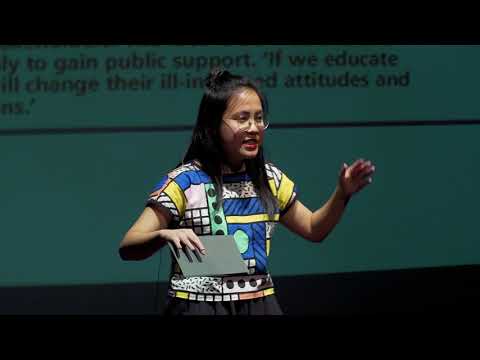
[0:07]My name is Jules. I am a theater maker. Um, I'm a light-skinned, middle-class, private school educated person. I'm a cis woman, I have a master's degree from the University of Oxford in Women's Studies, and what I'm trying to say is I spend a lot of my life nestled in privilege. I thought it would be important for you to know that before I keep going because what I'm going to talk to you about is decolonization and self-determination. So, broadly speaking, decolonization is the means by which colonial powers, both structural and cultural, are dismantled. Self-determination is the act of freely creating your own future. These concepts have their own relationship in governance, in politics, and in law. But that's all much too complicated for me, so I'm going to focus on how we can enact these processes in our creative expression, both personal and professional. So, as an Australian woman, um I've profited from European colonization in a lot of ways. Uh the houses that I lived in, the jobs that I got my money from, they were all on stolen land. But as a Filipino woman, I walk around in a colonized body. I am subject to all manner of racism, uh casual, institutional, sexual. So, as a theater maker, uh what I do is make work that splays open these bodies and these identities in order to flesh out what it means to be both. I go about it in really random ways. Um I write plays for Asian Australian women. I uh attempt stand up and spoken word. I try to sing karaoke. Um and I also come into rooms like this one and I chat about my personal business whether anyone asked me to or not, that kind of thing. Um so one question has come up in my practice, uh repeatedly. And that question is, how do I go about decolonizing myself and my practice without erasing myself entirely? In the East Asian theater community in the UK, one of the biggest questions that we face is how to combat our own erasure. In the British cultural sphere specifically, um to roughly paraphrase from the wonderful Vera Chock in her chapter in The Good Immigrant. East Asians are approximated as the third largest ethnic group in this country. But spend one minute scrolling through BBC iPlayer and you'd be lucky if you could count the number of yellow faces that you see on one hand. That's if you're lucky. As if our general absence weren't enough, we seem to be whitewashed out of pretty much everything in sight. Um earlier this year, in January, the Print Room, a once well-regarded theater in the west of London, opened a Howard Barker play that was set in ancient China. No prizes for guessing, but it featured an all white cast and team. What was most upsetting to me about this was that the play seemed to use Chinese culture and living histories that belong to real Chinese people in order to promulgate some sort of exoticist fantasia for the benefit of goodness knows what or whom. The theater ended up defending the play, saying that any allusion to ancient China was merely invoking the abstract and folkloric idea of the universal, which I struggle to believe is actually a thing. Particularly when you have real Chinese people looking at you in the face and saying that it's not. So, after protest upon protest, a bunch of uh East Asian theater companies came together and they sent out a survey to the community to gauge their concerns. It found that an overwhelming majority of us had a deep concern for the lack of East Asian representation in mainstream media. And it therefore, a deep desire to be part of the British mainstream. And yes, I am one of these people. Wouldn't it be nice to see more people who look like me on telly? Yeah. Wouldn't it be nice to feel valued and seen and heard just as much as anybody else? Yes, it would be really, really nice, but if I were to wake up tomorrow to an announcement that the BBC, ITV, Channel 4, and Sky were each going to commission brand new programs that featured all East Asian casts. Do I have any proof that any power has actually changed hands? Earlier this year, a Melbourne-based artist and researcher called Tanya Kanyas wrote an incredible article and it was called Diversity is a White Word. In the article, Tanya foregrounds the notion that in Australian arts and culture, diversity has been deployed in cosmetic terms, which means that white-led organizations started paying more attention to the white to non-white ratio of the people in their public images. Then they did to providing any meaningful support to people of color behind the scenes. Tanya writes, just because we exist in a space does not mean that we've had the autonomy in the process by which that existence has occurred. And she uses this diagram in order to measure out um whether or not that diversity initiative has actually done anything more than make the organization look good. Um so this is Sherry Arnstein's ladder of participation. At the bottom, we have our most tokenistic practices. So that's like engaging a group of people uh in order to just manipulate them for your own benefit, for your own purposes. That's at the bottom. If you climb up a little bit, you get to consultation and placation. And that's things like hiring that one diversity officer for the building, so that everybody has one person to talk to in relation to all diverse people things, yes? So that's in the middle. Um right at the top, we have delegated power and citizen control. And what that entails is a group or a community doing their own thing that they devise and that they execute themselves. An organization can come along and support and help, so long as there are no strings attached and that the power and the control remains firmly in the community's hands. Um now, let's go back to the weird fantasy that I had that all the terrestrial networks were suddenly programming East Asian, uh programs for the general British public.
[6:54]Where do you think on Arnstein's ladder of participation that would be? The networks themselves are actively trying to fulfill a brief of their own, so I think that's citizen control and delegated power out. The head commissioner of the network and the East Asian cast and teams that they are employing don't necessarily have equal power. So that's partnership out. If we're lucky, we're sitting pretty at around the consultation placation level, which means that East Asian people have um they have a presence in the room that they're in. But when it comes down to the final decision making, that's down to the network. So, what was once a fever dream of ultra representation is now sort of a middle-ground goal. At best, it's a small move towards something better than invisible. At worst, however, it might represent an inculcation and exploitation within a system that was not built for us in the first place. Because no matter how feisty or strong willed these East Asian characters are, they have been created for mainstream tastes and mainstream interests. So, what does this have to do with decolonization? Well, my heritage is in the Philippines. It's a country that has undergone hundreds of years of colonization. Colonization still has an effect in the country's governance, its education, its economic situation, and its culture. Colonialism still has a say in how Filipino bodies walk around in the world. It says that we are more likely to be male order brides, to be sexually submissive, to be compliant, to be adaptable, to be trafficked. It also says that whiteness is something to be aspired to and that most of us aren't white enough. Therefore, we have a gigantic skin whitening industry, so massive that approximately 50% of Filipino people have tried a skin whitening product or use it on the regular in their lives. What we need isn't more of that. What we need is to divest power from what that is. What we need is something else. Yes, I do want to see East Asian people on telly, who wouldn't? But I also know that something fundamental about the way in which we consume the bodies of people of color and indigenous people needs to change. Last Christmas, I went back to Australia um to develop a script with the national play writing organization there, which was very cool. Um and it was a total honor because I'm a baby playright and it was really unexpected and I got to work with some really amazing people. Um the script that I was working on was for two Asian Australian women. And the director of the workshop, some way during the process, asked me to set my characters on a scale from Asianness to Australianness. Like is she downtown Beijing or is she Crocodile Dundee? The question threw me at the time and it still kind of does because what was happening to my characters is exactly what happens to a lot of first gen migrants around the world. White people want to know, how Asian really are you? And it only encourages us to see ourselves as a spot on a spectrum or worse, as a rung on a ladder towards whiteness. In the context of the workshop, even I could see that the question was justified within the discipline of Western dramaturgy. Which is why what we need to do is to question the terms of engagement, question the tools that we are given for our self-expression. Do they fit? Do they confine us? Do they silence us? What I've learned in my tiny, tiny career as a theater maker is that anything less than citizen control. Anything less than delegated power and certainly anything less than a partnership has the potential to inculcate and exploit indigenous people and people of color into white colonial norms. But as somebody who has invested in and has worked at their whiteness for so long, how do I know that once I divest power from the whiteness that lives inside of me that there will be anything left for anyone to erase? What I have for you now are three sort of um things that might help us stumble towards an answer. They're also the test principles of a new performance production platform that I've set up called the Joy Offensive. Inspired by Tanya Kanyas, these three things are hopefully some self-nourishing ways in which we can acknowledge the whiteness of our cultural imaginations, whilst also offsetting its power. The first of these is investing in and creating new spaces, physical, temporal, planned, or enacted by chance. I want to encourage you to keep on creating new spaces in which you are not the other. I started the Joy Offensive as a kind of active choice to not be a token yellow in somebody else's coloring book. I wanted to create a space in which hybridity and intercultural exploration were the norm and not the anomaly. So the first of our events that I'm producing um brings together 16 short works by makers from Australia, New Zealand, and the Pacific Islands. And in the process, what we want to do is to value that space of togetherness, of intercultural inelegance as much as we would a well-regarded space in the mainstream. So more generally speaking, investing in new spaces means legitimizing your front rooms, your back gardens, your WhatsApp conversations. Chance encounters on stairwells, as much as you would say, a university building, the Sydney Opera House, or the Houses of Parliament. New spaces can be amorphous, they can be spontaneous, they can be undefined. If there's a space in which you feel like a human, like you're more than how you are perceived, then spend time in that space and see what happens. The second thing is placing power in the process. So this sort of goes against what we know about arts and enterprise, right? Um what we're told is to maximize our reach, to maximize our influence, to treat our peers as workers, and to treat our audiences as customers to be satisfied. Worse still, as ignorant subjects looking to be educated. In the performing arts, what ends up happening is that we commodify artists bodies in order to play into a system that doesn't support us back. If we place power and value in the journey of creating a piece of theater, however, it works against this in some way. By thinking of the artists themselves as the beneficiaries, as the community members, not as the workers, not as the products. Then we value the very act of self-determination in creating a piece of work just as much as we would the performance. By placing value and placing power in the process, we celebrate the um the discoveries made rather than the targets that we achieve. And the third thing is positive solidarity. Positive solidarity isn't necessarily about unifying disparate groups, it's about showing up for other people because that's what you think is just and right. A big impetus behind um uh setting up these mixed bill nights for Australian, New Zealand, and Pacific Island makers was so that we could work together in the UK in ways that were new and unexpected. Um these regions are quite far off and they have some intersecting uh colonial history via Captain James Cook, but that's really about it. It's not about what we have in common, it's about looking each other in the eye and saying we need to do something different and we need to do it together. Now, none of these principles work a way to strip at whiteness. Most of the plays that we put on are Western in their construction. That's fine. We still use British currency to operate and 90% of the time we still speak English. But what the principles do is to create a space for us in which we can exist in our own new environment. With the freedom to hold any part of the process in contempt, with the freedom to work towards our own self-determined art practice, whatever that might look like. So how do we go about decolonizing ourselves and our practice without erasing ourselves entirely? I don't very well know. But I feel that the answer lies somewhere in questioning the structures that teach us what to value. By learning for ourselves, uh where these structures came from and learning to divest power from them when they stop working for you. I also think it lies in learning to value yourself, valuing your voice and your actions, and learning to value each other when you do the same. Thanks very much.


