[0:00]King Tutankhamun, the teenaged Pharaoh who the Egyptian tomb yielded dazzling treasures. Limped around on tender bones and a club foot and probably died from malaria. If you're new to my channel, welcome. Here on Mortal Faces, I transform historical portraits to see how famous figures we read about might have looked in real life. And this video, we will check out King Tut as well as go through his inbred family tree. So let's get started. Thank you for watching, subscribe for more historical recreations. Let me know in the comments who you'd like to see in real life. King Tut was born in 1341 BCE and died in 1323 BCE. So he would have lived for only about 18, 19 years. Let's talk about his health and his family tree. King Tut probably had a slight build and was around 5 feet 6 inches tall. He had an overbite, which was a characteristic of his family, a cleft palette and a mild case of scoliosis or a curved spine. A cleft palate could have left him with problems with feeding and speaking clearly, and he might have had ear infections coupled with hearing and teeth problems. His right foot was flat, while his left foot was clubbed with bone necrosis, which basically meant not only was it curved, but the bone was dying due to lack of blood supply. This can result in increased pain and swelling through the affected area. As a result, he likely walked with a limp and a cane as many were found in his tomb. What made matters worse is he was repeatedly infected with the most severe strains of malaria, which could have further reduced his immune system. Then it looks like he fell fracturing his leg, which never fully healed. To top it all off, he had sickle cell anemia, which results in a number of health problems. Basically, he didn't win the genetic lottery. All of this could have been the result of him inheriting bad genes within his family tree through multiple generations of inbreeding. This is his family tree. We're going to go through it like I did on my Cleopatra family tree and please forgive my pronunciations for these wonderful names. We're about to see. We're going to start off at the top with the seventh Pharaoh near the end of the 17th Dynasty. To put it in perspective, there were 30 dynasties in ancient Egypt until Alexander the Great conquered it in 332 BCE. King Senakhtenre Ahmose married Tetisheri, a woman of non-royal birth. His son, Seqenenre Tao became the next 18th King. He married his three sisters and had kids with all three sister wives. Ahmose Inhapy had Ahmose-Henuttamehu. Sitdjehuti had a daughter, and Ahhotep I became his queen consort and bore the next generation of kings. Kamose was their first son. He became the ninth and final King of the 17th Dynasty, but died young without any male heirs. His only daughter married her father's brother, also her uncle, Ahmose. Ahmose I became the next Pharaoh and was the first Pharaoh of the 18th Dynasty. Ahmose I united all of Egypt. You see the previous 17th Dynasty was a whole bunch of kingdoms and this guy united it much like how the Qin Dynasty did in China. We've established that Ahmose married his niece, Kamose's daughter, but he also married his half-sister, Ahmose-Henuttamehu, and his full sister, Ahmose-Nefertari. With his full sister Ahmose-Nefertari, that's where we have the next generation. Brother and sister had Ahmose-Meritamun, Amenhotep I, and Mutnofret amongst others. Amenhotep I became the next Pharaoh and married his older sister Ahmose-Meritamun and then another lady, Ahhotep II. Ahhotep II is a very confusing individual. There are a lot of theories of where she came from and no conclusive answer. But one inscription says she was Amenhotep's wife and sister, so we'll take it as that, but they had no surviving heirs. And that's how King Tut's direct ancestor, Thutmose I, gets the throne. Thutmose I was a soldier. Perhaps he was his best friend or maybe loosely related to Amenhotep's family. We don't really know, but he gets the throne becoming the third Pharaoh of the 18th Dynasty. And to secure his position, he married members of Amenhotep's family. He married Ahmose, who could have been the daughter of Amenhotep I or Ahmose I. She could have also been the same woman as Ahmose-Nefertari or even Thutmose's very own sister. Either way, the couple had a daughter, Hatshepsut, who became a famous queen and the second female Pharaoh in Egypt. Thutmose I also married Mutnofret, who was the sister to the previous Pharaoh, Amenhotep I. With Mutnofret, they had the next Pharaoh, Thutmose II. Thutmose II first married Hatshepsut, his half-sister. When he died, that's when she became regent and Pharaoh. They had no surviving heirs. Thutmose II also married Iset, a woman of unknown origins. And it's now for the next three generations that we see each Pharaoh marrying possible outsiders. Thutmose III married Hatshepsut-Meryetre, a daughter of a noble. They had Amenhotep II, who married Tia'a, a possible sister or half-sister. They had Thutmose IV, who married the daughter of a noble, Mutemwiya, and they had the famous Amenhotep III. Amenhotep III was the wealthiest Pharaoh of the Dynasty, and so far we've seen uncles and aunts marrying nephews and nieces, brothers marrying sisters, but it's with Amenhotep III that we see a father marrying his daughter. And this guy not only marries one but two of his daughters, Iset and Sitamun, who he even possibly fathers children with. However, it's with Tiye, a daughter of a non-royal landowner, that King Tut's father is born from. His name was Amenhotep IV, who is famous for his religious rebellion and changed his name to Akhenaten. He also married the famous Queen Nefertiti, and they had a daughter, Ankhesenamun. Akhenaten also married his full sister named The Younger Lady. Together, they had Tutankhamun or King Tut. King Tut married his half-sister, Ankhesenamun, and they had two daughters. The daughters ended up dying young and this marks the end of his family's direct line and about 258 years of the throne, and in 30 years would be the beginning of the 19th Dynasty. So thank you for watching on this video about King Tut and his family tree. So I hope you enjoyed this video. Thank you for watching, subscribe for more historical recreations. Let me know in the comments who you want to see in real life, and I will see you in the next one.
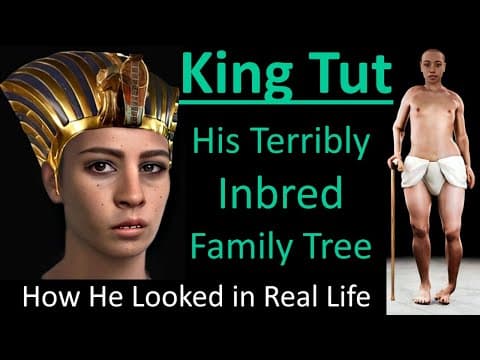
King Tut's Inbred Family Tree: How He looked in Real Life- Mortal Faces
Mortal Faces
8m 44s1,104 words~6 min read
YouTube auto captions
Transcript source
YouTube auto captions
This transcript was extracted from YouTube's auto-generated caption track. The transcript below is server-rendered so it can be read, searched, cited, and shared without opening the original YouTube player.
Pull quotes
[0:00]King Tutankhamun, the teenaged Pharaoh who the Egyptian tomb yielded dazzling treasures.
[0:00]Here on Mortal Faces, I transform historical portraits to see how famous figures we read about might have looked in real life.
[0:00]And this video, we will check out King Tut as well as go through his inbred family tree.
[0:00]He had an overbite, which was a characteristic of his family, a cleft palette and a mild case of scoliosis or a curved spine.
Use this transcript
Related transcript hubs
Watch on YouTube
Share
MORE TRANSCRIPTS


