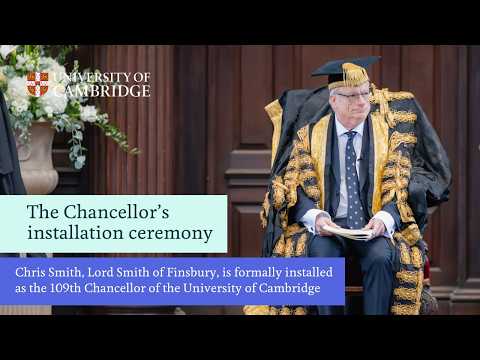
[0:58]Please be seated.
[1:18]In July 2025, in accordance with statutes and by votes of the members of Senate, Regent and non-Regent, given both online and in person in the Senate House,
[1:31]The Right Honorable Christopher Robert Lord Smith of Finsbury was elected into the office of Chancellor. As required by statute, an instrument confirming that election was sealed on the 23rd day of July and delivered to him the same day.
[1:52]On behalf of the doctors, masters and scholars of this university, in whose name and in mine it is issued, I welcome you, Lord Smith, no stranger to this house, but here now is our Chancellor and invite you to take the oath of office.
[2:18]Da bis fidem te bene et fideliter præstiturum omnia quæ spectant ad officium cancelarii academiæ Cantabrigiensis. Ita do fidem.
[2:50]Chancellor, I invite you to sign the book of admission to office and to receive a copy of our statutes and ordinances.
[3:32]Magistri, would everyone please stand.
[8:15]Magistri, would everyone please stand.
[9:17]Please be seated.
[9:59]Dignissime Domine, Academiæ nostræ Cancellæ, quod ut præscriptum statutum, et æ More Prisco, suffragiis totius Senatus designatus, ad summum atque quatissimum munus et officium Cancellæ, Academiæ Cantabrigiensis, suscipiendus es. Nos procancelaria, Magistri et scholares, hujus Academiæ, tibi gratias, quam maximas, agimus. Sacramentum jam dicto et statutorum codice accepto, et summo tibi apud nos imperio delato, Ejus præcepti memores sumus. Quod in tuens tot fere annos, rubis procatum succedenti incide, quo vir æquum et parimumque vales. Quæ verba dum memoramus, præstantissima tuas res gestas miramur.
[11:13]Te enim inimicorum prifecto, in somnities divitibus, adeo regundantes in grata etes, ut musarum thesauri recongnis refractis, populus ausus. O pusculi in intimis latrigis dire recognitis, libere tamen fovere. Quibus in solemniis non fefellit, te industria libenter conlocares, sed inter alios artium administros, priter eminens, ut omnium undique gravissimorum ad totum laudem tibi colligeretur. Postea, arctius studiis, ut Quico depositus, ut integra annimu, concilio ad naturam conditionem protigenderetur, id totius consoderes, perimus difficultatibus et maximi momenti. Aerum ingenio consudebas, ut non tantum quod postularent ii, qui nihil extra mentem existere statuerent, sed quid re vera, et ii, qui re publicam prompti esset, et opibus veribus, existere posset, sciscitare auderes. Absit enim, in Manibus, proprior Musis centrum quæ iter, Magistris theatro, cum ingenio atque foecunda. Tuum donum te, duce, in audita magnitudinis acceptum, Collegium Pembrochianum in meliorem planem redivisti, quam quod unquam fructum erat statutum. Nullum tamen est dubium, quin non numquam procurreres, eadem, et in aliis rebus, et in quorum tu, primus ex plebe, Concilio Socius, primus ut opinor, ex iis, qui palmam Cantabrigiæ tuerentur, omnium atque totorum omnium perfectissime adsensus.
[13:10]Voca et vitae itus consuetudinem. Eho fortunas non cesseres, admonens, quum magis omnium et scientiarum varietatione gaudeamus. Quibus sequitur, gratias agimus. Hoc tamen cancellariatus officium non solum honoris et gloriae causa offeratur. Tu enim es havere, ut nos omnes officio nostra academia dedita rite præstemus. Ut longae fere secula incepta, at scientiam viam sedulo et gnavus, ut sanctissimum veritatis luce, extra hos muros, prona et repetita communiquemus. Hoc igitur tempore, cum in angustis versatus es, arma habuit ad eos hospites obsidendos, qui sanctam hanc domum diu tenuerunt. Quibus discutiendum vocis confutare, qui ipsam veritatem dolis et fallaciis compluxus est, negare conantur. Beat us nos, et fortunatos animos, qui tua virtute, integritate, humanitate freti, una cum te, summa fides hoc iter jam faciamus. Dignissime, et nobilissime Domine, Christopher, Robert, Lord Smith of Finsbury, Universitatis Cantabrigiensis Cancellarium, te salutamus.
[15:33]My lords, ladies and gentlemen, orator, friends. It is a signal honor to have been elected to the role of Chancellor in this great university. It is a role that has been in existence for 800 years, and I have many distinguished predecessors, not least of whom was Lord Sainsbury, my immediate predecessor. David gave great service to the university and I pay warm tribute to him for it.
[16:18]Cambridge is in my blood. I was an undergraduate and postgraduate student here, reading English and then completing a PhD on Wordsworth and Coleridge. I returned 10 and a half years ago as Master of Pembroke, my own old college, and never would I have dreamed as a young 18-year-old arriving in Cambridge for the first time that I would now be standing here as Chancellor. I do, however, intend to be an active Chancellor, regularly interacting with colleges, departments, university officers, academics, alumni and students. I intend to speak out on behalf of Cambridge and on behalf of higher education more broadly, and I intend to provide the best possible support and encouragement to our Vice-Chancellor and to the heads of our colleges. Cambridge is one of the great universities of the world. There aren't many things we do in the UK that are genuinely world-beating, but some of our finest universities, including both Oxford and Cambridge, are amongst them. Cambridge is a center of excellence in learning, teaching and research. It is no accident that we have given to the world 126 Nobel Prize winners. We must at all costs protect and sustain that excellence, which means, amongst other things, that we should think very carefully before any any move to expand the number of students studying here, simply for the sake of expansion. It also means that we have to strive ever harder in these straightened financial times to secure the philanthropic funds that will help us to sustain that level of academic excellence. I want to ensure that when I step down as Chancellor, Cambridge is still at the forefront of global discovery, learning, teaching, research, knowledge and yes, of wisdom. We are and can be a center for innovation, a place that is a catalyst for economic growth and the development of new processes and ideas. We are already probably the most successful university in Europe for the spinning out of businesses from the intellectual discoveries that have arisen from the university and our academics. Cambridge alumni have created more venture-backed startups than any other European university. But we need to enhance this aspect of our work still further. And we need also to persuade our own UK government of the quality of the international innovation asset we have here. This is, of course, most obviously true in terms of the sciences and stem subjects that are studied here. But it is surely vital to recognize that it is also true of the arts, humanities and social sciences. I vividly remember my interview half a century ago when I applied for a Kennedy Scholarship to go to Harvard for a year.
[21:09]I had been studying English for six years at that point, and the first question they asked me was, well, Mr. Smith, it would seem from your application that you want to have some sort of a career in public life. What's the relevance of English to that? And I remember from somewhere, I still don't know where, came the perfect answer. I said that I thought there was no better preparation for a career in public life than the study of English literature because it would tell you more about character, relationships, society, joy, sorrow, emotion and intelligence than anything else possibly could. I still believe that to be profoundly true. We need to acknowledge the profound knowledge of human behavior and motivation that can come from the study of the arts, humanities and social sciences. I will defend the importance of these subjects to my last breath. This is, I believe, especially important in the age of AI. AI is brilliant at trolling through the entirety of what has been said and written about a subject in the blink of an eye. It cannot, however, be genuinely humanly creative. We need to teach our students how to develop AI tools, how to use them, and also how to steer them and oversee them.
[23:26]Knowing when AI can be useful, and also knowing when it poses dangers, is an essential skill in the contemporary world. And the understanding of human behavior that comes from a study of the humanities is part of that essential development. It is often said that in Cambridge, we don't try and teach our students what to think, but how to think. Let's hold fast to that approach, especially when AI plays such a role in all our lives.
[24:14]We live in an age dominated by misinformation and fake news. Universities have to be at the forefront of countering this tidal wave of misleadingness. Universities are where truth and knowledge are discussed, debated, contested, and as a result, discovered. It is why the first assault of autocrats across the world is always on education. Dictators do not want their populations thinking for themselves. It is precisely why academic freedom and freedom of speech are so fundamentally important to universities. It is by listening to arguments you don't agree with, and then contesting them, that you learn and discover. Both the listening and the arguing are crucial parts of this process. It's why I will strenuously oppose any attempt to deprive anyone of a platform, however much I might disagree with what they have to say.
[25:47]It's why students have every right to protest and make their point, provided, of course, they do so peacefully and unthreateningly and without disrupting their fellow students.
[26:05]Many UK students are increasingly worried, of course, about the level of debt they incur through tuition and maintenance loans, and the way the repayment system works. It is now widely recognized that the student loan system is broken. It needs change. It cannot be right that many graduates on average salaries are paying substantial sums in loan repayments every month, yet making no dent at all in their overall level of indebtedness. The rate of interest charged is too high. The threshold at which repayments have to start is too low, and there probably needs to be a cap on the overall level of indebtedness. And for overseas students, who fundamentally enhance the lives of everyone in a university community, there are absurdly increasing visa problems in coming here at all. I plead with my colleagues in government to recognize and understand these very real problems and to intervene to make them fairer and better. Because of the levels of debt, because of the onward march of AI, and because of worries about employability, many prospective students are nowadays asking, what is the point of going to university? This doesn't affect Cambridge as much as it does some other universities around the country, but this transactional approach to a university education is nonetheless deeply worrying. I believe passionately that a university education is not just about the acquisition of learning and knowledge. It is, above all, about the development of the whole person. It's about stretching someone's vision. It's about reaching beyond the horizon. It's about finding interests and passions you never dreamed you would have. I always used to say to our matriculating students at Pembroke, you're not here to become better than anyone else. You're all already good. You're here to become the best you that you can possibly be.
[29:13]Let's never forget that a university is here to help students to aim high, to reach further, to find fulfillment in all sorts of ways, in and beyond the library and the laboratory. Yes, it's about achieving outstanding academic excellence. It is also, however, about providing a supportive community, about helping young people to find their true humanity, and as a result, about helping them to make a difference to the world. That's the true purpose of a university. Thank you.


