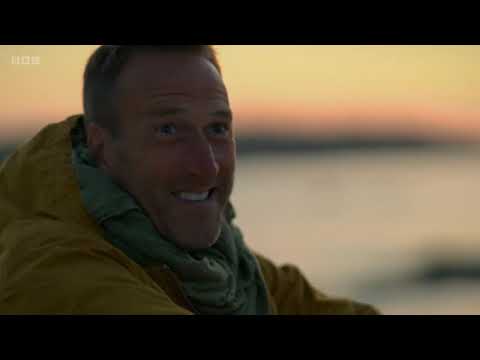
[0:07]Over 800 islands dot the British coastline.
[0:14]with many of the most spectacular around Scotland. This awe inspiring landscape has been a sacred destination for over 1600 years. It was here that Christian pilgrims first arrived, establishing a new faith over a century before it took hold across the Scottish mainland. That spiritual legacy is still an important part of these islands today. Here you're forced to relate to something outside of yourself, and that's the beginning of faith.
[0:57]My name is Ben Fogle. 20 years ago, I lived on a remote Scottish island for a year with 35 others, for a TV show called Castaway. Like those early Christian pilgrims, I formed a deep and enduring connection to this landscape. Now, I'm returning to discover how their sacred history still resonates today. These islands are steeped in faith, it's in their blood, it's in the rocks.
[1:33]and to explore whether the physical aspect of the landscape makes it easier to make spiritual connections. I am just blown away. Look at this.
[1:47]My journey this time will take me through the southern part of the Outer Hebrides. Wow, look at these cliffs. I'll meet people whose lives were transformed by moving here. I just feel a real sense of belonging and it's been really life-changing. And I'll meet people who pray and play. We always played on Sundays, church and then the football in the afternoon.
[2:18]Join me on a thousand mile journey across 20 of Scotland's magical, sacred islands.
[2:36]I'm taking one of the dozens of ferries that crisscross the seas to Scotland's remote islands. From Oban on the West Coast of the mainland, it's a five-hour journey to reach my destination, the Outer Hebrides. I can see the chain of islands on the horizon. I've lived on the island of Great Britain all my life, but I wouldn't describe myself as an islander.
[3:05]We are an island nation ourselves, but it's a very different proposition when your island is so much smaller. And and life is so much more tangible. You're living so much closer to the elements, you become much more aware of your impact, you become much more aware of the importance of the weather, the seas, everything around you.
[3:42]My first stop is the island of Barra. Then I'll visit the uninhabited island of Mingulay, before I continue north to Eriskay, and onto South and North Uist.
[4:03]Christianity reached these shores 1400 years ago, and Barra's named after one of the early Celtic saints, Finbar. The Protestant Reformation made inroads in the northern part of the islands, but not in the South. And Irish missionaries reinforced the Catholic faith here in the 17th century. This is the main settlement, Castlebay. It's named after the imposing medieval fortress just offshore. It was once a thriving herring port, and fishing is still one of the main livelihoods on the island today.
[4:43]A long-standing maritime tradition, knitted fishermen's jumpers, has a strong symbolic connection to people's lives here.
[4:55]Fishing obviously plays and has played a huge part in island life.
[5:03]Last time I was up here, I visited an island just north of here called Eriskay, and uh, I got a fishermen's jumper, this one. I'm hoping I'm going to be able to understand a little bit more about the hidden messaging within the knitting with the next person I'm off to meet.
[5:27]I've come to the north of the island to meet knitter Margaret Ann and her cousin Donald William. Morning.Hello Margaret Anne, Donald William, how are you both? We're good thank you, good.Permission to come aboard? All for it. Yeah, lovely day for it. Yeah, perfect.
[5:51]We're off for a spin around the bay. Margaret Ann grew up in this area. Her grandmother was a herring girl, and like many of them she knitted in her spare time. She passed this skill on to Margaret Ann, and taught her how to make fishermen's jumpers, or guernseys. Margaret Ann, I've always loved handmade sweaters. I actually got this years and years ago. Oh, yeah. My Eriskay sweater, now I know that this is something you do. Can can you help me interpret what what this means? I can go through a few of them with you, you know, um, when the top here, that, yeah, that's the tree of life. Why the tree of life? Life goes on, hook goes on and just grows from it. When the down in the front there, looks to be the closed diamond, the open diamond. I would say that's the reflect an empty net and a full net all the way through. That's the way I would interpret it. For ourselves this is a very old guernsey, this is one of my granny's that she had knitted, um, but this one pattern here is what we call the true lover's knot. We would identify that the fisherman was from Barra. The anchor's a sign of safe homecoming. I wonder whether the story's true as well on a darker level that if someone was washed overboard, they could be identified through their sweater. Through the guernsey. Through the guernsey. Yes, that's very, that's a very practical side of it, very, very practical side of it and you're hoping that one day your guernsey isn't returned to you. I actually find these really moving because not only have you got a story within the sweater, they're made for practicality, they're made for love, they're momentos, they're love letters. Yeah, in a way and there's also the sense of belonging and hope. The hope, you know, when they come home to see their guernsey that it has been knitted again with the anchor on it to say, you know, the true love and happiness to see someone come home. How how important do you think knitting was to your ancestors? I think it in this day and age we talk about mindfulness and sort of taking time and sit back and take time to think and process things. That's what you do when you're knitting, it's very, very therapeutic.
[8:06]You know, and it must have been when they would get the end of the day where they would just sit and think or maybe when they were at the herring, think about home, think about who they were knitting the jersey for, think about what was happening at home. So I think there's more to the guernseys than just an item of clothing. The women known as herring girls, followed catches of herring as they moved around the coast. As the men caught the fish, the girls preserved them. While they traveled, they knitted and sent the jumpers back to fishermen at home.
[8:41]How important is your ancestry? Oh, very, very important. I think it's the thread of everything that we kind of stand for, um, I couldn't say one part of it being the culture, the language, the location. It it all makes you up, it it's all my make up. Three of my grandparents came from this area, you know, so I have a great hold to it. Um, both my grandfathers turned to the sea for money, um, and they had to turn towards the sea for a living, you know, and you know, a hard living it would have been. Is it true that part of the fisherman's wage had to go to the church? Yes, at the end of the season it was divided up and if it was five crew, it was divided into six. And the sixth one went to the church, yeah. A lot of the churches in the southern end of the western Isles were very based on money that came from the fishing. I suppose the appreciation to get home safely, you know, the church had a big, big part of the community, I suppose, holding on to about a faith, you know, when times are hard, uh, would have been essential to them. I think the spiritual connection to the sea and the sense of belonging, your roots are really within the sea and the hard way of life that your ancestors had, it's just, you know, it's very moving actually.
[10:12]I'm down at Hallaman Bay on the island's west coast. It's no wonder that one of the island's nicknames is paradise. It's simply stunning.
[10:27]For me, this is a moment to slow down and be present, aware of myself and my surroundings.
[10:39]I find it quite empowering that tomorrow is a whole new day. You can start a fresh. A lot of people bring the baggage of yesterday to tomorrow. But actually, I find it, I find it a really powerful moment to just be. I'm not always on a beautiful beach like this, but be with, with nature, with the earth, with this extraordinary planet on which we live.
[11:06]We live so fast that we sometimes just don't take time to sit and absorb. And this, it is, it's the place where I just could think of specific things.
[11:36]Before I leave Barra, there's one other place I'd like to visit, the highest point on the island.
[11:46]I've noticed little religious statues dotted around the island, and there's one up the hill that's much larger. It reminds me of the statue of Christ the Redeemer in Rio de Janeiro, and I'm intrigued to see it up close.
[12:03]I'm told that it's known locally as our Lady of the Sea, carved out of white marble. It's a sculpture of the Madonna and Child. She's the protector of seafarers and watches travelers coming and going from the harbor, and the views out to sea are spectacular. This is a familiar part of the world to me. The island where I lived for a year is in the Outer Hebrides, but this is an unfamiliar view.
[12:37]I've never seen the Outer Hebrides like this, certainly not with this weather. I have been to many of these islands before, but with the experiences I've had in the last two decades, I'm seeing them from a whole new angle now. And I think for me that's what really excites me about understanding a bit more about what life is like here and why they're driven to the spirituality, to the religion, to, to, to the things that make the Outer Hebrides so unique.
[13:16]To understand why faith is so strong here, I'm keen to visit another island, that I can just make out in the far distance. I can see Mingulay in the haze over there, it kind of looks otherworldly. I feel I feel drawn to it.
[13:37]It's an island that has a religious connection going back hundreds of years. And somewhere that I've always wanted to visit.
[13:49]This is an island I've never been to, an island I've heard so much about. An island steeped in spirituality, an island steeped in tragedy, in hope, in so many of those elements that that make up island life, I suppose.
[14:17]In the 16th century, Mingulay and the adjacent islands belonged to the Lord of the Isles. They were granted to the Bishop of the Isles, who leased them out for rent. Consequently, they became known as the Bishop's Isles. Mingulay is the second largest, at just two and a half miles long. In the 19th century, it had a population of over 160, but the last residents left in 1912.
[16:04]Wow. This, this is what I've come. Look at these cliffs.
[16:15]Forget the White Cliffs of Dover, these are something else. It's like a huge cavernous cathedral, soaring 200 meters above us.
[16:32]You see this, this is my church, my mosque, my synagogue, my place of worship. You can see why these islands are so founded on spirituality and religion, when you come to a place like this, you can't help but be moved.
[16:58]Dwarfed by nature here, dwarfed by the landscape.
[17:19]The cliffs are a haven for nesting seabirds, like kittywakes, razor bills and even majestic eagles.
[17:28]These birds here, this, this was one of the reasons people lived here. Imagine scaling those cliffs.
[17:42]This was a larder for the island's inhabitants, who climbed down the near vertical cliffs to collect eggs.
[17:54]But their main livelihood was fishing and small-scale farming called crofting.
[18:25]It's a world away from the island's rugged west coast.
[18:32]This really is a tale of two worlds. The dramatic cliffs on the other side and this side, beautiful sandy beaches and our sign of life, buildings.
[18:48]It's easy enough for the seals to get ashore, but more difficult for boats. Exposed to the wind and swell, the inhabitants were often cut off for weeks on end. Getting ashore today is still a challenge and requires a smaller boat. Any knack in getting ashore here, Jonathan? Yeah, just be very careful and you don't hang about. I'll follow you. I'm lucky there's not too big a swell today. I might just be able to keep my feet dry. Come on, make your up. Okay, thank you very much.
[19:31]We're 12 miles from the nearest inhabited island. Despite being so remote, people lived here for thousands of years. Jonathan is now the most regular visitor and temporary resident. He stays in the last intact building on the island. It's a school and a building attached to it without the roof, what was actually the school room. So I think in its height, it had about 40 children crammed into that wee building there.
[20:44]I'm curious about the church because it's obviously prime position. It's up on that little hill. I don't know if it's looking down on the community or the community are looking up to it. But only but both actually, I think most churches are placed in that sort of raised level looking over the community.
[21:06]We didn't have a resident priest on the island that would come down whenever he could, you know, every four to six weeks and in the winter time, he possibly wouldn't get down for months on end, you know. Uh, but the people here were very, very religiously minded and the priest was a very, very important person in their day-to-day life. And there is a theory that one of the reasons the people actually left the island was to be nearer to their pastor and also the priests would have been happier seeing a quite substantial amount of his folk nearer to hand, you know, where he could possibly keep an eye on them I suppose. Do you find this quite a profound, powerful place because it feels, it feels very calm? Yeah, there's a tranquility about it. I mean, okay, when the the wind picks up, you got an Easterly gale blowing in the day, that doesn't feel quite that tranquil, but a day like this is just nowhere else quite like it.
[22:36]I've been wondering about the church and the relationship with the people that lived on this island, because for me, I think the draw of any sort of religion or spirituality is a sense of belonging. And and needing answers and help from something, someone else. And what I need to do is take myself back 100 years when this truly was a tough life here.
[23:08]I think you would need something else to believe in. And I think the church was that hope. Maybe it was the hope of a better life.
[23:22]It's time for me to continue my journey north, to visit people who live on some of the other islands.
[23:41]This morning, I'm on the 9:25 ferry to Eriskay.
[23:46]Sadly, the weather's turned. What a different today can make.
[23:53]I love arriving by sea, whether on a small fishing boat or a ferry. It always feels like a proper journey.
[24:09]Eriskay is tiny. It's under three miles long and has a population of less than 150 people. Not including the native Eriskay ponies.
[24:22]I've come to visit the island's Roman Catholic church.
[24:27]It was built in 1903 when the population of the island swelled to around 400. Many of them had been cleared from their farmland in South Uist to make way for sheep. Here, they turned to the sea for their living, and the influence of their new livelihood is clear. The anchors are emblems of hope as written in the letter to the Hebrews, We have this hope as an anchor for the soul. And even the altar is made from an old lifeboat from a World War two aircraft carrier. Here, work and faith seem indivisible. To understand why, I need to find out about the man who oversaw the building of this church, Father Allan McDonald. He was a well-loved priest who lived and worshiped here at the beginning of the 20th century. But even a hundred years after his death, people still remember him. The local history society want to provide information about his life to visitors. So they're building a memorial to him. Is that ready? This one down here. Yeah. I've come to help builder Angus McDonald construct it.
[25:52]This is one of 11 stone stacks, known as cairns, that will form a walking trail around the island. Each will have information on Father Allan's life story and his influence here. That ready? This one down here. Yeah.
[44:19]I'm driving 16 miles across the island to meet someone who's found peace here.
[44:26]Artist and weaver, Marie Melville took, moved here from London less than 20 years ago. She's taking me down to a place that's very special to her. I always get excited at this moment. You don't know what you're going to see. You know what you're going to see. Oh, I know what I'm going to see. It's like hidden treasures. Yeah. Oh, wow.
[44:52]That's pretty magical. It is, it's fantastic.
[45:21]I'm interested in the effect the natural world has on people's mental well-being. What do you feel, coming out here on a day like today, when you're out in the wilds? I feel free. I think there's nothing, there's nothing like it. Um, you know, when you just get out of the car, and you know, you feel, I need to be here to to feel peaceful in many ways. Um, yeah.
[46:43]You speak with such passion and such knowledge. You speak as an islander but you have my accent. So what does that mean to to your relationship with this land? Well, I suppose I've never, I've never really felt like I belong anywhere. Um, because I come from quite sort of mixed heritage anyway. But when we moved to this area in 2013, and I just kind of fell in love with it.
[48:06]How did it affect your your mental well-being? It's been, it's been really life-changing, really life-changing.


