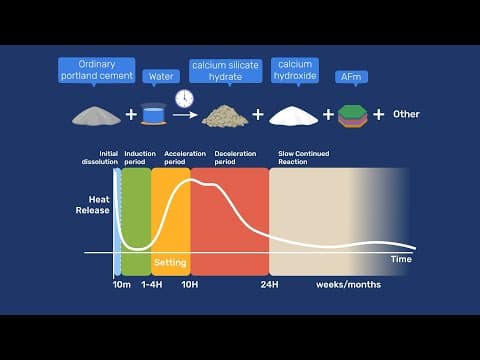
[0:03]In this video, we present the hydration of ordinary Portland cement, that is often referred to as OPC. This process of hydration turns concrete from a fluid or plastic material that can be easily shaped, into a solid and very strong material that can bear significant loads. In a previous video, we explained that OPC is obtained by cogrinding clinker with about 4% gypsum, and that clinker contains two silicate phases, noted C3S and C2S in cement chemistry, and two aluminate phases, respectively C3A and C4AF, which is best noted C2 (A,F) as it is a solid solution. We will place the hydration of OPC in perspective with respect to that of natural cement, a late 18th to early 19th century mineral binder, that was replaced by OPC, and for which further information is provided in two separate videos. C3S is the most important and abundant phase, representing 50 to 70% of OPC. It reacts with water to produce CSH and CH. Using an average stoichiometry for CSH as C1.7SH4, we have that C3S + 5.3H gives CSH + 1.3CH. Transforming this reaction from molar stoichiometric coefficients to volumetric ones, we have that C3S + 1.31H gives 1.58CSH + 0.59CH.
[1:58]This corresponds to a chemical shrinkage of about 6%, which is mostly found in the form of porosity in the hardened cement paste. Most importantly, and as for other mineral binders, this reaction increases the volume of solids, here by about 117%. As for natural cement and pozzolanic mortars, the hydration reaction can take place in absence of air. The hardening of these binders does not result from the losing of water through drying, but rather from the binding of water into solid phases through chemical reactions. In practice, more water than needed for the chemical reaction has to be used for the material to be plastic or flowable. That excess water leads to additional porosity, which negatively impacts the strength and durability of the hardened material. Conversely, decreasing the water content in concrete will decrease porosity, increase strength, and durability. This should be taken into account when deciding what type of concrete to use depending on load bearing requirements and the planned service life. An important reason for the success of OPC is that it not only binds a lot of water, but does so at a much faster rate than natural cement. Because this reaction is exothermic, it can be well followed by isothermal calorimetry, which essentially provides a fingerprint for hydration kinetics, as shown here. The initial stage corresponds to a fast dissolution, releasing a lot of heat, very rapidly, but slowing down also very quickly. This is followed by a second phase, characterized by a slow but non-zero reaction rate called the induction period. This is very useful in practice as the material remains workable and castable during this time. This period ends after 30 minutes to a few hours, after which the reaction enters the so-called acceleration period. During this time, the rate of CSH and CH formation increases very rapidly up to a peak rate. Thereafter, it decelerates progressively, with about 50% of the cement having reacted after about one day for temperatures between 20 and 25 degrees Celsius. In the following days, weeks and even months, the rate continues to decelerate. An important aspect of cement hydration concerns tricalcium aluminate or C3A. While this phase is typically intermixed with C3S and or other clinker phases in cement grains, we will represent it separately for didactical purposes. C3A reacts initially very fast with water, producing AFM phases and releasing aluminate ions into solution. Under normal conditions, this solution also receives calcium, hydroxide, and silicate ions from the dissolving C3S. However, if aluminate ions from the solution adsorb on the surface of C3S, they can hinder its dissolution and thereby delay cement hydration. This inhibition of C3S dissolution can be prevented by adding calcium sulfate, that we will simply refer to as gypsum, although some anhydrite and or hemihydrate may be present too. The presence of gypsum slows down the initial reaction of C3A. This takes place in two ways. First, calcium sulfate ion pairs adsorb onto C3A and hinder its dissolution. Second, aluminate ions reaching the solution precipitate with calcium and sulfate ions released by gypsum, so that the mineral ettringite is formed. This removes aluminate ions from solution and therefore prevents them from adsorbing on C3S, which can then freely dissolve to supply the ions needed to form CSH and CH. If too little gypsum is added, not only will C3S hydration be delayed, but the material will also more rapidly lose its workability. This is referred to as flash set and probably also explains the short open time of natural cements. Another problem can occur if during the co-grinding of clinker and gypsum, the temperature becomes too high so as to cause an extensive decomposition of gypsum to hemihydrate. In such cases, the hemihydrate in cement reacts with water to precipitate gypsum, which causes a rapid loss of workability in a process referred to as false set. The term false is used because its consequences may be reversed by further mixing. Thereby, the gypsum formed may react with C3A, while the mixing better distributes the products throughout the mass. For a reminder on gypsum and hemihydrate, please check our video on gypsum chemistry. As hydration proceeds, hydrates fill up the microstructure, reducing porosity. This increases both strength and durability. These hydrates form both in between grains and on their surfaces. In one way or another, this accumulation of hydrates reduces the space and ease at which hydration may proceed, which along with the diminishing reserve of anhydrous phases contributes to the slowing down of the hydration rates. One consequence of this is that after one day, concrete has already a fair strength, which is doubled by day three and can be related to a more extensive filling of the porosity. The strength increase continues after that, but at a reduced rate, so that to have another doubling of the strength, one must wait until day 28. Even if to a much lesser extent, the hydration of aluminate phases also contributes to the increase in the solid volume and to the decrease in porosity, which is beneficial both for strength and durability. From a chemical point of view, the outcome of aluminate hydration is important in terms of durability. For our purpose, we note that once the gypsum has fully reacted, C3A continues to react, but then does so with the previously formed ettringite. This leads to the formation of monosulfate, which is part of the family of layered calcium aluminate phases, noted AFM. In most cements, at least some limestone is present, and this can react with C3A to form other AFM phases, in particular monocarbonate. If the hardened concrete is exposed to sulfates, in particular from groundwater, sulfates may enter the concrete through its porous network. These sulfates can then react with monosulfate and or monocarbonate to form ettringite, which under some circumstances may lead to detrimental stresses from the crystallization pressure of ettringite. Overall, this process is referred to as external sulfate attack. It is also known as secondary ettringite formation, noted SEF. On the other hand, in presence of chlorides that may come from deicing salts or sea water, monosulfate and or monocarbonate may react with incoming chlorides to form a chloride AFM phase called Friedel salt. This essentially captures chlorides and slows down their further ingress. This is beneficial in delaying the ingress of these chlorides and the corrosion of steel rebars that they enable in reinforced concrete. In conclusion, ordinary Portland cement is a complex coupled chemical system, in which two silicate and two aluminate phases react simultaneously, but at very different rates. However, they do not do so independently, rather, they influence each other through the ions that they release in solution. An illustration of this is the use of gypsum to prevent C3A hydration from passivating the hydration of C3S. In a well-regulated cement, C3S is responsible for strength and durability and has extensively reacted after a few days only.


