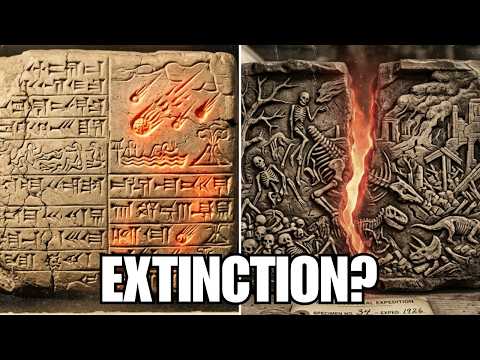
[0:00]A clay tablet, smaller than your hand sits in a museum vault in Istanbul. 5000 years old, covered in wedge-shaped marks that most people walk past without a second glance. But buried in those ancient symbols is something that made every archaeologist who translated it go completely silent. A prediction. Not about the past, about right now, about what happens next to the human species. The Sumerians didn't just invent writing. They documented something they called the Great Cycle. Seven destructions, seven renewals, and according to their calculations, we're living in the final phase of the seventh cycle right now. The tablet doesn't just predict an extinction event, it describes the exact conditions that trigger it. Conditions that sound disturbingly familiar when you compare them to what's happening on Earth today. Here's what makes this terrifying. Every previous cycle the Sumerians documented, matches geological evidence we've only discovered in the last 50 years. Mass extinctions, climate collapse, civilizational reset. They knew. Somehow, 5000 years ago, they knew. And if their pattern holds, the next extinction isn't coming in some distant future. It's already begun. If you want to understand ancient history, hidden knowledge, and what our ancestors knew that we've forgotten, hit subscribe right now. This channel covers the mysteries that mainstream archeology won't touch. And this story is one of the deepest we've ever investigated. The tablet was discovered in 1952 during an excavation near the ancient city of Nippur in modern-day Iraq. A French archaeological team led by Dr. Henri Sartre, was documenting everyday Sumerian artifacts when they found it buried beneath the ruins of what appeared to be a scribal school. At first, they cataloged it as just another administrative record. Sumerians kept detailed records of grain inventories, trade agreements, temple donations, standard stuff. But when Dr. Sartre's translator, a linguistics specialist named Amelie Duchamp, began deciphering the cuneiform script, she realized this wasn't a grain receipt. The language was different, more formal, almost ritualistic. The tablet opened with a phrase that translates roughly to "the pattern of seven deaths and seven births." She spent three weeks cross-referencing the symbols with other known Sumerian texts. Nothing matched, this was unique. The tablet describes something the Sumerians called the Anu cycle, named after their sky god Anu. According to the text, the cycle repeats every 26,000 years. That number should sound familiar. It's almost exactly the length of what modern astronomy calls the precession of the equinoxes, the slow wobble of Earth's axis that takes roughly 25,920 years to complete one full rotation. The Sumerians had no telescopes, no satellites, no way to measure this astronomical phenomenon, yet somehow they knew. Modern astronomers didn't fully understand precession until Hipparcus documented it in 127 BCE. And even then, it took centuries more to accurately measure the full cycle. The Sumerians were calculating this 2,500 years before Hipparchus even lived. Their astronomical knowledge was extraordinary. They tracked Venus with such precision that their observations are still used to calibrate ancient chronologies. They divided the circle into 360 degrees, a system we still use today. They mapped the zodiac. They understood planetary motions well enough to predict eclipses. But precession is subtle. You can't observe it in a single lifetime or even across several generations. It requires comparing star positions across thousands of years. The only way the Sumerians could have known about the 26,000-year cycle is if they inherited records from earlier observers who tracked the sky for millennia. Or if they had some other source of information we don't understand. Either possibility challenges our assumptions about the development of human knowledge. Here's where it gets unsettling. The tablet breaks the 26,000-year cycle into seven phases. Each phase lasts approximately 3700 years, and at the end of each phase, the tablet describes what it calls a purification. Mass death, catastrophic environmental change, the collapse of whatever civilization existed at the time, then a renewal, a fresh start for the survivors. The first cycle described on the tablet mentions a great flood that covered the Earth. Water rising from below and falling from above. The destruction of cities, the death of livestock. Only those who prepared boats survived. Geological evidence supports a massive flooding event around 10,000 to 12,000 years ago, when the last Ice Age ended. Sea levels rose over 400 feet as glaciers melted. Entire coastlines vanished. Communities that had existed for thousands of years were swallowed by the ocean. The Black Sea flood hypothesis suggests that around 5,600 BCE, the Mediterranean Sea broke through a land barrier and flooded into the Black Sea basin with the force of 200 Niagara Falls. The sea level rose hundreds of feet in a matter of months, displacing tens of thousands of people and destroying settlements around the shore. Marine archaeologist Robert Ballard, the same man who found the Titanic, discovered evidence of ancient human habitation 300 feet below the current surface of the Black Sea. The Sumerians documented this. They passed down the memory through oral tradition until someone finally carved it into clay. Their flood story in the Epic of Gilgamesh describes the hero Utnapishtim, who was warned by the God EA to build a boat because a flood was coming to destroy humanity. He built the boat, loaded it with animals and seeds, and survived while the world drowned.
[6:15]The story is eerily similar to Noah, but it predates the biblical account by over 1000 years. The second cycle on the tablet describes fire from the sky, burning mountains, ash that blocked out the sun for years, crops that failed, starvation across the known world. Modern volcanology has identified a supervolcanic eruption at Lake Toba in Indonesia approximately 74,000 years ago. The eruption was so massive it created a volcanic winter that lasted 6 to 10 years. Global temperatures dropped. The human population collapsed to somewhere between 3,000 and 10,000 individuals. We almost went extinct. The Toba eruption ejected 2,800 cubic kilometers of material into the atmosphere. For comparison, Mount St. Helens ejected one cubic kilometer. Krakatoa ejected 25 cubic kilometers. Sulfur dioxide from the eruption would have created a global aerosol cloud that reflected sunlight back into space, dropping global temperatures by as much as 15 degrees Celsius in some regions. Genetic studies support the population bottleneck. Analysis of human mitochondrial DNA shows that all living humans descended from a population that went through a severe reduction around 70,000 years ago. The genetic diversity we should have based on our age as a species is much lower than expected, consistent with a near extinction event. We all carry the genetic signature of that catastrophe. But here's the disturbing part. The Sumerians existed around 4,500 BCE. The Toba eruption happened 74,000 years ago. There's no way they should have known about it. No written records existed, no geological science. Yet the description on the tablet matches what scientists discovered in volcanic ash layers and ice core samples. They knew. The third cycle mentions great shaking of the Earth. Mountains rising from flat land, cities swallowed into cracks in the ground, rivers changing course overnight. The tablet describes this happening in the region between two rivers, which is exactly where Sumer was located, in Mesopotamia, between the Tigris and Euphrates. Seismic studies of the region show evidence of a major earthquake sequence around 7,000 years ago that dramatically altered the landscape and river systems. The fourth cycle describes a darkness that fell across the land. Not night, but a shadow that lasted for months. Cold like winter in the middle of summer. The tablet says the darkness came from a wound in the sky. Modern researchers have theorized this could describe an asteroid impact or a near miss that disrupted the atmosphere. There's geological evidence of an impact event around 5,000 years ago in the Indian Ocean that would have caused tsunamis and atmospheric disruption across the region. The fifth cycle is where things get more recent and more verifiable. The tablet describes the drying of the Great Rivers. Lands turning to dust. Migrations of entire peoples fleeing north and west to find water. Archaeological evidence shows that around 4,200 years ago, the Middle East experienced a severe drought that lasted for 300 years. This drought directly corresponds to the collapse of the Acadian Empire, one of the first major civilizations in Mesopotamia. Cities were abandoned, trade routes collapsed, civilizations reset. The sixth cycle describes a plague of weakness. Not a disease of wounds or fever, but a sickness that made people unable to bear children. Bloodlines ending. Villages with no young. The tablet says this purification was gentle compared to the others, taking generations instead of years. There's historical evidence of significant population decline across the Mediterranean and Middle East around 1,200 BCE, during the Late Bronze Age collapse. Multiple civilizations fell simultaneously. Trade networks disappeared, writing systems were lost. Recent archaeological research has found evidence of widespread malnutrition and disease that could have affected fertility rates. And then there's the seventh cycle, the one we're supposedly living in right now. The tablet describes it as the cycle of great abundance followed by great emptiness. It says the people of this cycle will master the Earth and sea. They will create wonders that seem like magic. They will grow so numerous, they cover the land like locusts. And then the Earth itself will respond to restore balance. The description is remarkably specific when you read the original cuneiform carefully. The tablet says the people of the seventh cycle will dig deep into the Earth and pull out black stone that burns. They will make the air thick with smoke from their fires. They will poison the waters with waste from their great works. They will cut down the forests until the land bleeds. They will kill the great beasts of the ocean until the waters are empty. All in pursuit of comfort and power. This isn't vague mythology. This is an accurate description of industrial civilization. Coal and oil are black stone that burns. Air pollution from factories and vehicles makes the air thick with smoke. Industrial waste contaminates water supplies. Deforestation causes soil erosion and desertification. Overfishing has depleted ocean ecosystems to the point of collapse. The tablet describes our world with unsettling precision. The tablet lists specific signs that mark the beginning of the seventh purification. People fighting over the last fertile ground. Plagues that emerge from disturbed places, and finally, fire from below, from the Earth's blood itself. Let's break down what that actually describes. Rivers that burn could mean industrial pollution. We've had rivers catch fire from chemical contamination. The Cuyahoga River in Ohio famously burned in 1969 because of oil and industrial waste. Air that chokes describes air pollution, smog, particulate matter from wildfires and emissions. Seasons arriving at the wrong time is climate change disrupting weather patterns. Animals disappearing is the current mass extinction event scientists are documenting right now. We're losing species at 1000 times the natural background rate. Water rising slowly refers to sea level rise from polar ice melt. It's happening gradually enough that we adapt and ignore it until coastal cities start flooding regularly. People fighting over fertile ground describes resource wars, water conflicts, mass migration from climate affected regions. Plagues from disturbed places could mean zoonotic diseases jumping to humans as we encroach on wilderness and thaw permafrost containing ancient pathogens. Fire from the Earth's blood likely means volcanic activity, or possibly the extraction and burning of fossil fuels, literally the compressed remains of ancient life. The tablet doesn't give an exact date for when the seventh purification reaches its peak. But it does provide a timeline based on signs. It says when the signs appear together, the purification will unfold over three generations. One generation to see the signs. One generation to experience the collapse, one generation to survive in the new world. If we take a generation as roughly 25 to 30 years, and the signs started becoming obvious in the 1970s with the environmental movement and recognition of climate change, that puts the collapse phase somewhere between 2000 and 2030.
[13:50]The survival and renewal phase would be 2030 to 2060. We're in the collapse phase right now, according to this timeline. And if you look around, it's hard to argue against it. Record temperatures every year. Glaciers melting faster than predicted. Coral reefs dying. Insect populations crashing. Topsoil degradation, ocean acidification, microplastics in every living thing, including human blood. The Amazon rainforest approaching a tipping point where it becomes savannah. The Atlantic meridional overturning circulation, which regulates global climate, showing signs of weakening that could trigger abrupt climate shifts. But here's what the tablet says about the survivors. It doesn't say everyone dies. It says the purification resets civilization, not humanity. The people who survive are described as those who remember the old ways. Those who know how to live with the land instead of against it. Those who store knowledge in forms that outlast stone. The tablet itself is part of that knowledge storage. 5,000 years later, it's still here, still readable, still warning us. Dr. Sartre's team published their findings in 1955 in a French archaeological journal. The academic response was dismissive. Most scholars argued the tablet was either a later forgery, or that the translation was overly interpretive. The precession cycle correlation was called coincidence. The geological evidence was considered retrofitting modern knowledge onto ancient text. Dr. Sartre died in 1958 without seeing his work validated. Amelie Duchamp continued researching the tablet until her death in 1991, but mainstream archaeology never fully accepted the implications. The tablet currently resides in the Istanbul Archaeology Museum, catalog number SI-4427. It's not on public display. Most visitors to the museum never know it exists. But researchers who have examined it confirm the text is authentic Sumerian cuneiform, dating to approximately 3,000 BCE based on the clay composition and writing style. The content is real. The question is whether the Sumerians were recording actual cyclical patterns they somehow understood, or if this is mythology that happens to correlate with geological history by chance. There's another element to this that makes it even stranger. The tablet mentions that knowledge of the cycles was passed down from the Anunnaki, the Sumerian gods who came from the sky. Mainstream archaeology interprets the Anunnaki as mythological deities, personifications of natural forces or planetary bodies. But if you read Sumerian texts literally, the Anunnaki are described as physical beings who taught humans agriculture, mathematics, astronomy, and writing. They're credited with jump-starting Sumerian civilization essentially overnight. Before 4,000 BCE, the region was populated by small farming villages. By 3,500 BCE, Sumer had states, complex irrigation, bronze working, wheeled vehicles, and the first writing system. That's an incredibly rapid development for a civilization with no apparent predecessor. Most civilizations evolve gradually, building on earlier cultures. Sumer appears almost fully formed. And their own records say the knowledge came from the Anunnaki. If you follow this thread, it raises an uncomfortable question. Did the Sumerians have access to information from a source we don't understand? A previous advanced civilization that survived an earlier cycle. Contact with something non-human? Or did they possess observational and pattern-recognition abilities we've lost in our specialized, technological society? Indigenous cultures around the world maintain oral histories spanning thousands of years with remarkable accuracy. Australian Aborigine stories describe the flooding of coastal areas that geological evidence confirms happened 10,000 years ago. Native American stories describe megafauna like mammoths that went extinct 12,000 years ago. These cultures didn't have writing, but they preserved information across hundreds of generations through story, song, and ritual. The Sumerians had writing. They could preserve even more. What if the Great Cycle isn't prophecy but recorded observation? What if previous civilizations documented these catastrophes and the survivors passed down the information? What if there have been multiple rises and falls of complex societies over the past 100,000 years, and we only know about the most recent ones? The geological record gets messy the further back you go. Erosion, tectonic activity, and climate change destroy evidence. A civilization that existed 30,000 years ago and was wiped out by the Ice Age would leave almost no trace. There's one more detail on the tablet that's worth mentioning. After describing the seven cycles, there's a final section that Dr. Duchamp struggled to translate. The phrase she eventually settled on was the cycle ends or the cycle transforms. The grammar is ambiguous. It could mean the seventh cycle is the last one, that after this purification, the pattern stops, or it could mean the cycle itself changes into something new, a transformation rather than a repetition. The tablet suggests that the outcome depends on whether the people of the seventh cycle learn the pattern. If they recognize what's happening and change their relationship with the Earth, the cycle transforms into something sustainable. If they don't, the cycle ends, and whatever emerges afterward won't be recognizable as human civilization. The survivors would be starting from scratch, back to small communities living directly off the land, rebuilding slowly over thousands of years. Modern climate science presents a similar fork in the road. We have about a decade to make significant changes to prevent the worst outcomes of climate change. Not to stop it completely, that ship has sailed, but to keep it within manageable bounds. If we don't, we're looking at feedback loops that accelerate warming beyond our control. Permafrost melt releasing methane. Amazon dieback releasing stored carbon. Ice sheet collapse raising sea levels by meters. Ocean current disruption causing abrupt regional climate shifts. The feedback loops are the terrifying part. Permafrost in Siberia and Alaska contains twice as much carbon as the entire atmosphere. As it thaws, microbes digest the previously frozen organic matter and release methane and carbon dioxide. Methane is 80 times more potent than CO2 as a greenhouse gas over a 20-year period. More warming means more thaw, which releases more methane, which causes more warming. That's a feedback loop. The Amazon rainforest generates about half of its own rainfall through evapotranspiration. Trees pull water from the soil, release it through their leaves, and that moisture becomes rain that falls back on the forest. But as deforestation and drought stress the forest, less moisture goes into the atmosphere, which means less rain, which means more tree death, which means even less rain. Scientists estimate the Amazon is approaching a tipping point where it transitions from rainforest to savannah. Once that process starts, it becomes self-reinforcing. The forest has maintained itself for millions of years, but we're pushing it past the point where it can recover. Ice sheets work the same way. White ice reflects sunlight back into space, keeping the poles cool. As ice melts, it exposes dark ocean water or land, which absorbs sunlight and warms up, which melts more ice. The Greenland ice sheet is losing mass at an accelerating rate. If it melts completely, sea levels rise 7 meters. The West Antarctic ice sheet is even more unstable, sitting below sea level and vulnerable to warm ocean currents undermining it from below. That's another 5 meters of sea level rise. These aren't distant possibilities. They're active processes happening right now, just slowly enough that we normalize them. Each year is a little worse than the last, but the change is gradual enough that we adapt instead of responding. That's exactly what the tablet describes. The slow rise of water, the subtle shift of seasons, the gradual disappearance of animals. By the time the crisis becomes undeniable, the momentum is too great to stop. But the tablet also says knowledge is the key to transformation. The people who remember survive. The people who prepare for the purification instead of denying it, have a chance. That's why the Sumerians carved this into clay, not to scare people, but to warn them. To give future generations a pattern to recognize so they wouldn't be caught unprepared. Whether you believe the tablet is literal prophecy, geological observation, or symbolic mythology doesn't really matter at this point. The pattern it describes is playing out in real time. The signs it lists are visible to anyone paying attention. The timeline it suggests aligns uncomfortably well with our current trajectory. We can dismiss it as coincidence, or we can take it as a warning from people who survived previous catastrophes and wanted to give us a fighting chance to do better. The Sumerian survived. Their civilization collapsed, like the tablet predicted it would, but the people persisted. They adapted. They rebuilt. Their knowledge passed forward through Babylon, through Assyria, through Persia, through countless generations, eventually reaching us through archaeology and translation. The message made it across 5,000 years intact. And that's the point. Knowledge survives if you preserve it in the right way and pass it on to those who will listen. So what do we do with this? The tablet offers no solutions, only warnings. But the warning itself is valuable. It tells us catastrophic change is part of a pattern, not an anomaly. It tells us civilizations fall, but people endure. It tells us the key to survival is remembering, adapting, and working with natural cycles instead of against them. Those aren't religious ideas. They're practical strategies that worked for our ancestors and could work for us. The seventh cycle is unfolding. The purification the Sumerians described is happening in slow motion around us, where the generation experiencing the collapse phase. What we do now determines whether our descendants live through a renewal or simply try to survive in the ruins of what we built. The choice isn't about stopping the cycle. It's about how we move through it. A clay tablet smaller than your hand tried to tell us this 5,000 years ago. Most people still walk past it without a second glance. But now you know what it says. Now you know the pattern. The question is, what do you do with that knowledge? The Sumerians did their part. They remembered. They recorded. They warned us. The rest is on us. That's the story of the Sumerian tablet that predicted extinction. If you want more content on ancient knowledge, hidden history, and what our ancestors understood that we've forgotten, subscribe to the channel. We're diving deep into the mysteries mainstream sources won't touch. And if you found this unsettling, the next video is going to shake you even harder.