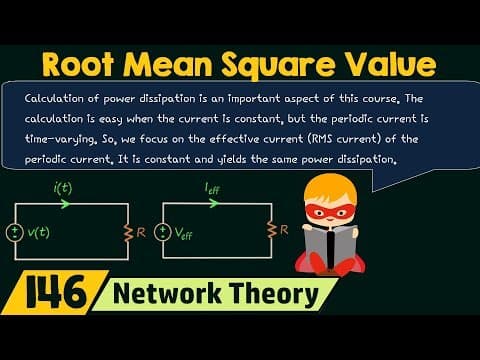
[0:00]In this presentation, we are going to have discussion on root mean square value or the effective value of current and voltage. And we will first understand the need of effective value, and then we will move on to the definition of effective value and from the definition of effective value, we will try to find out the formula of effective value and finally, we will have the effective value for sinusoidal sources. So let us try to understand the need of effective value. The idea of effective value arises from the need to measure the effectiveness of a voltage or current source in delivering power to a resistive load.
[0:56]The effective value of a periodic current of a periodic current is the DC current that delivers the same average power to a resistor as the periodic current. So, from this definition, we have two cases, in case number one, we have one resistor with resistance equal to R and we have one periodic source. And here, you can observe, I am having plus minus in the representation because it is a periodic source and not specifically the sinusoidal source. And the current in this circuit is a periodic current IT and in case number two, we have the same resistance, but this time we are having the DC source and I am calling the voltage effective voltage and representing it by upper case V, subscript EFF. And the current in this circuit is the effective current and I am representing it by uppercase I, sub EFF. So, this current here is a periodic current and this current here is a DC current. And according to the definition, we should have the same average power delivered to the resistance we are having in the two cases. So, let us first find out the power delivered to the resistance in case number one, and let's say, the average power delivered to this resistance is PAV and we know it is equal to one over T integration over one period. I squared, I'm just writing I squared multiplied to resistance R dt. R is a constant, we can take it out of integration, so we will have R over T integration 0 to T I squared dt. Let's move on to case number two, and let us say that in this case, the average power delivered to resistance is P and we know it is equal to the square of effective current, square of effective current multiplied to the resistance. And to have the effective value of current, this power should be equal to this power, P should be equal to PAV. So, we have square of the effective current multiplied to R, equal to R over T integration 0 to T square of I dt. This R and this R will cancel out, so we will have the effective current I effective equal to the square root of 1 by T integration 0 to T square of I dt. Now, observe this result carefully, and you will find we are having the square root, we are having the square root and then we are having the mean or the average. We know 1 by T integration 0 to T I squared dt is the mean or average of I squared. So, we have mean of square of current. So, we are having root mean square, and therefore, this effective current we also call it as the RMS current and represent it by I sub RMS. So, we can say that the RMS value of this periodic current is equal to the effective current in this circuit and they are equal to the under root 1 by T integration 0 to T square of this current dt. Now, following the same process, you can have the effective value of the voltage VT, the effective value of the voltage VT, which we also call as VRMs. And it will be equal to the square root of 1 by T integration 0 to T square of V dt. So, in this way, now we have the RMS value of the periodic voltage and the RMS value of the periodic current. Now, what will be the RMS value of the current and voltage when they are having the sinusoidal nature? So, let us try to find out the RMS value of the current IT when it is sinusoidal and let's say it is equal to IM cos omega T. We will put IT equal to IM cos omega T here, so we will have the RMS value of current equal to root one over T integration 0 to T. Then we will have square of IM and square of cos omega T. And we will take IM square out of integration because it is constant. So, in this way, we will have under root IM square over T and then integration 0 to T. In place of cos square omega T, we can write one by two, one by two inside the bracket, 1 plus cos twice of omega T. And we know when we integrate 1 with respect to T from 0 to T, we will have T and when you integrate cos 2 omega T from 0 to T, you will have 0. Because integrating a sinusoidal signal over its period will give you 0. So, the result of this integration is equal to T by 2. So, in the next step, we will have I RMS equal to I RMS equal to under root I m square divided by T. I am square divided by T and then multiplied to T by 2. This T and this T will cancel out, so we will have I am divided by root 2. So, we can say that the RMS value of the current is equal to the maximum value of the current divided by root 2. And similarly, we can have the RMS value of voltage. It will be equal to the maximum voltage divided by root 2. So, this is all for this lecture, I will end it here, see you in the next one.


