[0:01]Six minute English from BBC learningenglish.com. Hello, this is six minute English from BBC Learning English. I'm Neil. And I'm Beth. It smells delicious sizzling in oil, and it's great for keeping vampires away, but don't eat it on a first date. I'm talking, of course, about garlic. Neil, do you like garlic? Oh, yes, I love garlic. I had a very garlicy meal last night. I know I can smell it from here. Here is Jason Chan, an Australian chef who specializes in Asian cuisine, and Paul Eric Jensen, a Danish chef living in France. talking about their love of garlic to BBC World Service program The Food Chain. I love garlic because it's a versatile ingredient that can be used for cooking and offers various health benefits. We use it a lot, and so from stocks to soups and in vegetable dishes, meat dishes, there's very certain a clover of garlic in somewhere. Yeah, it's unimaginable not using garlic. Jason loves garlic because it's versatile, meaning it can be used in many different ways. And Paul thinks cooking without garlic is unimaginable, meaning it's difficult to imagine because it would be so bad. Love garlic or hate it. In this episode, we'll be finding out more about this versatile, strong smelling food. And as usual, we'll be learning some useful new words and phrases as well. And remember, you can find all the vocabulary from this episode on our website, BBClearningenglish.com. Now, Beth, I have a question for you. It's a little known fact that of the 600 varieties of garlic, many grew only in the former Soviet Union and were unavailable in the West until the fall of communism in the 1990s. So, which of the following varieties of garlic grew in the former USSR? Is it A, Rock and roll, B, fire, or C, recy? Oh, I have no idea. I'm going to guess fire. Okay, we'll find out if you're right at the end of the program. Garlic is much more than just a cooking ingredient. For centuries, garlic was an important food throughout ancient Egypt, Greece and Rome, as well as India and China. It was the Roman Empire that brought garlic to European countries like France. And everywhere garlic grew, it was praised for its health-giving powers. Here, BBC presenter Rumela Das Gupta asks author and garlic expert Robin Cherry about garlic's medicinal uses on BBC World Services, The Food Chain. And what kind of illnesses or conditions would they have treated, for instance? Everything from cancer, curvy, the plague, respiratory elements, it was used as an aphrodisiac. Garlic was used to treat respiratory ailments. An ailment is another word for an illness or minor health problem. So, a respiratory ailment is an illness of the lungs. In ancient Greece, garlic was also used as an aphrodisiac. A food or drink believed to increase sexual desire. But, interestingly, this was the same reason why some cultures avoided eating garlic altogether, including a religious group from India called James. Yes, Jainism is an ancient Indian religion like Hinduism and Buddhism, based on the idea of ahimsa, or non-violence. But unlike many Hindus and Buddhists, Jane's definition of non-violence includes plants and vegetables. James don't eat garlic because uprooting the plant kills both it and the soil ecosystem it grows in. Here's Sunil Ved, a Mumbai-based cooking show host and author of many books on Indian cuisine, explaining another reason why James avoid garlic to BBC World Service program The Food Chain. According to Hinduism also, garlic is considered a food which is called the Tamasik food. It is believed to stimulate desire, passion, aggression, and that's why they abstain from eating those kinds of food because it is believed to impact your spiritual growth and also your mental clarity. James abstain from eating garlic. If you abstain from doing something, you choose not to do it. For example, you might abstain from tobacco or alcohol because you know they're bad for your health. Like the ancient Greeks, James believed that garlic stimulates sexual desire. The verb to stimulate means encourage it or cause it to develop and grow. Modern medicine has confirmed some of these ancient beliefs about the health benefits of garlic, including reduced blood pressure and better gut health. Okay, Neil, isn't it time you revealed the answer to your question? Yes, Beth, I asked you which variety of garlic grew in the former USSR. And I said fire. Was I right? You were, absolutely, correct. Yay. Fire or Georgian Fire is a hot white garlic from the Republic of Georgia in the former Soviet Union. Okay, let's recap the vocabulary we've learned, starting with versatile, an adjective, meaning to have many different purposes or uses. The phrase it's unimaginable is used to say that something is difficult to imagine because it would be so good or so bad. An ailment is an illness or health problem. An aphrodisiac is a food or drink believed to increase sexual desire. If you abstain from something, you choose not to do it. And finally, to stimulate means to encourage something or cause it to grow. Once again, our six minutes are up. If you've enjoyed this episode, then head over to our website, BBClearningenglish.com, where you'll find a quiz and worksheet to practice the vocabulary you've learned. See you again soon, but for now, it's goodbye. Goodbye. Six minute English from BBC Learning English.com.
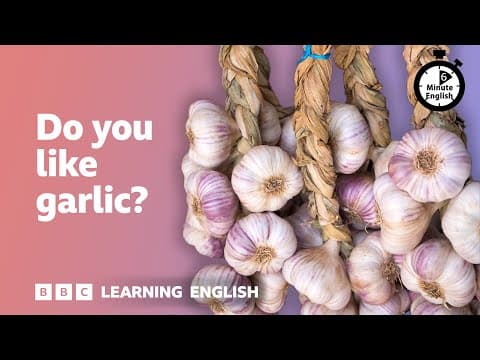
Do you like garlic? ⏲️ 6 Minute English
BBC Learning English
6m 14s910 words~5 min read
YouTube auto captions
Transcript source
YouTube auto captions
This transcript was extracted from YouTube's auto-generated caption track. The transcript below is server-rendered so it can be read, searched, cited, and shared without opening the original YouTube player.
Pull quotes
[0:01]It smells delicious sizzling in oil, and it's great for keeping vampires away, but don't eat it on a first date.
[0:01]Here is Jason Chan, an Australian chef who specializes in Asian cuisine, and Paul Eric Jensen, a Danish chef living in France.
[0:01]I love garlic because it's a versatile ingredient that can be used for cooking and offers various health benefits.
[0:01]We use it a lot, and so from stocks to soups and in vegetable dishes, meat dishes, there's very certain a clover of garlic in somewhere.
Use this transcript
Related transcript hubs
Watch on YouTube
Share
MORE TRANSCRIPTS


