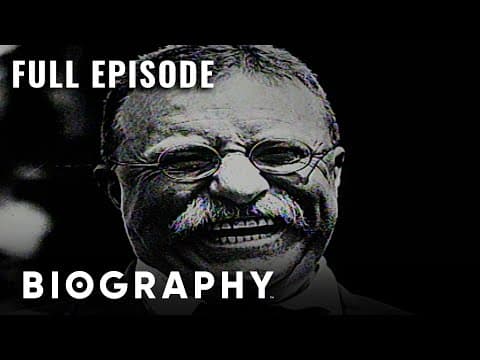
[0:05]Only those are fit to live who do not fear to die, and none are fit to die who have shrunk from the joy of life and the duty of life.
[0:15]Both life and death are part of the same great adventure. Theodore Roosevelt.
[0:26]He was called TR and Teddy. By any name, Theodore Roosevelt was a true American original.
[0:34]At age 42, he was the youngest man ever to become president, and with his youthful vigor and vision, transformed America from a fledgling industrial nation into a world power.
[0:47]Theodore Roosevelt made the presidency the focus point of American government.
[0:54]He is generally perceived to be the creator of what is called the modern presidency.
[1:00]TR said no president ever enjoyed himself as much as I, and no wonder.
[1:06]His achievements include building the Panama Canal, creating national parks and busting big business monopolies.
[1:13]He was the first president to go up in a plane and down in a submarine.
[1:18]And though he loved a good war, Theodore Roosevelt was the first American to win a Nobel Peace Prize.
[1:25]A whole lot of people see him as almost a human spirit incarnate, enthusiasm personified, this tremendously alive person.
[1:34]Who could be bored with Theodore Roosevelt?
[1:45]The great adventure TR called life began in this house on East 20th Street in New York City, where he was born October 27th, 1858.
[1:56]Theodore Roosevelt grew up as an upper class Knickerbocker, which meant that he was at the top of the heap socially.
[2:02]You couldn't get more elite than Theodore Roosevelt.
[2:07]Theodore, the second of four children, was named after his father, a wealthy and socially prominent glass importer.
[2:16]TR was profoundly influenced by his father, the best man I ever knew, as he said, the only human being to whom I ever told everything.
[2:29]The only man of whom I was afraid. The father was an extraordinary human being.
[2:38]He was involved in all the charities. He was a perfect father, a perfect husband, he was a paragon.
[2:44]And I think it was a big problem for TR as to what to do because he believed himself I think all of his life inferior as a human being to his father.
[2:54]He had to go into politics in part because his father had been defeated by politics, that was his one defeat, he'd been beaten by the bosses in a brief foray into politics at the end of his life.
[3:06]And there was the one thing that Theodore Roosevelt could do that his father didn't, he could beat the political bosses.
[3:13]Theodore's mother, Martha Bullock, was a Southern Belle from Roswell, Georgia.
[3:19]Some believe that Margaret Mitchell, the author of Gone with the Wind, based the character of Scarlett O'Hara to some extent on Theodore Roosevelt's mother.
[3:30]Her only public role was really as a society leader, as a person who had a charming salon, who was funny, articulate, well-read.
[3:39]His mother is the person who gives TR his love of playing on words.
[3:45]He was terrific at turning phrases, the press loved him.
[3:50]He created such phrases as the lunatic fringe or throw your hat in the ring, phrases that today everybody uses all the time.
[3:59]But neither his loving parents nor privileged background could shield Theodore from a childhood plagued by severe bouts of asthma, which kept him isolated from others.
[4:11]Theodore Roosevelt develops a combative personality, not only in struggling to breathe as a small child, but also in the struggle that his father sends him on to kill that invalid within him.
[4:24]TR created his own character from puny man to man of action, and it began here in his childhood, working out in the gym that his father created for him.
[4:35]Later, when they learned as part of therapy for asthma, that he should go out in the country and that he should exercise, nature and the outdoors represented health to him.
[4:47]He spent much of that time looking at nature, particularly birds, he was fascinated by birds.
[4:52]That was the beginning of his interest in natural history. He began immediately, we're talking when he was 9 and 10 years old.
[5:00]He learns how to become a taxidermist, he learns all the Latin names of the birds and animals.
[5:06]He keeps diaries, notes. He would save his specimens in the family icebox upon one occasion, a maid reached in for some cheese and there was one of TR's dead mice lying on the cheese and she screamed.
[5:19]One of the great achievements of Theodore Roosevelt's presidency were his conservation efforts, and that clearly was an outgrowth of his childhood studying natural history.
[5:29]In fact, he had thought up through his college years that he would become a naturalist as an adult.
[5:35]TR's college years were spent at Harvard, where he excelled in academics, and eagerly pursued rowing, boxing, and Alice Hathaway Lee.
[5:46]She was a very pretty young girl and she had a lot of suitors and he despaired of ever attracting her attention because she had so many suitors.
[5:56]How he wins Alice is funny. He ingratiates himself with her family.
[6:02]He talks politics with her uncle. He buys uh little Indian presents for her brother and he just charmed the family slowly and Alice gets used to this rather bumptious and awkward academic fellow.
[6:14]Finally, he persuaded her to marry him and they were married right after he graduated from Harvard.
[6:22]It was during this period that Roosevelt manifested an interest in politics.
[6:28]Politics was a forbidden field for men of his class when he graduated from Harvard in 1880.
[6:33]TR decided to become a professional politician because he wanted to be in on the on government.
[6:40]And he broke with the tradition of gentleman of New York at that period.
[6:46]In 1881, at the age of 23, Teddy Roosevelt, a Republican candidate won election to the New York State Assembly.
[6:55]Theodore Roosevelt went to the state assembly, something of a conservative, somewhat anti-labor.
[7:01]But when he got there, he had a chance to look around, he went to inspect the houses of the people who are making cigars in lower New York and he was appalled at the conditions that he saw.
[7:11]And this was his introduction to how a large part of the citizenry of New York of the country lived.
[7:16]He became very much a reformer and very much a friend of labor.
[7:20]In fact, he sponsored legislation banning making of cigars in tenements.
[7:26]But TR's fledgling career as a reform-minded politician was shockingly sidetracked.
[7:34]Theodore Roosevelt had the incredible misfortune of having a double tragedy in that his wife and mother died in the same house on the same day, February the 14th, 1884.
[7:50]Typhoid fever claimed Roosevelt's mother.
[7:53]Hours later, his wife, Alice, succumbed to kidney disease.
[7:58]Only two days earlier, she had given birth to their daughter, also named Alice.
[8:03]In his tribute to his wife, TR wrote:
[8:07]She was beautiful in face and form, and loveliest still in spirit.
[8:14]As a young flower she grew, and as a fair young flower she died, and when my heart's dearest died, the light from my life went forever.
[8:29]And when he finished that tribute and had it printed, he never spoke of Alice Lee again.
[8:37]His way of dealing with that particular grief was to walk away from it and not look back.
[8:45]In the wake of his personal losses, Theodore Roosevelt abandoned the world of New York politics and went out West to start over.
[8:54]It was a course that would eventually lead him to the White House.
[9:27]He said it more than once that had it not been for his years in North Dakota, he never would have become president of the United States.
[9:34]Now what does that mean? But I think he acquired something of the Democratic spirit out there. This is where the romance of my life began. Theodore Roosevelt.
[9:44]The rank and file were as fine natural fighting men as ever carried a rifle or rode a horse in any country.
[9:51]Everybody worked, everybody was willing to help everybody else, and yet nobody asked any favors.
[10:00]He learned how Americans outside the Northeast thought and looked at things.
[10:07]He acquired a broader view of the needs of working men and women, and he acquired the image of a cowboy.
[10:14]You probably have that wonderful picture of him in the buckskin. Now, that was the silliest costume to wear if you're going to be a cattleman.
[10:22]Nobody was dressed like that. That was his romantic notion of what a Westerner should look like.
[10:30]There's one amusing story that he said it on a roundup to some of his men. Hason forward there.
[10:36]And of course, everybody just laughed, practically rolled off their horses and laughed.
[10:41]He wanted to be accepted among men because he had had a childhood where he had to be kept away from other children.
[10:48]So it was really painfully important for him to make it socially among the Cowboys and and he really conquered some of his own self-doubt in the West.
[10:59]I do not believe there was ever any life more attractive to a vigorous young fellow than life on a cattle ranch in those days.
[11:08]It was a fine healthy life too. It taught a man self-reliance, hardihood, and the value of instant decision.
[11:17]In short, the virtues that ought to come from life in the open country.
[11:23]He picked a very unfortunate time to go into the cattle business.
[11:28]The ranch was becoming overpopulated, cattle prices were plunging, and that there was a tremendous blizzard which wiped out his herds, as well as everyone else's.
[11:37]And he lost his buckskin shirt.
[11:42]In 1886, TR went back East to resume his political career and the life that he had known.
[11:49]He lost the election for mayor of New York, but won the heart of Edith Kermit Caro, a childhood friend.
[11:58]Edith would say to Theodore, you are like a sensitive plant that I will cultivate and take care of.
[12:04]Edith really developed a maternal attitude towards TR, which even though he bulked at it sometimes, really appreciated.
[12:13]Because she took care of the practical side of his life.
[12:16]She was the wife he needed for a political career.
[12:21]While Edith raised their growing family, Theodore's political career began its swift descent.
[12:27]I rose like a rocket, is how TR himself described it.
[12:34]He was able to make a name for himself, make an impression and accomplish a great deal wherever he landed.
[12:40]He had a homely phrase that he repeated and that was, do what you can with what you have where you are.
[12:50]And that proved to be a great deal indeed.
[12:54]Roosevelt's rise began when he was appointed commissioner, first of the Civil Service, and later the New York City Police.
[13:03]Theodore Roosevelt's work as United States Civil Service Commissioner in Washington from 1889 to 1895, helped replace the so-called spoils system of political appointment with the merit system where a person was hired on the basis of their ability to do the job rather than the basis of their politics.
[13:22]As police commissioner of New York from 1895 to 1897, he was particularly notable for introducing modern technology and reforms to police work.
[13:37]And this foreshadowed his work with modernizing American government when he was president.
[13:41]That flamboyance that he has, almost his exhibitionism of liking to be in the newspapers and knowing how to make issues colorful, comes out in this time period, where he is seen with his cape going down to the slums and trying to catch policemen not doing their job.
[14:00]As one of the policemen said, at the time Roosevelt resigned to become Assistant Secretary of the Navy, it's tough on the force for Roosevelt was dead square, was Roosevelt.
[14:16]We'll miss him.
[14:19]New York City's loss would be the nation's gain, when Roosevelt was appointed Assistant Secretary of the Navy by President William McKinley in 1897.
[14:31]As Assistant Secretary of the Navy, Roosevelt had relatively little actual power and relatively little influence, but he did work hard behind the scenes to advance the cause of war.
[14:46]He did this partly because he thought that the United States should have an Empire.
[14:51]He wanted war because he wanted to prove himself in battle.
[14:59]No triumph of peace is quite so great as the supreme triumph of war.
[15:07]TR got his war in 1898, when the Maine, an American armored cruiser, blew up off the coast of Havana during Cuba's revolt against Spain.
[15:20]The yellow press of the day leapd upon the sinking of the Maine as uh a causus belli, they blamed it on the Spaniards, and this led the United States into a war with Spain.
[15:31]Which John Hay, John Hay, the good friend of Theodore Roosevelt called a splendid little war.
[15:39]Roosevelt, a leading advocate of intervention in Cuba, resigned from the Navy to form the First U.S. Volunteer Cavalry Regiment, better known as the Rough Riders.
[15:53]The rank and file were as fine natural fighting men as ever carried a rifle or rode a horse in any country.
[16:01]We had a number of first-class young fellows from the East, most of them from Harvard, Yale and Princeton.
[16:09]But the great majority of the men were Southwesterners, they possessed hardihood, endurance, and physical prowess, and above all, they had the fighting edge.
[16:21]Rough Riders with the genuine article, they really were.
[16:26]The Chaplain of the Rough Riders said, well, a Rough Rider never killed a man except if he cheated at cards, and a man who cheats at cards deserves to be shot.
[16:34]That's what the Chaplain said.
[16:38]On July 1st, 1898, Colonel Roosevelt and his Rough Riders became legends when they charged up San Juan Hill.
[16:47]The Battle of San Juan Hill, which actually involved assaulting two hills, Kettle and San Juan, was a very important battle in the capture of Santiago, Cuba, which was crucial in bringing about the end of the war in Cuba.
[17:00]And the Rough Riders were indeed heroes, they had the highest casualty rate of any regiment in the war, nearly 20% killed and wounded, so they were definitely in the thick of it.
[17:10]TR himself was wounded slightly on the arm by shrapnel.
[17:14]Roosevelt charged up the hill, calling his troopers to come behind him, the troopers were dismounted.
[17:22]He was on a horse, he shouted at one of them, why do you refuse to stand up when I am on horseback alone?
[17:33]Afterwards, he invited people to look at those damned Spanish dead.
[17:37]He boasted that he himself had doubled up a Spaniard.
[17:42]Unquestionably, he was a war lover just as unquestionably he was a hero.
[17:53]TR would later describe San Juan as the great day of my life.
[17:59]The glory he had won had fixed his image in the public consciousness as a fearless, virile leader, who would risk his life for a cause in which he passionately believed.
[18:11]The Spanish-American War and Theodore Roosevelt's participation in it was critical for his political career.
[18:17]He never would have been president, I believe, if he hadn't had the opportunity of leading the Rough Riders up San Juan Hill.
[18:26]When the war was over, the Rough Riders returned to the United States as heroes.
[18:31]But their leader returned a candidate.


