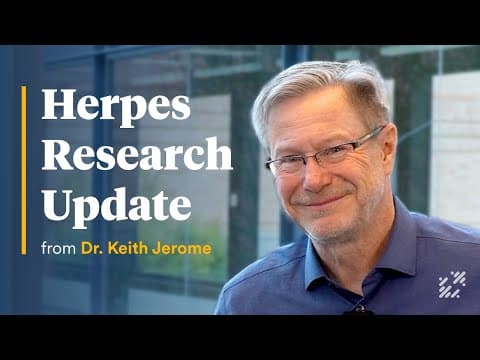
[0:00]Hey everyone, I'm Andrea Larson and I'm on the Fred Hutch philanthropy team. I'm here with Keith Jerome today in honor of Herpes Awareness Day and we thought we'd share a little bit of an update on his work. First of all, can you share an update on the clinical trials in humans? Sure. First of all, thanks for doing this with me. It's it's fun to get to do something in recognition of herpes awareness day. Um yeah, this is a question we get a lot, when are the trials coming? Um and I I think the message that I want to give everybody right now is we are working, that is our absolute number one goal. So we are working really hard to get to those trials, but there's a lot of work that's going to be between here and there. So one of the messages I want to have is just please be patient with us and and when it seems like things are taking time, don't think we're not working hard on this. Um when you move from something that's been proven in experimental systems, like we've been done before and now want to take it into people, you have to tweak things. We want to make sure that it works as well as possible in people. Um and then even more importantly, we need to be sure it's completely safe. The last thing we want to do is hurt anybody with this. Um not only because we don't want to hurt anybody, but if we make a mistake, overlook something, it doesn't work as well as it should, that could set the entire field back by years. And so we really want to dot every I, cross every T, make sure we're ready. So we're working on this, there's a lot of regulatory steps that we're going through and and we're doing all that. Uh so a little bit of patience and and we're all going to get there together. And in the meantime, where should someone get in touch if they would like to get updates on this work? Yeah, well people actually can contact you directly.
[1:48]Uh the the the the address is HSV@fredhutch.org. Um and that's a great way to get on our mailing list for some updates, if there's ever a trial, it'll be announced there among lots of other places. Um typically, I think we try to get some sort of update out uh every couple of months, so you won't be spammed with a lot of stuff if you sign up for this. Um as the pace of science moves forward and when we have something uh something new and exciting to tell, that's where we always share it. Great. Um another question that we get a lot is uh the difference between HSV-1 and HSV-2. So HSV-1 is the primary cause of HSV that people get around the the face or lips. Um now that can now cause does can cause genital disease and and we're seeing more of that in a substantial fraction of new cases of genital herpes are actually caused by HSV-1. Um and that has some prognostic implications in terms of how likely recurrences are and how frequent they happen. Um HSV-2 is typically uh the cause of genital disease, um can affect around the face and lips but that's fairly rare and and doesn't tend to recur much there. So they sort of each have their unique biology, um but they overlap some.
[3:17]And the good thing for us in what we're doing is that they're similar enough that the lessons we learn as we work against HSV-1 tell us something about how to cure HSV-2 and vice versa. So um a lot the other question I often get is why are you only working on the other one? Um so I get about 50/50, why are you only working on HSV-2 or why are you only working on one? We're actually working on both at the same time and sometimes one gets a little ahead of the other just because of the science, but uh the overall goal is to have a cure for both. Great. And we have such a strong community now that is supporting your work. Is that really making a difference? Yeah, the community is making an enormous difference, so thank you for for everybody who's who's done your part, whatever that might be. Um the biggest thing, so as some of you know, I I have had uh an advisory role at NIH for a few years that's that's uh coming close to an end, but it's been more around the HIV stuff but but also a little more general. And there's an increasing recognition of HSV as a detriment to the health of the American people, right? Like what you heard years ago was oh, people don't die of this, why would we work on it? I say, you know, we're the National Institutes of Health, not the National Institutes of not dying, right? So, uh so there's a big recognition now and that's been the community just frankly speaking up and saying you ought to be working on this and there ought to be a plan and ultimately there should be funding set aside for this. So the good news is there's a plan now, there's a strategic plan uh for NIH for HSV research, um and it specifically mentions cure, which I think is really cool, right? Not just, oh let's have a better test or a vaccine, which are all important, but the aspirational goal, right, is to cure people and that's called out now. That's really neat. Um there's also something uh recently that's called a notice of special interest or No-see. Um and that basically says that when people interested in cure like myself or other aspects of Herpes research, write a grant, it's a way that the NIH gets to say this is important to us. Unfortunately, every once in a while, you might run into somebody who's looking at a proposal and they say why would we work on herpes, it's not important, people aren't dying, right? You get that, and it basically takes that out of play because it says the NIH has determined that this is important. So a great step forward and when not money set aside yet, though, but I'm hopeful that that's coming and there'll be uh more funding toward better diagnostics, better work toward a vaccine, better treatments and and hopefully even cures.
[6:16]That's fantastic. Um before we wrap, is there anything else you'd like to share with your advocates? Uh the the last thing is just again, thank you very much. Um the the the community's been wonderful and advocating for this. Um it's made my life easier as a scientist because uh again, when I talk to other scientists or or government funders, the work's not considered crazy anymore. It's considered something that's important and and that we should be doing so that that just makes everything easier. And then a lot of people in the community have have just just kind of voted with their pocketbooks and I was say I, you know, most of these folks are American taxpayers. And so some of those funds need to be going as well, but until we get to that point, uh I'm incredibly grateful. It's kept the work going, um it's accelerated the work, it's meant we never had delay anybody off when we've had some difficulty with some of the grant funding. Um so really from the you know, bottom of my heart, thank you very much for everything you're doing and and hopefully we'll all continue this and and actually beat this virus. Great. Thank you everyone and again, that email address is HSV@fredhutch.org if you want to get in touch.


