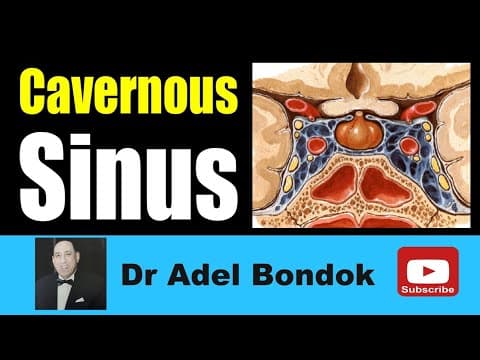
[0:16]Hello everyone. This is Dr. Adel Bondok, Professor of Anatomy and Neuroscience, Mansoura University, Egypt. I am going to talk about the cavernous sinus. The cavernous sinus is the most important dural venous sinus because thrombosis of the cavernous sinus can lead to serious complications. I will talk about the location, the relations, structures in the lateral wall of the cavernous sinus, structures inside the cavernous sinus, tributaries and then the drainage. It drains posteriorly to other sinuses and then the clinical importance of the cavernous sinus. Start by the position of the cavernous sinus. This is the cavernous sinus. Where is it located? It is located in the middle cranial fossa. This is the middle cranial fossa. So it is located on each side of the body of the sphenoid bone in the middle cranial fossa. It extends from the medial end of the superior orbital fissure, this is the superior orbital fissure, from the medial end of the superior orbital fissure till the apex of the petrous temporal bone. Okay? So this is the position of the cavernous sinus, in the middle cranial fossa, on each side of the body of the sphenoid, extending from the medial end of the superior orbital fissure till the apex of the petrous temporal bone. This is the open cavernous sinus. This is the closed cavernous sinus. Then regarding the relations of the cavernous sinus. Okay? Anterior relation, this is anterior relation. It must be the superior orbital fissure. Okay? And this is the posterior relation, it must be the petrous temporal bone. And then medially, this is the medial relation, of course, this is the pituitary gland above, and this is the sphenoidal air sinus. So medial relation to the cavernous sinus. Okay, pituitary gland and the sphenoid air sinus. This is cavernous sinus and this is the other cavernous sinus. Okay? Laterally, it is part of the brain, it is the temporal lobe of the brain. Superiorly, this is above. Above the cavernous sinus, internal carotid artery after leaving the cavernous sinus and optic chiasma, this is the optic chiasma. Inferiorly, yes, this is the sphenoidal air sinus. So again, the relations of the cavernous sinus, this is the cavernous sinus, anterior relation, superior orbital fissure, posterior relation, petrous temporal bone, medial relation, pituitary gland. This is the pituitary gland and infundibulum, pituitary gland and sphenoidal air sinus, lateral relation, it is the temporal lobe of the brain, superior relation, it is the internal carotid artery after leaving the sinus and optic chiasma, inferior relation, it is the sphenoidal air sinus. Then structures in the lateral wall of the cavernous sinus. This is the lateral wall of the cavernous sinus. Okay? This is the lateral wall of the other cavernous sinus. The lateral wall contains four nerves. Four nerves, OTOM, OTOM from above downward. The first one, this one, is the oculomotor nerve.
[4:24]Okay? The second one is another nerve. The T. This is the trochlear nerve. Okay? Trochlear nerve. The third one, this one, is a branch of the trigeminal nerve, it is the ophthalmic division, ophthalmic nerve. And number four, this one, another division of the trigeminal nerve, it is the maxillary nerve. Therefore, the mandibular nerve, this is the mandibular nerve, is outside the cavernous sinus. So the four nerves in the lateral wall of the cavernous sinus from above downward, oculomotor, trochlear, ophthalmic and maxillary. Okay? Just for orientation, this is the trigeminal ganglion, and this is the sensory root of the trigeminal nerve. So remember 3, 4, 5. 3 oculomotor, 4 trochlear, and 5 two branches, ophthalmic and maxillary. So these are the structures in the lateral wall of the cavernous sinus, OTOM. Oculomotor nerve, trochlear nerve, ophthalmic nerve and maxillary nerve.
[5:41]Structures inside the cavernous sinus. Inside. Okay? Two important structures inside the cavernous sinus. This is the internal carotid artery. Okay? Internal carotid artery and this is the abducent nerve inferior lateral. Okay? To the artery. And around the internal carotid artery, there is a sympathetic plexus. So structures inside the cavernous sinus, internal carotid artery, abducent nerve inferior lateral to the artery, and sympathetic plexus around the internal carotid artery. Then tributaries of the cavernous sinus. This is the cavernous sinus, tributaries. Anterior, medial, okay, superior and inferior tributaries. Okay? So at the anterior end, the anterior end receives three veins. This is the first one, ophthalmic veins, ophthalmic veins, superior and inferior. This is the superior ophthalmic vein. So ophthalmic veins. The second vein is inside the optic nerve, it is the central retinal vein, or central vein of the retina. And the third one, this one, this is the sinus sphenoparietal sinus. So the anterior end of the cavernous sinus receives three veins, okay, ophthalmic veins, central retinal vein, sphenoparietal sinus. Then medially, medially, okay, intercavernous sinuses. Three intercavernous sinuses, anterior, middle and posterior. The anterior and posterior run in the diaphragma sellae. This is the diaphragma sellae, and the middle one runs deep to the pituitary gland, between the pituitary gland and the bone. Then superior and inferior. Superiorly two veins, two cerebral veins, superficial middle cerebral vein and inferior cerebral vein. So middle and inferior cerebral veins. Inferiorly, it is connected with the pterygoid plexus and pharyngeal plexus by emissary veins. So emissary veins connecting the cavernous sinus with the pterygoid plexus through the foramen ovale and lacerum and with the pharyngeal plexus through the carotid canal.
[8:35]Again, tributaries of the cavernous sinus, anterior end, receives three veins. Okay? Ophthalmic veins, central retinal vein, sphenoparietal sinus. Medially, intercavernous sinuses, anterior, posterior, and middle. And then superiorly, middle and inferior cerebral veins. Inferiorly, connected with the pterygoid plexus and pharyngeal plexus veins by emissary veins. Then drainage of the cavernous sinus. The cavernous sinus drains posteriorly. Okay, too. Number one, this sinus, this is the superior petrosal sinus. Okay, to the transverse sinus. So the first drainage through the superior petrosal sinus to the transverse sinus. The second tributary is this one, inferior petrosal sinus. Okay, through the inferior petrosal sinus, it joins the internal jugular vein. So finally, the venous drainage of the brain reach the internal jugular vein. Okay? So, drainage of the cavernous sinus, it drains posteriorly through the superior petrosal sinus and inferior petrosal sinus. Through the superior petrosal sinus to the transverse sinus and through the inferior petrosal sinus to the internal jugular vein. This is the cavernous sinus. The cavernous sinus has very important connection with the anterior facial vein. This is the anterior facial vein. Okay? This is the anterior facial vein, draining the face. Or actually, draining the dangerous area of the face. Okay? So, the cavernous sinus is connected with the anterior facial vein by two roots. The first root is direct root. The direct root is through the ophthalmic veins, superior ophthalmic vein and inferior ophthalmic vein. So this is the direct, directly to the cavernous sinus. Okay? Ophthalmic veins, superior and inferior. And then indirect root. The indirect root through the deep, this one, the deep facial vein, connecting the anterior facial vein with the pterygoid venous plexus. And then from the pterygoid plexus, emissary vein to the cavernous sinus. Again, connection of the cavernous sinus with the anterior facial vein, because this is very important clinically. Direct connection through the ophthalmic veins, indirect connection through the deep facial vein, pterygoid plexus, and emissary veins. So what is the clinical importance of this connection? The clinical importance of this connection is that infection from the dangerous area of the face can spread to the cavernous sinus. Okay? So infection from the dangerous area of the face can spread to the cavernous sinus causing cavernous sinus thrombosis and meningitis. This is the dangerous area of the face which includes the upper lip, the nose, the eyes and the forehead, dangerous area of the face. So infection from the dangerous area of the face can spread to the cavernous sinus causing infection and thrombosis. So infection and thrombosis of the cavernous sinus may cause.
[12:30]Remember the relations and the tributaries, it may cause blindness due to impaired venous return from the retina, through the central retinal. It may cause paralysis of the extra of the nerves which supply the extraocular muscles. Okay? Paralysis of the oculomotor, trochlear, ophthalmic and abducent nerves and also ophthalmic nerve. Okay? Oculomotor, trochlear, ophthalmic, abducent run in the lateral wall, abducent nerve run inside the cavernous sinus. And due to obstruction or impaired drainage from the orbit, okay? Orbital edema and bulging of the eye. Orbital edema and bulging of the eye due to impaired venous return from the orbit. Therefore, the cavernous sinus is very important clinically because it has connection with the with the face through the anterior facial vein. Okay? So infection from the dangerous area of the face can spread to the cavernous sinus through the ophthalmic veins, through the deep facial vein, pterygoid plexus and emissary veins, causing cavernous sinus thrombosis and meningitis. Thrombosis of the cavernous sinus can lead to blindness, okay, paralysis of the oculomotor, trochlear, abducent and ophthalmic nerves and orbital edema and bulging of the eye. This is orbital edema, okay, and bulging of the eye due to cavernous sinus thrombosis. Thank you very much.
[14:08]Best wishes and good luck.


