[0:00]May 10, 1996, the summit of Mount Everest, a storm of unimaginable ferocity strikes, claiming the lives of eight climbers and leaving others stranded in a fight for survival.
[0:14]This is the story of one of the most controversial and tragic days in mountaineering history.
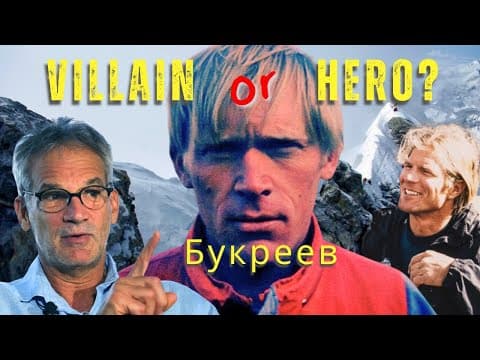
[0:21]Among the chaos and controversy, one name stands out: Anatoli Boukreev, whose actions that day would spark a heated debate that rages on to this very day.
[0:33]In this video, I'm going to break down the controversial actions of Anatoli Boukreev and what he did on Mount Everest during that tragic storm on May 10th, 1996.
[0:45]that claimed eight lives, five on the South side where Anatoli Bv was working as the head guide for Scott Fisher's Mountain Madness expedition team, and three lives were lost on the North side on the Indotibetan Border Police team.
[1:02]We're going to break down some of the key errors that I think were made on the mountain before and leading up to the storm, and also some of the most incredible things that Anatoli himself accomplished during that storm to save lives.
[1:16]We'll look at the bottled oxygen situation where Scott Fischer, in my estimation, planned a woefully low amount of oxygen for the summit bids for a group of inexperienced climbers.
[1:28]Also, we'll take a look at the fixed rope situation, which slowed the climbers' progress toward the summit, and very importantly, we'll look at the decision to let Anatoli Bukreev climb on Mount Everest without the use of bottled oxygen.
[1:45]And also the disregard of any reasonable turnaround time on Mount Everest, which is tantamount to any successful ascent of that mountain.
[1:56]Now, I want you to keep in mind, this is not a full accounting of everything that took place on Mount Everest during the storm.
[2:04]There are countless videos on YouTube and also the book Into Thin Air by Jon Krakauer, and The Climb by Anatoli Buv, which is the inspiration for this particular video.
[2:17]And also on this very channel, I have a video about Scott Fischer, as well as about Sandy Pitman, their roles and their accountability in what took place on the mountain.
[2:30]I'll put links to those in the description of this video.
[2:33]One thing to keep in mind, this was an ever-changing time in the world of high altitude mountaineering.
[2:40]Very few people had actually been guided to the summit of 8,000 meter peaks.
[2:47]Rob Hall, who was the owner and expedition leader for Adventure Consultants, another of the expedition guiding companies that was on the mountain and ultimately, the competition for Scott Fisher's Mountain Madness team.
[3:01]Rob Hall himself had guided 39 clients successfully to the top. He had had unimaginable success on the mountain, and I think both went in there thinking that this was going to be a piece of cake.
[3:14]Scott Fischer had also said in an interview in base camp shortly before their summit bid, that they had built the yellow brick road to the summit of Mount Everest, which is the ultimate irony given the events that would soon take place up on the mountain.
[3:31]Anatoli Boukreev was a Soviet and Kazakh mountaineer, he had made ascents of 10 of the 14 8,000 meter peaks without supplemental oxygen.
[3:44]And from 1989 through '97, he made 18 successful ascents of peaks above 8,000 meters.
[3:51]He was known for his incredible strength and fortitude and his amazing, almost superhuman ability to climb without the use of any bottled oxygen.
[4:02]It's also important to note that Anatoli was from Kazakhstan.
[4:08]This is not your typical United States American or British or even European climber who lived a life taking for granted that there was going to be food on the table for three meals a day.
[4:21]Versus Anatoli living in Kazakhstan, where they were just barely eking out a living.
[4:27]And one example that Anatoli talks about in his book The Climb is he said he was on a mountaineering expedition to an 8,000 meter peak, where typically someone like me who can't really afford to lose weight on an expedition, might lose 10 kg or 20 plus pounds, and Anatoli would go to these expeditions and actually gain weight because it was the first time in a long time that he was eating regularly.
[4:56]It's just shows the complete contrast of the cultures that are coming to this mountain for this 1996 disaster.
[5:08]Hey, I want to jump in real quick and let you know that the extended version of this episode can be found over on my podcast, The Happiness Quotient.
[5:18]I am going to put a link in the notes below, and also, while you're at it, if you haven't done so already, please subscribe.
[5:25]And there's also free content over on my Patreon page, patreon.com/everestmystery.
[5:33]Now stick around because at the end of the video, there's something I'm going to say about this story, about the tragedy on Everest that I'm pretty sure you've never heard before.
[5:43]I'd love it if you stuck around. So, thanks. Now, back to the episode.
[5:48]A couple of days before the storm, May 8th, Anatoli was on his way up the mountain when he passed American mountaineer Ed Viesters, who at the time was working with David Brashears for the IMAX film that was being produced.
[6:06]And Viesters had said that they did not like the conditions up high on the mountain.
[6:10]Now, this points to the idea that Fischer and Hall seemed to be fixed that May 10th was it. That was the day they were going to go to the summit, come hell or high water, and here we have some of the most experienced mountaineers, not only on the mountain, but in the world, saying, "We're going to wait for a better day, we don't like the conditions up high."
[6:33]Now, that might have been because Brashears, being the director and filmmaker that he was, didn't want anybody in the background of the magnificent shots that he was getting on this massive film camera.
[6:47]However, we do know that the winds were very high up above because on May 9th, when the Mountain Madness Sherpa team reached the South Col, the winds were so high that they could not even set up a tent.
[7:00]They were struggling, and then when Anatoli showed up in the South Col at 2:00 p.m. in the afternoon, they had a hell of a time getting the tent set up, and went so far as to have Clev Showning climb inside the tent to wait it down while they got the tent affixed.
[7:23]So the conditions on May 9th, only hours before the teams were supposed to leave for the summit, were horrendous, really, really bad, cold, high wind conditions.
[7:35]When the winds finally died down, it was 10:00 that evening.
[7:40]Many of the clients surmised that there was no way in hell that they would be going to the summit that night, but by 11:30 p.m. Rob Hall's team had already emerged from their tents and were making their way up toward the triangular face on their summit bid for Mount Everest.
[8:00]Now, when the Mountain Madness team emerged from their tents, they were not too excited to learn that Rob Hall's team was ahead of them.
[8:10]Let's just say essentially Scott Fisher's team were far more prepared, better athletes, far stronger, and it wasn't long before, as it says somewhere in the book, they were looking at the butts of Rob Hall's team slowly, too slowly, making their way up the fixed ropes toward the summit.
[8:34]The fact that the Mountain Madness team was already slowing down at the beginning of their summit push points to Scott Fisher's decision to use a limited amount of oxygen canisters for their summit.
[8:52]Honestly, a razor thin margin for error.
[8:55]They were using these Russian-made Poik oxygen bottles.
[9:00]They're called 3-liter bottles, and they last at a flow rate of about 2 to 2 1/2 L per minute, about 6 hours.
[9:09]And so the plan was that the climbers would use two to get up to the summit and hopefully get them back down to the South Summit where a new cache would have been delivered with a third Poik oxygen bottle that would be hopefully ample for them to make it back down to Camp 4.
[9:30]This is just absolutely one of the most absurd things I've ever heard, and honestly, when I was reading this in the book, this is the first time I really knew this detail.
[9:40]I was shaking my head thinking, So, we're talking 18 hours to leave your tents at high camp, Camp 4, get to the summit, and all the way back down, and if it surpasses 18 hours at a 2 to 2 1/2 L flow, which is kind of low, that means you're out of Os.
[10:02]That doesn't leave you anything to get back down the mountain. We're talking about a group of clients with, for the most part, zero experience on the mountain.
[10:11]Sandy Pitman was the only person who had been on Everest before, but her high altitude experience was severely limited.
[10:19]So, we're already putting some pressure on this, if you will, 18-hour round trip amount of oxygen, which was only going to get worse as they made their way up the mountain.
[10:30]Another major issue that took place on the mountain later on in the day as all the teams were making their way up to the summit is that reportedly there was an agreement between Scott Fisher and Rob Hall.
[10:46]That they would each have one of their Sherpas participate in fixing ropes across the corniced ridge up the Hillary Step toward the summit.
[10:56]This is an absolutely vital place to have fixed ropes because one slip, one gust of wind, and you will fall several thousand meters to either side of the mountain.
[11:08]So Neil Beedleman, one of Fisher's guides, got to that location where the ropes were supposedly going to be fixed, and nothing had taken place at that time.
[11:21]And so this caused an extreme delay of well over an hour, losing time, losing body warmth, not moving, consuming more oxygen from the bottles.
[11:31]The clock was ticking, and Beedleman didn't know what to do.
[11:34]So he took over the job of fixing whatever ropes he could get up through the corniced ridge and up on the top of the Hillary Step.
[11:44]Let's just fast forward 3:00 p.m. in the afternoon.
[11:47]Scott Fisher himself has finally got above the Hillary Step, where he encounters Anatoli Boukreev, who was coming down from the summit, oxygenless, without using any bottled oxygen.
[12:03]Now, I'm going to jump in here before I tell you what their conversation was to say that a turnaround time of 2:00 p.m. was set and supposedly was an ironclad agreement that Rob Hall had made.
[12:19]If you have not tagged the summit by 2:00 p.m., I don't care where you are, you turn around.
[12:25]That's the time to go down the mountain. Now, at this time, Scott Fisher himself, reportedly, had not made an ironclad turnaround time, but there he was, a little bit tired, not doing too well at the top of the Hillary Step, moving his way upward with the knowledge that all of his clients had successfully summitted and were making their way back down.
[12:51]So, I just have to ask, a little asterisk right there, why did Scott Fisher keep going up at that time?
[12:59]We can only conjecture, because as it would turn out, it wasn't many hours later where Scott Fisher would die himself.
[13:06]Now, to that conversation that Boukreev had with Fisher at the top of the Hillary Step, they made an agreement supposedly before their summit bid down in base camp, and then again reiterated that at the top of the Hillary Step, that Boukreev would descend quickly down to Camp 4 and rest up, recuperate as best as he could, make some hot tea and get the camp ready for the climbers who would hopefully soon be making their way into Camp 4 after their successful summit bid.
[13:46]At the time, nobody was aware that a gigantic storm was descending upon the mountain.
[13:52]That's the conversation that Bukreev says he had with Scott Fisher, but also a bone of huge contention in the writings of Jon Krakauer, and Into Thin Air, who said that he felt that was one of the most selfish decisions that any guide could possibly make at that time when there were climbers up and down the mountain from the summit on down to Camp 4.
[14:21]So, this is where some of the controversy really begins between the telling by Anatoli Boukreev and the telling by Jon Krakauer.
[14:29]So Boukreev gets back down to Camp 4, no oxygen, recuperates, gets some rest.
[14:35]And now we have to remember, Camp 4 is at about 8,000 meters in altitude, 26,000 plus feet in altitude, well into the death zone, where any normal human being can't do anything, not even tie their bootlaces, and I mean this literally, without the use of bottled oxygen.
[15:00]And now Anatoli is down in the tents getting ready for the climbers to make their way down, and about that time, the storm hit the mountain like a sledgehammer, catching people spread out all the way up from where Anatoli was toward the summit.
[15:18]Regardless of whether that decision for Boukreev to descend to Camp 4 in advance of the clients, whether anybody might agree with that or not, the thinking between Fisher and Boukreev was that Anatoli would be in a far better place to assist those climbers if he were to come down and get the camp ready.
[15:42]Now, obviously, they didn't know that the storm was coming, and I'm sure that decision would have been different, had there been that storm raging, maybe even only an hour or two before, which actually points to you just the incredible irony of that storm itself, had it come a few hours earlier or just a few hours later, there's a chance nobody would have died on the mountain.
[16:06]The storm descends, all hell breaks loose, and within 12 hours, five climbers on the South side of the mountain had lost their lives.
[16:17]It was an absolutely devastating scene, and of those lives, in Mountain Madness, none of the clients lost their lives.
[16:26]However, Scott Fisher himself died just below an area called the Balcony, and beside him was his trusted friend and Serdar, the head climbing Sherpa Lopsang Sherpa, who loved Scott dearly.
[16:42]They were very, very close. He stayed with him as long as he absolutely could to try to save Scott's life, going so far as to put tea in Scott's mouth, but Scott wasn't even able to swallow that tea, and Scott said, "You have to descend, you have to go down."
[17:05]Send Anatoli back up to help me, or else you're going to die here too.
[17:12]And one of the last words, this just sends chills up and down my spine.
[17:18]I can't believe how emotional this must have been for Lopsang, because I'm recounting it 20, almost 30 years later.
[17:35]And one of the last words Scott said to him is, "I'm dead, I am dead."
[17:41]And it just must have been the most heartbreaking thing for Lopsang, who looked up to Scott as a mentor, that here is this bigger than life human being laying down to die on the mountain, when all they had was good intentions.
[17:56]Yeah, they made amazingly poor decisions along the way, but they just wanted to get people to the top of the mountain to share their joy about what it's like to stand on the summit of the greatest mountain in the world, and Scott Fisher perished there just below the balcony and broke the hearts of people around the world, and to this day still the hearts are broken as was the hearts of so many when they learned of the passing of Rob Hall, who died there having just made a radio conversation with his wife at home, who was pregnant with their child, just an absolutely devastating experience.
[18:40]And then three other climbers, the guide Andy Harris, and then two clients, Doug Hansen, who was there on his attempt with Rob Hall, and the Japanese woman, Yuko Namba, who would die ever so close to Camp 4, perishing within a few hundred meters of the camp.
[19:01]In the flats of the South Col, there was an epic taking place.
[19:07]The winds were so high and and the cold, absolutely bitter, and the snow was falling so hard that some reported that one could not see past their outstretched hand.
[19:24]It was that poor of a visibility there, and of course, it was dark and going well into the night.
[19:30]And Boukreev, who there he was, having rested up in his tent, would venture out from his tent toward where he believed the people would be, looking unsuccessfully the first time, and then Clev Showning gave him some intel on where he thought Tim Madison, Charlotte Fox, and Sandy Pitman were.
[19:54]And he went out there and found them and helped get them all back in camp, saving their lives.
[20:05]Making the absolutely devastating decision that he made at the time to leave Yuko Namba behind, because he felt that she could not at the time be saved.
[20:17]And so the following morning, when if you will, the dust settled, there were five dead people on the mountain, and as teams were preparing to make their way back down, Anatoli went up to the site where Scott Fischer had died to see if perhaps he was still alive, to try to revive him.
[20:43]And found Scott frozen. Anatoli took the time out to cover Scott's face with a backpack, so none of the birds that fly out there could could reach him.
[20:55]And he also packed around Scott's body, four or five oxygen bottles to kind of let him, you know, keep him in place, as if you will, a makeshift grave for his good friend Scott Fischer, who he admired greatly.
[21:12]In the aftermath of the storm, which is still being broken down today and debated around the world, there was a lot of criticism, namely in the book written by Jon Krakauer, called Into Thin Air, who was highly critical of Anatoli's decisions.
[22:34]One of the quotes from the article, he says, "Buv returned to Camp 4 at 4:30 p.m. before the brunt of the storm, having rushed down from the summit without waiting for clients."
[22:49]Extremely questionable behavior for a guide. Buv didn't take long to clap back, if you will, with an article to Outside Magazine, defending himself, but the publisher at Outside Magazine refused to put his letter in its entirety, saying, "We'll edit it down to 400 words," which Anatoli thought was absolutely absurd, because you can't explain all these things in just 400 words.
[23:15]So he passed on that and then began at that time writing his own book, The Climb, which is an absolutely amazing first-person view of what took place on the mountain, which for the most part, really defends Anatoli's actions on the mountain.
[23:33]So my ultimate take, and I welcome your comments and thoughts below, is that Anatoli, while I do think he should have been on oxygen.
[23:47]I don't think any guide should ever be on an 8,000 meter peak without oxygen, no matter how good they are at altitude without it.
[24:00]However, that was a decision that rests on the shoulders of Scott Fischer. One thing I think we can all completely agree upon, however, is Boukreev is a hero, and what he did, despite the fact that he descended down to camp.
[24:16]He did heroic deeds to save lives there.
[24:20]Now, here is the final bombshell that I think that people don't talk about that often.
[24:27]Had Anatoli remained up the mountain to assist the climbers as they were making their way down the mountain, and had he been there when the force of the storm began, my gut tells me that he would have been much closer in proximity to Scott Fischer and in a better place to save Scott Fischer from himself, who in my opinion, was his own worst enemy on that mountain.
[24:55]I don't mean that in a critical way, that he was a bad guy.
[24:58]I just think Scott was was gone, and I think had somebody like Anatoli been near him when he was continuing to go up the mountain, he might have been able to extract him off the mountain.
[25:11]So I'd love to hear your thoughts and comments about this.
[25:15]I'm sure there will be many who disagree with me, or many who point out little facts that I haven't mentioned.
[25:22]I just can't make this video an hour and a half long.
[25:25]It's got to nip it in the bud somewhere. I think I've pointed out the key elements of it.
[25:31]I strongly advise you to check out my Sandy Pitman and Scott Fisher video.
[25:35]The links will be in the description of this video.
[25:38]And also, if you really want to do the deep dive, get Into Thin Air and The Climb.
[25:43]They're great books to read and just real heartbreaking books about something that took place on Mount Everest that really changed forever the trajectory of where the guiding industry went.
[25:55]Thanks for being here. Go do a good deed. Don't ask for anything in return. Make the world a little bit better of a place to live in one step at a time.
[26:05]Peace be with you, my friends.