[0:35]Okay folks, welcome to the first teaching tutorial from the ICT Monthly Mentorship for month of September 2016. This is the first of eight. Each month you'll get eight individual teaching tutorials that will complement the general theme for the month. Uh this particular teaching is going to be elements to a trade setup. And as you probably noticed, uh this month so far, we've been focusing primarily on showing the consistency that's able to be delivered to you as a developing trader after you've submitted the time and you've done the work with the exercises and the content uh materials that we're going to be presenting to you. Um, when we refer to elements to a trade setup, there's really just two primary uh concerns. And one is obviously context or framework surrounding the idea. In other words, what makes the idea uh favorable for a trade. It's not just simply, well my indicator tells me this or my support and resistance level tells me that, there has to be something that builds a reason to want to do this trade. In my material, I mean learning for specific principles, and we're going to be dealing with them in general terms and then what we do in those conditions. What do we specifically pairing up with in terms of the ICT tools? The first one's going to be expansion. Okay, uh we're going to talk about expansion and what we look for in that condition. We're going to we're going to be talking about retracements and what tool or concept we used for retracements. Reversal and lastly, consolidation. Now, each one of these four give a specific framework and a context to the marketplace that you're going to be trading in. They can only be one of these four conditions, either the market's going to be expanding, running away in other words, uh trending, a retracement, or pullback, uh altogether reversal, and obviously, when the market's doing nothing, it's consolidating. But really we all learned in the market maker uh series that there's really no such thing as the market doing nothing and consolidating. It's exactly accumulating orders. Now, the other characteristic we use for defining elements to a trade setup is using these four criteria for context and framework to specific reference points in institutional order flow. The first one is order blocks.
[3:24]The second one is fair value gaps and liquidity voids. Liquidity pools and stop runs. And lastly, equilibrium.
[3:47]Now, understanding those two characteristics together will give you a greater understanding of market efficiency paradigm. How the smart money interprets price and how they influence the general populace or the speculative uninformed money. It's going to be a rather illuminating to uh tutorial actually. You're going to be able to look at the marketplace with an expectation of knowing what tool to apply based on what the market's providing you right now. It only takes a second or two to look at the marketplace to determine, okay, what characteristic are we trading in. So that way you can build the context or framework on how you're going to approach the marketplace. Sometimes you'll have right away an issue where you can say, I'm not going to do anything because the market's consolidating, I'm going to be waiting. The other three conditions are going to be providing you an opportunity to take action relative to the tools that we couple with those conditions or context. Now, the interbank price delivery algorithm, or what I always refer to as the algo or interbank algo, uh is the actual, basically artificial intelligence. Uh it's a price engine that um when we receive our price for our currencies, it's actually 90% done by electronic uh algorithms. So it's all computer based now, it used to be open and out crying in the pits, uh but there's no longer an auction market, it's all AI. And it's based on the principles I've been teaching for about seven years now. Um, you're not going to learn these things because number one, no one's going to believe that it exists.
[5:40]Uh there is this movement away from human involvement with market making. Um it's become much more efficient to be electronically based and these things uh are programmed by human beings obviously, and those intelligence are limited.
[6:17]So, uh while that is probably unsettling for some of you that are listening to this thinking, well, I thought I had a free market I was trading in, uh it's actually not. It's highly manipulated especially in the foreign exchange, which is what we're primarily dealing with here, because of the nature of it being so manipulative, the the fingerprints if you will, are easy to see once you understand the operations and the conditions the market maker uh interbank price delivery algorithm functions. So when the market does what it's doing, uh it gives you indications, it gives you fingerprints or clues as to what you should be expecting next and that's where your anticipatory skills are going to be coming in. Uh you're not going to know these things right away, the first time watching these videos, it may go over your head, but for some of you that have already went through the prerequisites, I believe that are in my free tutorial section on my website. If you haven't gone through the sniper series, decision trading concepts and the market maker series yet, you're going to need those, okay? So don't be discouraged if you hear some terms in here to go over your head because they're all taught in those three tutorial series for free, it's a lot of material over there, so you dig into not only just stuff you're getting in this curriculum with the mentorship, but fill in the space when I'm not giving you content with the free tutorials. Those three tutorials, I'm going to say what they are, they are Market maker series, precision trading concepts and the sniper series. Okay, the Interbank Algo. Okay, obviously, uh there's going to be times when the market goes sideways in order to consolidation or what I refer to as a holding pattern. Now, when this happens, the market will be looking to do an expansion. Okay, so all markets start from a consolidation, then move into an expansion, that means there's an impulse move or an impulse price swing. Uh after that impulse swing, okay, either it goes back to a consolidation again, or it goes to a retracement. When the retracement happens, it goes back down into another level of expansion or after the expansion, it can go to a reversal pattern. After the reversal pattern, it'll see another retracement and then back to potentially a consolidation. These four conditions, they interchange throughout the ups and downs and eds and flow of the marketplace. You're only going to get one of these four conditions. Now, you're probably saying, okay, well that's a lot. I need to know one of these things to make a trade. No, you just need to know where it's at right now, where it's likely to go, where it came from, and over the course of the month of September, you're going to get a lot of understanding about how to know where the market's going to go next.
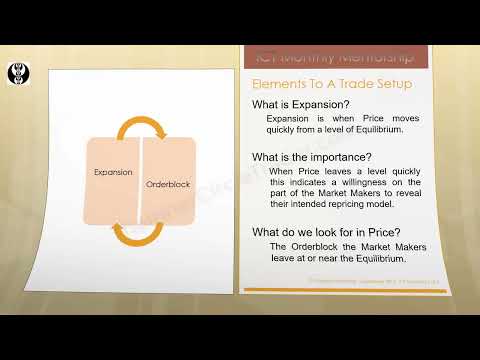
[9:05]And that's going to fill in a lot of the gaps that you've had with teaching me directional bias ICT. The main thing is is the consolidation begins with everything. all the moves that take place in the marketplace start from a measure of consolidation because that's where the markets are building orders. So the market maker keeps the market in a tight range or a defined range until there's enough money on both sides of the uh upper and lower end of the range that's being defined by the consolidation. Whichever one has the highest amount of money to be absorbed, that's the direction it's going to move in. We don't always know what that is, but we wait for the expansion. When the expansion occurs, that's when we get the clue as to what the market is most likely going to be doing. And then we wait for either a retracement or another consolidation or reversal, but we always wait for the first expansion. That gives us all the insight that we need to make a decision. Now, sometimes it may expand so far that we can't do anything with it and we have to wait for the retracement or the next consolidation. There's nothing wrong with that. It's all normal, you're not going to catch every move. The main thing is is understanding these four individual uh characteristics to a trade setup because price is delivered by one of these four conditions. It can't be any other way. Now, what is expansion? Expansion is when price moves quickly from a level of equilibrium.
[10:40]Now, what is the and what's the importance of knowing expansion? Well, when price leaves a level quickly, this indicates a willingness on the part of the market makers to reveal their intended repricing model. Now, what does that mean? Well, if we're in a consolidation, okay, or a point of equilibrium, if price were to move up quickly, that would give us an indication of looking for a bullish order block. We don't want to chase price, we're going to wait for price to come back down into the order block. Where's that going to occur? Well, what do we look for in price? The order block that the market makers leave near or at the equilibrium price point. So I know what you're thinking, okay, Michael, this is already going over my head. Give me some examples. No problem, I'm going to show you that right now. As you can see here, there's a consolidation in the blue shaded area, very clear defined consolidation. It's got a clear discernable high and low and the equilibrium price point is directly in the middle of the high and the low end of that range. You can simply take the Fibonacci told you have in all your platforms, lay the fed from the high and the low and the general consolidation, find that midpoint. And you can check yourself also by looking at how many times the market touches up up against it from below and from above it going down into other words, how many times it's touching and hanging around that level. Eventually, the market will move outside of the consolidation. You can see that impulse move in that tan shaded box. It moves away from the equilibrium price point and then all we have to do is go back to the down candle right before that up move. That down candle or black candle I'm drawing a small little segment, I hope that's the bullish order block. When the price comes back down into that and hits it, that's where we would be buying. And then obviously, you can see it hits that level and expands to the upside over 100 pips just by using that simple principle. It repeats itself all the time, it's in price action all the time. And if you study just to the left of the consolidation we have shaded in blue, there's actually a consolidation uh in the cell side where the market broke down and came right back to the equilibrium price point again and then sold off. I'll leave that for your study now, but we're going to move over to the next characteristic of a trade setup.
[13:30]The next one is a retracement. Now, what is a retracement? Retracement is when price moves back inside the recently created price range. Now, years ago, I think it was in 2012, I did a webinar called trading inside the range. And a lot of folks that were following me on uh one of the uh forums that is pretty popular on the internet, uh they went head over heels when they learned this this simple principle of understanding how you can trade it inside of a range and it doesn't even have to break out, it doesn't have to trend. You you can define the range by a high and a low and trade inside that range. And that was the beginning basis point of how I brought a lot of people from that form into the understanding of an order block. The order block was introduced in the sniper series tutorial on my website, but uh prior to that I just gave indications and clues about what an order block was without actually really referring to or spelling it out for everyone. What's the importance of the retracement? Well, when price returns inside a recent price range, this indicates a willingness on the part of the market makers to reprice to levels not efficiently traded for fair value. When we're thinking retracement, the go-to is for ICT tools, we're looking for liquidity gaps and liquidity voids. When we look for price, when we see run ups real quick and run downs in price, in other words, real quick rallies up or real quick rallies down in price. Many times that range that's created will want to come back in and close that in. And I'll give you an example what that looks like now. Okay, this is uh example of a retracement. As you can see here, the orange shaded area, we had a real quick sudden movement away from a price level and that quick sudden movement creates what we call as a liquidity void. In other words, it as the market drops aggressively like that, uh there's going to be pockets where the price wasn't actually delivered on every um uh, you know, available price level at that in that range. It moved too quickly, it skipped or it created gaps. Well, what we'll do is we'll wait as a trader, we won't chase price, we'll wait and say, okay, there's going to be either an indication to get long and try to fill in that range or we can wait for to come all the way back up to it and fill in the liquidity void. Once it hits it, then it'll probably resume going lower and that's what we're looking for in terms of a liquidity void. So we've covered three conditions. The next one is the reversal. The reversal is when price moves the opposite direction that current direction has taken it. So if we are looking for reversals, we're directly coupling that with an ICT tool of liquidity pools. Now, what's the importance of it? When the price reverses direction, it indicates the market makers have ran a level of stops and a significant move should unfold in the new direction. What do we look for in price? The liquidity pools just above an old high and just below an old low. Okay, and we're looking at examples of reversals here. Every X indicates where stops would be and the market goes just above those levels and it rejects and goes the other way or goes just below those levels where there's an X and rejects and goes the other way. Look how many times there's so many opportunities just on this one chart and it's on a pair I don't really like to trade the US versus the Swissy. Uh this pair is real choppy, it tends to have a lot of this type of price action so it has a characteristic that is very favorable if you if you're into type of trading like this. Turtle soups and false uh breaks are really, really good um in the Swissy. And lastly, we have consolidation. And when we're referring to consolidation, we're we're directly relating that to an ICT toll of equilibrium. What is consolidation? Consolidation is when price moves inside a clear trading range and shows no willingness to move significantly higher or lower. Now, what's the importance? When price consolidates, it indicates the market makers are allowing orders to build on both sides of the market. Expect a new expansion near term. Now, what do we look for in price? We're waiting for the impulse move or impulse swing in price away from the equilibrium price level that is found exactly in the halfway point of the consolidation range. And I'll show you an example what that looks like. Here we see here where we've identified a range defined specifically by the bodies of the candles, not the wicks. As you can see, price moves out in an expansive manner and then comes right back down to the equilibrium price point and then expands to the outside. By having an understanding of these specific characteristics and elements of trading a setup, you'll give yourself framework to first learn how to practice and study price action and eventually work towards understanding consistent setup uh discovery. And by using the daily time with me where we can outline the elements of a trade setup, we'll be able to do all these things in a manner where you'll be able to retain it. Make it yours, you'll be able to discover really what type of trade you're going to be because one of these characteristics is going to be your bread and butter condition. Some of you will trust the equilibrium. Some of you will trust the order block. Some of you will look for the void or the liquidity gaps to trade into. Uh some of you will have one or two of these characteristics and you'll trade within uh those parameters, they'll they'll frame your trades. Some of you will eventually grow into understanding all of them and be universal, but don't think that you have to have all of them well known and under your belt before you're actually consistent because you can just find one element as we described here. If we just find one for you, just for you, one, you can start being consistently profitable in your trading. It only takes one setup, you need to know what context or framework you're going to trade in, couple that with an ICT tool and then wait for those conditions. You're not going to get a trade every single day, but you can get a couple of them every single week. If you look at four major pairs with one condition or criteria, you'll find a trade every single day. But that's not what you're trying to do right now, you're going to grow into that over time. But for now, just go through your charts and try to look at all the examples that's already happened in the left side of your chart and outline them individually based on the characteristics and elements that we've identified here in this teaching. Until next time, I wish good luck and good trading.


