[0:02]At 9:27 AM, on the 24th of March 2015, a plane got in contact with the Marseille Onroute Control Center. It was an Airbus A320-211 operated by Germanwings, headed from Barcelona to Dusseldorf. Everything seemed normal. The captain read back the air traffic controller's clearance at 9:30, allowing him to fly to an on-route waypoint. Only a few minutes later, something was off. The control center in Marseille saw that the altitude for the aircraft was around 30,000 feet, almost 2,000 feet lower than the original cruise altitude, and declining. Marseille contacted the plane and asked what altitude the plane was cleared for, but they received no response at all. Over the next 30 seconds, Marseille tried to contact the flight crew two more times. No answer. At 9:34, the control center tried a different frequency. But again, no response. From 9:35 until 9:39, the Marseille control center tried to contact the flight crew multiple times over different frequencies. An air traffic controller from the French air defense system also tried, as well as another aircraft. But each time, no response from Germanwings Flight 9525.
[1:38]At 9:40, radar contact was lost. The French air traffic controllers triggered a distress phase, declaring that the aircraft and its occupants were in imminent danger and required immediate assistance. At 9:41 AM, Flight Germanwings 9525 crashed into the side of a mountain in the Alps. What happened?
[2:03]The crash occurred on a remote mountain. Because there was no access by road, emergency crew had to be brought in via helicopter. The plane was completely destroyed. The debris field vast, but the pieces of the craft small. The cockpit voice and flight recorder were found in the same week, although they were both severely damaged. When flight investigators stitched together the data, a story of intentional action formed. The plane was hijacked, but not by terrorists. Let's go back.
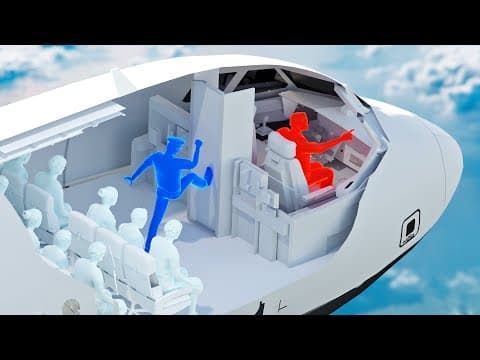
[2:41]After the aircraft leveled off at its cruise altitude, the captain left the cockpit to go to the bathroom at 9:30. While he was in the bathroom, the plane was almost immediately set for a different altitude in the cockpit. At 9:34, the captain came back and requested access, but he got none. The door was locked. As he stood in front of that cockpit door, the captain began to understand. The copilot had hijacked the plane, and he had no way of getting in.
[3:20]After 2001, cockpits were changed in order to protect those flying the plane from potential hijackers. To enter the cockpit, a crew member has to call the cockpit on the intercom and press the pound key on a keypad, which buzzes the cockpit. At that moment, the pilot can switch the door control from norm to unlock, and the crew member can enter. The crew is also given emergency codes, which they can use if there are concerns for those in the cockpit. In that case, the crew member will use the emergency code on the keypad, triggering a 30-second timer, and the cockpit door will open for 5 seconds. However, there are situations where those in the cockpit want to override the access by the crew, like during a hijacking. In that situation, the pilots can switch the door control to lock, overriding all emergency access. And it's that mechanism that the copilot used to permanently lock access to the cockpit while the plane began to descend. The captain was locked out of the cockpit without any control. At 9:39, the cockpit voice recorder picked up violent blows on the cockpit door. The captain had repeatedly tried breaking in to gain access. But the cockpit door was reinforced, made to withstand armed hijackers, the captain stood little chance. In the last minutes, the passengers, crew, and captain all knew that the plane was going down. No one survived the crash. 144 passengers, four cabin crew, and the captain and copilot died. Amongst the passengers was an entire school class, returning from a field trip to Spain. The captain, Patrick Sondheimer, was a 34-year-old father of two. In the aftermath, his wife set up a foundation in his name, intended to help children and young people handle grief and crisis. He had thousands of total flight hours, and his last moments were dedicated to trying to save the plane and passengers.
[5:36]The copilot was 27 years old, and from a young age, he was passionate about flying. His bedroom had posters of Airbus, Boeing, and Lufthansa, and he'd become an expert glider pilot as a child. He joined Lufthansa's Flight Academy straight out of school. But only a few months into the program, he stopped. He was suffering from a deep depressive episode, treated with antidepressants, and spent multiple months in the care of a psychiatrist. Eventually, he received a medical recommendation, declaring that he was in remission. After a few months, his student pilot license and fit to fly medical certificate were restored. But if he needed any more psychiatric treatment, he'd be grounded from flying. But he continued with his training until he ran into a problem. While filling out a document required by the U.S. Federal Aviation Administration to fly at an Arizona-based Lufthansa operated flight school. He said that he had never been diagnosed with any mental disorders. This was a lie, and he got caught. Lying on an FAA application can lead to a jail offense or the end of a flying career. But the FAA gave him a second chance. He admitted to depression and was accepted to go to Arizona. In 2013, he joined Germanwings, a low-budget airline owned by Lufthansa. And a year later, his depression returned. He thought he was going blind, visiting ophthalmologists and neurologists multiple times per week because he was seeing stars, halos, flashes of light, streaks, and flying insects. But the doctor's scans didn't find much. He was diagnosed with hypochondriacal disorder, as well as emergent psychosis from his family doctor. And that doctor urged him to go to a psychiatric clinic. But he do no such thing. Instead, in January of 2015, he returned to the psychiatrist that had helped him in the first place. He received psychotherapy and went on heavy antidepressants while continuing to work and fly. From February to March, he received multiple sick notes for multiple doctors. He wasn't all right, and he wanted something to change. Four days before the crash, he turned to his computer to understand the locking mechanism on the Airbus A320 cockpit door. On his outbound flight from Dusseldorf to Barcelona, he tested the descent settings for a moment, well Sondheimer was outside the cockpit. On the return flight, he used it to bring down the plane. How could this have happened? Pilots are required to do health screenings and annual checkups, but mental health is easier overlooked than physical. Since pilots operate under an honor system, they're expected to self-evaluate their health, and this can be an issue. The copilot was declared unfit to work by his doctor, but he decided to just not tell his employer. But if someone like him is a risk to public safety, a doctor can break doctor-patient confidentiality and report him to authorities. So why didn't at least one of the multiple doctors who wrote multiple sick notes and declared him unfit to fly think that the copilot may have presented a risk for public safety? Enough of a risk that he couldn't be trusted to report himself. We don't know. The doctors may have believed the copilot was a risk to himself, but not to others. Being depressed does not make you a killer. Or maybe the doctors were just scared. Breaking doctor-patient confidentiality does not come without risks. It's even possible cultural factors could have played a role. Privacy and data protection are valued really highly in Germany. But trying to understand why doctor-patient confidentiality wasn't broken is a dilemma and issue best left to healthcare professionals and ethics professors. Unfortunately, we're YouTubers. So we encourage you to read more about it in these articles. Nonetheless, when you're watching this today, it's important to understand that this type of incident is incredibly unlikely. In the aftermath, the European Aviation Safety Agency proposed multiple safety regulations. Psychological screening for pilots increased, and multiple airlines adopted a two person in the cockpit at all time rule, although Lufthansa has recently phased this out. In 2015, Germanwings was rebranded to Eurowings. The decision was made prior to the crash. In the end, Lufthansa compensated the families of the victims, but there are questions about whether it was enough. The families have faced losses that no money could ever heal.
[10:55]Hopefully you enjoyed this video. It was insanely hard to make. We love animation and deep research, but it's expensive. That's why we have sponsors on this channel. By the way, a lot of our animation, in particular, actually has a lot to do with math. Be it geometry or linear algebra for specific shaders or code for scripted and procedural animation, both can be exciting and fascinating, especially if taught in a playful manner. That's where Brilliant comes in. It gives you skills that can be applied to everything, literally, be it basic logic, artificial intelligence, data science, or physics. But it gives it to you in a way that isn't earth-shatteringly boring. To try everything Brilliant has to offer free for a full 30 days, visit brilliant.org/fern or click on the link in the description. The first 200 of you will get 20% off of Brilliant's annual premium subscription. You always have your phone on you, which means Brilliant always gives you access to learn math and science anywhere. Even if it's only for a few minutes each day, you can improve your skills while on a tram, walking, or while your significant other is trying to connect with you. We personally love the app. There is something incredibly satisfying about really getting something, about solving a puzzle or a logic problem. Why don't you give it a try?


