[0:00]FYUGP-(S-III)-Phy(MJ-4) 2023 Full Marks: 60 Time: 3 hours Answer from both the Groups as directed. The figures in the right-hand margin indicate marks. Candidates are required to give their answers in their own words as far as practicable. GROUP A (Compulsory) Choose the correct answer: 1x5 At which temperature, the velocity of a wave is double as that at 27 degree C. (i) 427 degree C (ii) 927 degree C (iii) 627 degree C (iv) 127 degree C b) In Young's double slit experiment, if D gets doubled then beta gets (i) Reduced to half (ii) No change (iii) One fourth of its original value (iv) Doubled c) The fringes obtained in Fabry-Perot interferometer are (i) Fizeau fringes (ii) Haidinger fringes (iii) Straight (iv) Convex d) The radius of the Airy disc is (i) r = lambda F / d (ii) Zero (iii) r = 1.22 lambda f / d (iv) r = 1.22 f / d e) The focal length of a zonal plate is expressed as (i) fn = r square n / n lambda (ii) fn = r square n / n lambda (iii) fn = r square n / lambda (iv) fn = rn / n lambda 2. Differentiate between Fresnel's Biprism and Lloyd's mirror. 3. Describe the production and detection of elliptically polarised light. GROUP B Answer any three questions: a) Write a short notes on Linearity and Superposition principle. 7.5 b) Explain the formation of standing waves on a stretched string by giving necessary theory. 7.5 5. Describe briefly the construction and working of Michelson's interferometer. How it can be used to measure the refractive index of a thin transparent sheet. 7.5 6. a) Using the theory of Fresnel Half Period Zones, show that the light travels in straight line. 7.5 b) How is a zone plate different from a convex lens? 7.5 7. a) Explain the formation of Newton's rings. Derive an expression for nth dark ring. 7.5 b) Newton's rings are formed by reflection of light of wavelength 600 nm. The diameter of the 10th dark ring is 0.4 cm, calculate the radius of curvature of the lens used. 7.5 8. Write short notes on any two of the following: (i) Laurent's half-shade Polarimeter (ii) Double Refraction (iii) Cornu's Spiral
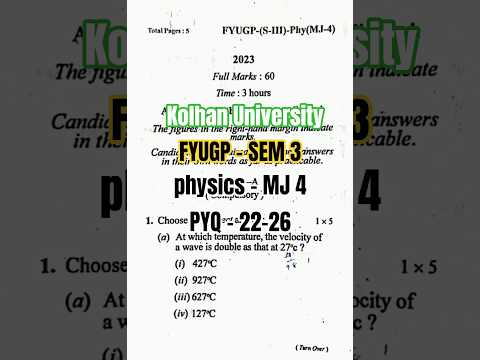
B.SC SEM-3 - Physics Major - 04 || PYQ (2022-2026) || #kolhan_university #physics
Shorts Shiksha academy
23s378 words~2 min read
YouTube auto captions
Transcript source
YouTube auto captions
This transcript was extracted from YouTube's auto-generated caption track. The transcript below is server-rendered so it can be read, searched, cited, and shared without opening the original YouTube player.
Pull quotes
[0:00]FYUGP-(S-III)-Phy(MJ-4) 2023 Full Marks: 60 Time: 3 hours Answer from both the Groups as directed.
[0:00]Candidates are required to give their answers in their own words as far as practicable.
[0:00]GROUP A (Compulsory) Choose the correct answer: 1x5 At which temperature, the velocity of a wave is double as that at 27 degree C.
[0:00]GROUP B Answer any three questions: a) Write a short notes on Linearity and Superposition principle.
Use this transcript
Related transcript hubs
Watch on YouTube
Share
MORE TRANSCRIPTS


