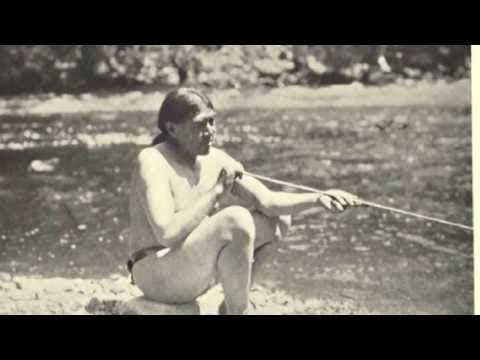
[0:03]In part one of this video series, we focused on the material issue used to make his arrows. In this second video, we'll show you the techniques he used to complete his archery equipment. Ishi's first process in making arrows was that of straightening his shafts. To do this, he either made a small heap of glowing embers from a fire or utilized a hot stone. He applied pressure with his thumbs on the convex side of any irregularities or bends in the shaft, and holding his near the heat, passed the wood back and forth before the stone or coals. When the wood was warm, it gave very readily to pressure, and less than a minute, any curve or crook could be straightened out. Wood, after cooling, always retained its new position. Glancing down the axis of the shaft from time to time, Ishi gauged his straightness. To burn or discolor the wood was evidence of bad technique. Smoothing was accomplished by scraping and rubbing the arrow shaft between two pieces of sandstone.
[1:05]At the smaller end of the shaft, he cut the notch for the bow string with a bit of obsidian, making this knock up to a half an inch deep.
[1:15]Next, the larger end of the shaft was drilled out to accommodate the for shaft. During this drilling process, the lower end of the shaft was tightly bound with sinu or cedar cord to keep it from splitting. His method of drilling was as follows. Placing a sharp piece of bone point up in the ground and steadied it with his toes, he rotated the shaft upon this point. The motion was identical to that employed in making fire by means of drill, the stick being rolled between the palms with a downward pressure. The excavation averaged an inch deep and a quarter of an inch in diameter.
[1:53]When a group of five arrows had been brought to this stage of completion, Ishi painted them. His favorite colors were green and red. At first, he insisted these were the only colors to use, since they had the effect of making an arrow fly straight. But after Saxon Pope began to beat him in marksmanship, he scraped off all the paint and replaced it with a red and blue design. The colors were applied with a little stick or hairs from a fox's tail that were drawn through a quill. When a number of shafts have been painted, issue was ready to feather them. He did this by carefully separating the bristles at the tip of the feathers with his fingers and pulling them apart, splitting the quill its entire length. Once the feathers were split, Ishi would take a piece of obsidian and scrape away the pith until the rib was thin and flat. He would then drop the feathers in a vessel of water. When thoroughly wet and limp, they were ready to use. Having prepared a sufficient number of feathers in this way, he gathered them in groups of three. Next, he chewed up thin strands of sinu, 8 to 10 inches long. Slowly rotating the arrow shaft, he applied one end of the sinu near the knock, securing it by overlapping. One by one, he laid the feathers in position, binding them down with the sinu. The first feather he applied in line perpendicular to the plane of the knock. The other two were equal distance from this. For a space of an inch, he lashed the sinu about the feather and arrow, slowly rotating it all the while. A last smoothing the binding with his thumbnail. The back end of the feathers were now secure and they were set aside to dry. Once dry, he was ready to secure the binding on the front part of the fletching. He did this by wrapping several layers of wet sinu around the tips of each quill, then pulled the feathers down till they were straight and taut. He continued the sinu wrapping for the space of an inch. Occasionally, issue would add a thin layer of glue along the length of each feather to help secure it to the arrow shaft, but this was not his usual custom. After drying, the feathers were cut with a sharp piece of obsidian, using a straight stick as a guide and laying the arrow on a flat piece of wood. During this process, Ishi would leave the natural curve of the feather so that it drooped over the end of the knock. He felt this gave an attractive quality to his arrows and aided in the steering qualities as it flew through the air. With the main shaft now complete, the arrow was ready for either a wooden blunt foreshaft used for target practice or hunting small game, or a foreshaft with an obsidian point used for hunting large game. In this type of point, a groove must be cut into the end of the foreshaft to accommodate the stone point. Ishi glued his points to the foreshaft with pine resin and finished securing them with wrapped sinu. Over time, pure pine resin becomes hard and brittle, and I prefer instead to use a natural glue made of pine pitch, charcoal and fine vegetated material. To make this natural glue, begin by melting some pine pitch, then slowly add the other ingredients. When cool, this glue is extremely strong and hard, but can easily be melted for future use.
[5:08]After the glue is applied, the point was further secured by binding it with chewed sinu. Back and forth around the tangs and around the shaft. Three wraps were made around each knock and the tenon was wound around the arrow for the distance of half an inch directly below the arrow head. After drying, the secured head was very firm and quite smooth. These heads frequently were kept in a little bag of skin and not attached to the arrow till a few hours before the expected hunt. Ishi's quiver was made from the skin of a river otter. Saxon Pope describes his quiver as being fur side out. However, it was later discovered that originally the fur was on the inside. Ishi carried both his arrows and his bow in this quiver, but he thought the best quiver for a bow would be the tail of a mountain lion. For most of his life, Ishi depended on his archery skills for his very survival. Saxon Pope wrote that Ishi loved his bow as he loved nothing else in his possession. Of all the specimens Pope studied at the University Museum, he said that scarcely any show such perfect workmanship as those of Ishi.


