[0:00]Hey friends, this is Stacy with SF Johnson Consulting and Construction Services, here to introduce a new segment of our educational program we call for, fill in the blank, only.
[0:13]And this is for roofing and roofers only. And so what that is is a program where we cover basics, estimating, and then safety related to that trade.
[0:26]And so we always start with the estimating or takeoff portion to introduce the trade, and we, what we have here is a small roof for a scooter's coffee.
[0:36]And this is the scope of work. So the keynotes on the roof, basically, it is a TPO roof, 60 mil over 1/2 inch dense deck over poly-iso insulation per building com check on GO4 over sheathing.
[0:53]And so what we need to do. We need to determine how many square feet of the TPO.
[1:00]We need to check to make sure if we have uh parapet walls, which we do. uh what is the um, how many square feet of of that do we have? Because chances are we're going to have to have the roof finish go over the parapet wall, right?
[1:17]And then we have some parapet caps, so we need to be able to And this is typical for every roof. So it's not really anything, you know, the the square footage of a finished material.
[1:34]Um, the uh cricket sizes, possibly. Um. How many linear feet of flashing for a particular purpose?
[1:47]Uh, anywhere where there's wall and roof meet is usually a a place to put the flashing. So I always give the uh basically the perimeter of the roof.
[2:00]And then any of the uh cricket lengths, right? And what's a cricket? It's just uh additional framing we place over the the main framing to give it a slope, so the water doesn't gather here, right?
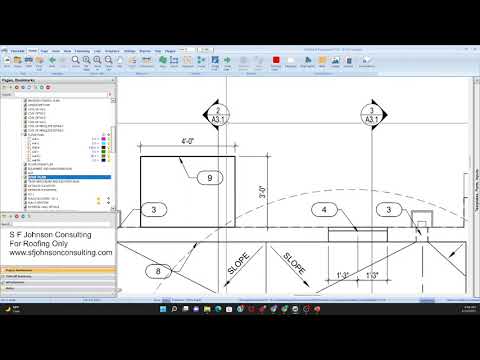
[2:18]So, uh, and the arrows indicate the direction the water's going to flow, right? So we want the water to typically flow uh in this direction towards the valley, right?
[2:32]Kind of kind of early. All right. And so we want the water to flow towards the valley, and it's usually some uh roof drains or you know, gutters, downspouts, and I'm sure number three, that's what that is. Let's see.
[2:49]Yep, a roof scupper. So, what do we have to do? How many square feet in total?
[3:00]Uh, we have to measure how many linear feet the perimeter, cuz chances are the parapet wall is uh the length of the parapet wall goes the perimeter of the building.
[3:08]We're going to look at the section views. That's a building section view. So we can see uh the thickness of the insulation and every all the other details, right?
[3:20]Because from the plan view, we can only determine how many square feet of the finish, plus we can determine how many linear feet. And so, for the roofer, square feet of the finish.
[3:31]Always uh determine how many square feet of opening we have, and this is an opening for a rooftop unit or condensing unit or something like that.
[3:41]Then we want to know uh, how many square feet, you know, we just it's a circle, you know, so we just square it out.
[3:49]Because we do want to be able to give to the roofer how many square feet of opening, because they're going to deduct that if you know, if they want to. I don't know, it's just waste, right?
[3:59]Deduct that from the total area of the roof. So, area of the roof, perimeter of the roof, because we're going to have to look at a section view.
[4:12]To determine the parapet height. So let's go here. So, we have four different building section views.
[4:22]So what this is for the now this building section view is good for a bunch of people, in such a small building. So, it's good for the framers. We need to know the full height of those.
[4:35]Uh God, I can't even think. The full height of the shear walls, shear wall height usually goes the full height of the building. So now I know that the shear walls are going to be this height.
[4:51]So I can use this for that or and two, I can use it for the thickness of the insulation. A lot of good things from this view.
[5:36]But because we are the roofer, we have to make sure we go to the next view. Why? Because this is a a callout, right? A detail callout.
[5:46]Meaning, it's telling us, it's going to call out just this portion of the building. And because we're the roofer and our roof is shown right here.
[6:00]So, we know that our parapet wall, it looks like it's a different height, right?
[6:05]Based on the side of the building. So, we have to go back to the roof plan and the 1 over 3.1 would be the height for these walls because that section view goes through both walls. So, that indicates that both of these walls are based on
[6:33]that height. Now once we get here, it's going to change. We're going to look at 4 over 3.1. So, if that parapet wall happens to be a different height.
[6:44]It's going to be at this point forward. We're going to calculate the different height. But for this whole section till we get here, it's going to be whatever height is shown. And then these also have a different.
[6:59]Then we'll look at 2 over a 3.1 for the height of these parapet walls, cuz again, we can see that the parapet walls are a different height. Okay? So that's how we get that.
[7:14]So we go to, cuz I want to go to more of the detail view. So, I'm going to go to 4 over A3.3. Still gives me another detail callout.
[7:30]So, I got to follow every one of them because I'm the roofer, and I have to make sure I followed every detail callout until there's no more. So, this is the final of the views, the final of the detail views.
[7:39]And so, as the roofer now, I know that I need to do all of this for my parapet cap. And I know that even though a rough carpenter is going to come to this view too.
[8:37]Or have it, yeah, because they need to do all of this. And then, you know, if you're doing the siding, then yeah, you're going to come here too, it's going to lead you here too. So, all of the views are based on whatever you do.
[8:53]You know, if I'm the flooring professional, right? I'm not looking at these views because it's not my scope of work. But if I'm the rough carpenter, the siding professional, the roofer, all of these uh, it's my scope of work.
[9:10]Okay? So, I have to go to every every view. And so now I know that in terms of cuz I'm looking at the plan, right, for my takeoff.
[9:20]And so, I know that even for the rough carpenter, I know I have two of these top plates. So, two times the perimeter of the roof if I'm doing my takeoff for that.
[9:33]I know I have the sealant. Continuous caulking. So, I know how many linear feet of caulk I have. So, I know from the container, how many linear feet of caulking, 8 oz, 16 oz, 32, whatever, a bucket, whatever.
[9:51]So, that way I can do a proper takeoff to do a proper material determination, material cost determination, right?
[9:59]Rain screen, high performance weather barrier. You don't want to miss out on any of that because if you do, chances are it's going to leak and you're going to have a construction defect.
[10:11]And if whatever trade was your trade, you'll be responsible for all the other trades that got damaged because you failed to do your portion. That's what I did for a living, construction defect litigation adjuster.
[10:25]That's why you get that insurance. So, just in case you don't show them, you don't know how to read set of plans, you don't get to the detail call out number six, or whatever, and you forget to put something in your construction and you blow it, and it leaks.
[10:35]And somebody gets sued because now the whole building is leaking, right? Yes. No. So, you want to make sure you know how to read your plans. Okay? Come to the construction queen. I think this is the only time I ever referred. I was like, what were you thinking when you came up with that name? Oh, probably a shot of tequila.
[11:03]See? I'm perfect for this job. Anyway, roof plan. Okay, so here are our uh wall curb attachments.
[11:13]So, whatever this is, you got to make sure you account for it. It shows you how you they want it up the wall, right? Cuz what's the purpose of the roofer? To make sure no moisture gets in the building. Okay?
[11:30]So, that's why we have the TPO roof on the roof and over the parapet and it with a parapet cap with the caulking, so water doesn't intrude into the building. Okay?
[11:46]And so, so what do we do as the roofer? Square feet of the flat roof. Now we know we have to break up the section view, right?
[11:55]Cuz at some points this parapet wall is 3 ft, some points it's 5 ft. So, we have to do 5 ft times, however many linear feet. So we're accurately determining the additional TPO for the parapet wall, right?
[12:11]And now we have to measure how many linear feet for the parapet cap, and whatever else goes with our scope of work. And we have to make sure we're doing whatever this tells us for the openings.
[12:25]Whatever this tells us number eight. Whatever this tells us number five, six. Vent, that's easy. So, we got a flash and it's going to show us that 5A. Let's go to 5 over A3.6.
[12:47]5. I never pan in the first time, right? Okay, so here's the vent pipe. Or cuz what's the point? We don't want moisture coming into the building.
[13:03]So, we have the vent pipe, that's the plumber. And now we have to do all of this, where the roofer. Okay? And so you need to know how to do it and how to account for it.
[13:18]And so it's a vent pipe, you know, so it's a circle. You could treat it like a square. That's fine when you do an actual takeoff numbers for, okay, how many linear feet of TPO to what point? And it tells you, I think.
[13:32]Stainless steel clamping ring. Uh, sealant, see what what's the point? So, no water gets down in there. So, you have to be able to follow every section view, detail view. So, you're doing the right thing.
[13:50]Okay? Roof deck, rigid insulation. And if this is to scale, which it is, then you can just measure how many, what's the thickness of the insulation. That's the whole point of having something to scale.
[14:02]If you don't know, so like 4 ft, 4 in, 6 in, whatever. What is this? This is different from that. So you got to make sure what that is. Okay, so it's fun. It's a lot of fun. All right, so, roofer, you are going to make sure you know how many square feet flat.
[14:25]How many additional square feet for your parapet wall, the parapet cap, all the goodies that go with that. And know the heights. That's why they give you the section views. Cuz the section view marker is if what? This is we cut down in two and now we're opening up and we're standing in here and we're looking at the interior construction.
[14:47]So, you can have a better view. And then that view will take you to a detail view most likely. Okay? And take you to all of these other places, so you'll know how the vent pipes come and are flashed, and how the, let's see what seven is. We didn't look at seven. Air conditioner, see mechanical drawings. Okay.
[15:09]All right? So if you have any questions on anything that we presented, please email me at education at SFjohnsonconsulting.com. So, in addition to this, we'll have stuff like safety for the roofer.
[15:20]Uh what the project manager needs to uh know from a roofer from that kind of perspective. So, join us every day. We have something good for you, and if you like the video, please let me know. And again, email me at education at SFjohnsonconsulting.com and I will see you next time.


