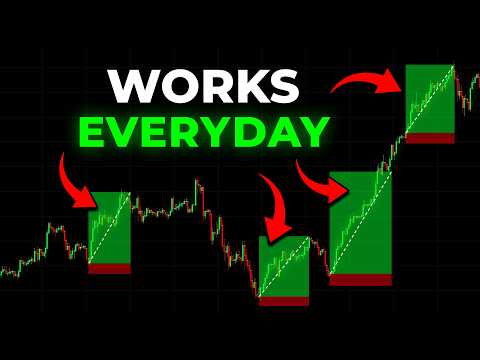
[0:00]In this video, I'll reveal a simple yet effective scalping strategy that works every single day. The strategy doesn't rely on any indicators or long preparations. It's completely rule-based and all you need to do is follow a simple three-step checklist before entering a trade. Now, to prove that this strategy is consistently profitable, I'll also show you some real trade examples on popular markets like crypto, Forex, and gold. What's great about this strategy is even though it's profitable on its own, you can still combine it with other systems like price action, trends, or even your current strategy to instantly boost its performance. That's why adding this to your toolbox could be a huge game-changer for your trading. So, what is the strategy? For this strategy, the only thing you need is one candle. Now, you might be wondering, how is one candle enough to build a profitable system? Well, we're not just using any candle. We're using what's called the 4-hour range, which is simply the range between the high and low of the first 4-hour candle that forms during the day. So, the way this system works is when we're scalping on a lower time frame, like the 5-minute chart, we can actually use that 4-hour candle's range to find potential entry points throughout the day. To execute this strategy, all it takes is a simple three-step checklist, which we're going to go through all of that in this video. So, step one. The first thing you want to do is mark the high and low of the first 4-hour candle that forms during the day. Here's how to do that on TradingView. First, choose any chart depending on the asset you're trading. For this example, I'm using the Bitcoin chart. Then, make sure the time frame is set to 4 hours, which means each candle represents 4 hours of price movement. Next, go to the time zone setting on the bottom right corner of the chart and select New York time. Now, this step is very important because we want the first 4-hour candle to be based specifically on the New York time. Next, hover to the first 4-hour candle that formed on today's date. In this example, since it's June 23rd, the first 4-hour candle that formed today is this one. Then, simply draw a line at the high and low of that candle and extend both lines to the end of the day. That's your 4-hour range on this chart. Now, an important thing to remember is make sure that the first 4-hour candle has fully closed before marking the range. If the candle is still forming, wait for it to fully close first. So, once the 4-hour range is identified, we move on to step two, which is the scalping setup. But before that, I want to quickly mention that every single day, I share daily market analysis and trade setups inside my free Telegram community. For example, I once shared a setup on a coin called SUI, and just one week later, it was up 22%. So if you want to learn how a professional trader analyses the market daily, make sure to join my free Telegram community. The link is in the description. Now, back to step two. So, after the 4-hour range is identified, we go down to the 5-minute time frame to look for scalp setups. So, the setup we're looking for is when the 5-minute candle closes outside of the range, either the range high or range low. But again, the key here is the candle must fully close outside, so wicks alone don't count.
[3:04]After the breakout, we then wait for price to re-enter and close back inside the range again. But make sure that all of this happens within the same day as the 4-hour range we marked.
[3:17]Once that sequence plays out, we move to step three, which is our entry. In this example, since price broke the range high, that's a signal to go short. For the stop loss, we place it at the exact high of the breakout move, and for the take profit, aim for at least two times the stop loss size. And here, price came down and hits the profit target. Now let's look at another example. Here, we're on the Bitcoin chart on the 5-minute time frame, and right here, we've already got the 4-hour range marked out. So that's step one done. We can now move to step two, look for the trade setup. In this example, we can see that price came down and broke below the range low. However, the candle didn't actually close below it, only the wick. That means the setup still isn't valid. But shortly after, we see another breakout, but this time, the candle does close below the range low. So that's the confirmation we needed. Now, we wait for price to re-enter and close back inside the range again. And right here, the candle closes back inside. So that completes step two. Now, we move to step three, which is our entry. Since price broke the range low and then re-entered, this is a signal to go long. For the stop loss, we place it at the exact low of the breakout move, and for the take profit, we set it at two times the size of our stop loss. As you can see here, price moves up and hits the take profit target. Now, keep in mind, as long as we're still within the same trading day as the 4-hour range we marked, we can still take more trades if another valid setup shows up. So, as we let the chart play out, we can see that price is trading well outside of our 4-hour range. However, it didn't manage to re-enter again until the end of the day. That means for this trading day, there were no more valid entries to take. But even with getting just one trade today, it was a high-quality setup and we walked away with solid profits. Now that you understand how the overall strategy works, let's take a look at some real trade examples across different markets so you can see just how well this strategy performs. So, let's start with crypto. Here, I'm on the Bitcoin 5-minute chart, and I already have the 4-hour range marked. Right here, we can see price broke out and closed below the range low, then it quickly closed back above. That gave us a long entry. Stop loss goes at the low of the breakout, and take profit set at two times risk. And as you can see, price hits the profit target, giving us a two-R profit. After that, price went out of the range again but didn't close back inside, which means there were no more setups for today. Now, for the next day, I marked the high and low of the 4-hour range. Here, the 5-minute candle broke above the range high, then closed back inside, so this will be a short signal. Stop loss goes at the range high and take profit at two times risk. And here, price hits the take profit target, giving us a two-R gain. Next, price dropped and broke below the range low. After that, it re-entered inside the range. So this will be a long setup. Stop loss goes at the range low, take profit at two times risk. And once again, price hits the target, giving us another two-R profit. On the same day, price gave us another setup. It closed above the range high, but then closed back inside. That signaled a valid short entry. Stop loss goes at the range high, take profit at two times risk. And here, price also hits the profit target, giving us another two-R profit. Later in the same day, price made a huge dip, but then re-entered inside the range. So this actually gives us a long entry setup. But here's the thing with this setup. The breakout was quite huge, which means if we were to place a stop loss at the low, it would be a very large stop loss. So for these types of scenarios, instead of using the exact low of the range, I looked for the nearest key level to place the stop loss. In this case, there was a small resistance level, so we set the stop loss there instead. For the take profit, set it at two times risk. Here, price hits the target perfectly, another two-R profit secured.
[7:27]So that concludes the setups for today. Now, let's see the final results. Here, you can see all the trades we backtested. Out of seven trades we took, the strategy gave us five wins and two losses with a total gain of eight R.
[8:33]That's about a 72% win rate on the crypto market, which is extremely impressive considering we only used the very basic version of the strategy. Now, of course, if we want to get a more accurate performance, we would need to backtest using way more than just seven trades. So I definitely recommend you test it yourself on a larger sample, but the point of this is just to show that even with using just the basic version of the system, it can achieve profitability in real trading scenarios. Now, before we continue, if you're looking for the best trading platform, I really recommend using BloFin. They're one of the top crypto exchanges out there and right now, they're giving an exclusive reward just for my viewers. Anyone who signs up using my link, you can claim up to $3,000 in futures bonuses simply for trading on their platform. So don't miss out, start trading on BloFin using my link and grab those rewards. Now, back to the video. So, let's see how the strategy performs on the Forex market. Here, I'm on the EUR/USD 4-hour chart. To apply the 4-hour range in Forex, it's the exact same process. Go to the time zone setting at the bottom right of the chart and select New York time. Then, find the first 4-hour candle that formed on the current date. Since it's August 4th, the first 4-hour candle that formed is this one. Simply draw a line at the high and low of that candle and extend both lines to the end of the day. So, this is your 4-hour range. Next, go down to the 5-minute time frame to look for the setups. Here, price closed above the range high and then back inside, so that is a short setup. Stop loss placed at the highs, take profit at two times risk. This trade hits the stop loss, so that's a one-R loss. Shortly after, price re-entered again, giving another short setup. Stop loss at the highs, take profit at two times risk. This time, price hit the take profit target for a two-R gain. On the same day, price gave another short setup. Stop loss at the highs, take profit at two times risk. Price then hits the profit target, giving us a two-R gain. But then, price gave yet another short entry. Stop loss at the highs, take profit at two times risk. This one ends up in the profits, giving us another two-R gain. And that's the end of today's range. Moving on to the next day. Here, we marked the 4-hour range. Then, price quickly gave a long setup. Stop loss is set at the lows, take profit at two times risk. Price hits the target, so that's a two-R gain. Later, price gave another long setup. Stop loss is set at the lows, take profit at two times risk. And price hits the target again, another two-R gain. After that, price broke above the range and didn't re-enter until the end of the range. So, there were no setups taken. On the next day, we have the 4-hour range marked. Price then broke above the range high and stayed there without re-entering, which means there were no setups taken for today. So, let's see the final results. Out of six trades we took on EUR/USD, the strategy gave us five wins and only one loss with a total gain of nine R. That's about an 83% win rate on the Forex market, which is a very solid result. Now, let's look at how the strategy performs on the gold market. Here, I'm on the XAU 5-minute chart and we already have the 4-hour range marked for today. Price broke below the range low. After it traded below for a while, it then closed back inside, which means technically, this is a valid long setup. Now, since the breakout was too large, we couldn't place the stop loss at the lows. Instead, we can use the nearest key level. In this case, there was an order block here, which we can use to set our stop loss. We then set a take profit at two times risk. Price then hits the profit target, giving a two-R gain. Shortly after, price broke above the range high but closed back inside. So this is a short entry. Stop loss at the highs, take profit at two times risk. Here, price hits the stop loss, so that's a one-R loss. Then, price traded above the range for a while before closing back inside, giving us a short setup. Now, since the breakout was too large, we instead used a nearby resistance for the stop loss, and the take profit is set at two times risk. And this time, price hits the target, securing a two-R gain. Moving on to the next day, we had the 4-hour range marked. Price broke below the range low, then re-entered, which gave a long setup. Stop loss is set at the lows, take profit at two times risk. And price hits the target, so that's a two-R gain. Shortly after, price re-entered the range high, giving us a short setup. Stop loss at the highs, take profit at two times risk. Price hits the take profit once again, another two-R gain. Then price closed slightly above the range high and then closed back inside, another short setup. Stop loss at the highs, take profit at two times risk. This time, price hit the stop loss, so that's a one-R loss.
[13:46]Now, moving on to the next day. Price broke above the range high and re-entered, giving a short entry. Stop loss at the highs, take profit at two times risk. Price hit the stop loss, a one-R loss. Shortly after, price gave another short setup. Stop loss at the highs, take profit at two times risk. Price hit the stop loss again, so that's another one-R loss. But then, price re-entered the range once more, so that's another short entry. We place a stop loss at the highs and take profit at two times risk. This time, price hit the target, giving us a two-R gain. So that's the end of this range. Now, let's see the final results. Out of 10 trades we took on gold, the strategy gave us six wins and four losses with a total gain of eight R. That equals to a 60% win rate, which again, are very solid returns. So, those are proof that the simple 4-hour range strategy works extremely well, even when traded on different markets. And remember, this was the most basic version of the strategy. We didn't even combine it with other concepts yet. But even then, we still got very solid returns. So this is definitely a strategy you can try out for yourself. Now, if you like the way I break down concepts like these and want to see how I analyze the markets in real time, I suggest you join my free Telegram community. Link is in the description below. Inside, I share my market outlooks and trade setups every single day with my subscribers. So, thanks for watching, and I'll see you in the next video.


