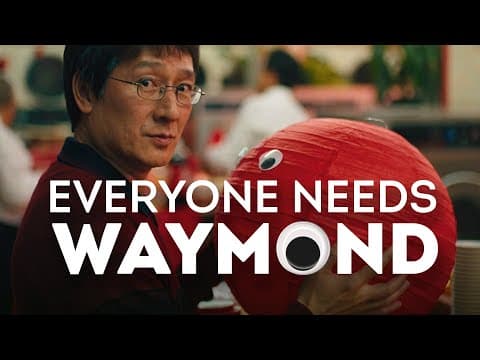
[0:14]I walked into a movie theater to see Everything Everywhere All at Once, expecting to see a genre-bending multiverse movie infused with interlocking layers of philosophical and cultural meaning. And I was not disappointed. What I was not expecting, however, was to witness one of the most challenging and subversive representations of masculinity that I have ever seen in any genre. In order to explain what I mean, we'll need to shift the focus away from the film's protagonist, played by the incredible Michelle Yeoh, and over to the character of her husband, played by actor Ke Huy Quan. Key became famous as a child actor in the 1980s for his roles as Short Round in the Temple of Doom and Data in The Goonies. Despite that early success, he couldn't find many opportunities for a young Asian-American actor in Hollywood. So, he eventually quit acting altogether. In his triumphant return to the big screen after nearly two decades, he has brought to life a truly extraordinary example of empathetic manhood. If you were to only watch the first half of Everything Everywhere All at Once, the idea that Waymond Wong could be an avatar for positive masculinity would seem a little strange.
[1:42]When we first meet Waymond in his original incarnation, he appears to be sweet, almost childlike, but ultimately naive.
[1:56]A goofy, silly, bumbling father whose marriage is in the process of failing. He's timid, conflict-averse, and perfectly content to let his wife run their business. These traits are often associated with a range of familiar subordinate male archetypes in Hollywood media. In interviews, directing duo Daniel Kwan and Daniel Scheiner, referred to collectively as Daniels, have said they wanted to turn a beta male character into a hero.
[2:42]That, in and of itself, isn't unusual. Most movie heroes begin their journey as someone decidedly unsup who then grows in power over time. Waymond is different. What's remarkable here is that the filmmakers managed to turn him into a hero without giving him his own character arc.
[3:10]He doesn't gain any new powers, or skills, or learn to fight.
[3:19]All of the other characters evolve in transformative ways over the course of the film, as you'd expect. But Waymond doesn't change. He is essentially the same character at the end of the movie that he was at the very beginning. On a fundamental storytelling level, that shouldn't work. Incredibly, the Daniels managed to make Waymond and his empathetic worldview the anchor point around which everything else in the movie ultimately bends. Before we explore how they pulled off that impressive narrative trick, it's important to note that the entire concept of alpha and beta males, as it relates to human men, is pure pseudo-science nonsense.
[4:08]The very idea that animal behavior can be neatly mapped onto the complexities of human society is absurd.
[4:20]Still, the erroneous myth of alpha and beta men persists and is perpetuated in popular culture.
[4:37]So let's talk very briefly about how terms like beta male are typically used because I think that's what the Daniels are attempting to subvert in the character of Waymond. In fiction, we expect this kind of character to be a pushover, a doormat, a man who lets other more dominant men walk all over him.
[5:09]If there's a wife involved, the guy usually falls into the old henpecked husband trope.
[5:21]Wherein a long-suffering man submits to the demands of a controlling, overbearing wife. This subordinate put upon man is often a comedic figure, and he's been around for as long as Hollywood itself.
[5:41]When men like Waymond are presented as too nice, too vulnerable, or too accommodating, it's framed as a significant obstacle to him being taken seriously as a real man. This media pattern has been especially common in stereotypical depictions of meek, often desexualized Asian men. Male characters who refuse to fight, or refuse to fight back, are nearly always mocked as weak, effeminate, or cowardly.
[6:27]Of course, subordinate male characters only exist in relation to the equally fictional myth of the alpha male.
[6:39]In Everything Everywhere All at Once, our original Waymond is juxtaposed with another version of himself from another universe.
[7:00]Alpha Waymond is shown to be assertive, domineering, and aggressive.
[7:10]Initially, the audience is just as enamored with this new Waymond as Evelyn appears to be. It turns out, however, that Alpha Waymond isn't exactly all he's cracked up to be. He's controlling, impatient, quick to violence, and distrustful of others. He builds Evelyn up, tells her she's the most important person in the whole multiverse, then abandons her the moment she doesn't live up to his expectations.
[8:14]If Everything Everywhere All at Once were a normal movie with normal character arcs, our original Waymond would essentially turn into Alpha Waymond by the end of the story. He'd learn to temper his sensitivity with an unhealthy dose of aggression, thus transforming from the sweet naive guy who wouldn't even kill a bug to the domineering dude who takes out a room full of security guards to protect his wife. He might even be given a cathartic, finally grew a spine moment, where he loudly demands a divorce.
[8:57]This type of hyper masculine transformation is a super trope in storytelling.
[9:05]This is how pop culture reinforces the myth that the correct way to be a man is to be aggressive, intimidating, and most importantly, to dominate others. It's not an exaggeration to say that that kind of power fantasy underpins the origin story of most male heroes in media. But Everything Everywhere All at Once is anything but a typical movie. As the story progresses, the audience experiences an epiphany.
[9:41]We realize our initial impression of Waymond was completely wrong.
[9:49]We share this revelation with Evelyn as she suddenly sees her silly husband in a new light. Waymond isn't actually passive or submissive. He's been quietly proactive throughout the movie, constantly striving to smooth things over with the tax auditor in order to save their laundromat.
[10:17]He's not getting what he wants out of his marriage, so he's taking steps to change it. The divorce was his idea, after all, part of his desperate plan to salvage their relationship. And he does all this while also expressing vulnerability and attempting to balance his needs with the feelings of others. In short, he knows what he wants and he never stops trying to get it. He just doesn't do it in a domineering way.
[11:00]Waymond's worldview is articulated in this powerful speech about two-thirds of the way through the film.
[11:11]His words echo those of Somni 451 from Cloud Atlas.
[11:34]If you heard it in the real world, Waymond's plea to be kind could come across as a little cliche or at best, unrealistic. So I think it's useful to break down exactly what he means when he says, be kind. For him, kindness is not putting on blinders, ignoring the negative, or being fake nice.
[12:20]And the movie presents all of those traits as useful, pragmatic skills. This brings us to Business Waymond, a version of the character from a divergent timeline where he and Evelyn never got married. This Waymond defends Original Waymond's perspective, without of course knowing that's what he's doing since he's unaware of the multiverse. He's speaking directly to us as the audience as much as he's speaking to Evelyn when he admonishes us for our previous assumptions about him.
[13:08]In reality, he's not naive. He understands the oppressive nature of the world, but chooses to fight back in his own way.
[13:19]With empathy, joy, and hope.
[13:28]It's interesting to note here that although Business Waymond should be considered the pinnacle of success, we don't envy him.
[13:44]Instead, we pity him for what he never had, laundry and taxes with Evelyn as his wife in a distant universe. Waymond is the anti-cynic, the antidote to nihilism, and his worldview is represented in the film through the visual motif of googly eyes. When Evelyn finally adopts his perspective, she affixes a third googly eye to her forehead. This marks the moment where the Daniels flipped the action movie genre on its head.
[14:21]Waymond's worldview runs counter to the underlying message in almost all action movies. The reductive notion that violence can solve all conflicts, regardless of the circumstances.
[14:39]Waymond understands that the way to ultimately win against a stronger oppressive force is to create a situation where the foot soldiers of the powerful refuse to keep fighting you.
[14:56]As noted eloquently in the book The Dawn of Everything by David Graeber and David Wengrow, "Revolutions are rarely won in open combat. When revolutionaries win, it's usually because the bulk of those sent to crush them refuse to shoot or just go home."
[15:16]And this is precisely what happens in Everything Everywhere All at Once. Evelyn uses her newfound multiversal power to learn why each of her opponents is hurting inside and then she gives them what's missing, after which one by one, they all lose interest in trying to fight her. Violence doesn't solve this conflict. It can't, because the enemy is a cynical, nihilistic bagel, devouring love and meaning and everything else.
[15:53]Empathy is what solves it, as it must. Notice that even though he's pivotal to the film's resolution, Waymond's masculinity doesn't require him to become an action guy. He doesn't need to take center stage or fix the problem himself. Waymond is content to inspire his wife and then stand back and support her while she wins the day. It's particularly important that this depiction of transcendent masculinity is embodied by an Asian man. As Chris Karnati pointed out in his Slate article about Waymond's character, "It's a rare depiction of an Asian male lead that not only rejects and deconstructs Hollywood's stereotypes of them, but also serves as a necessary evolution for Asian representation in cinema." At the beginning of this video, I said that Waymond doesn't have a character arc. Well, it turns out that by the time the credits roll, it's us as the audience who've been given the character arc. Over the course of the film, our perspective has shifted so dramatically that we've come to understand Waymond and more importantly, to embrace his revolutionary worldview. This shift in perspective also reframes the social expectations that Hollywood so often places on masculinity. Like kindness, empathy can occasionally feel naive or ethereal. Just a pretty empty word with little to reinforce it, especially in difficult times like ours. I'd argue though, that what Waymond advocates is actionable empathy.
[17:55]Thanks for watching.


