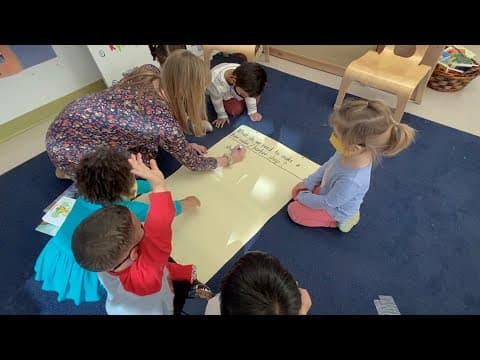
[0:02]Oh, this real stop sign? Oh, that's going to give you a clue of how to write the the the. We could put the the the stop sign on the bus. We let's put let's make a stop sign for the bus. Emergent curriculum is often born from the questions, interests, passions of young children. The curriculum responds and changes depending on the interests of the children. We have about 48 learning objectives that we address throughout the school year. If I think about building a house, I look at those learning objectives, that might be my foundation, my two by fours, the frame of the house. But the children decide on the content. What do you need?
[0:49]The children decide on what color we're going to paint the house. What furniture we put inside of it, that's driven by the children. There is shampoo. Our dramatic play area changes quite often. It has been a pancake and waffle restaurant, it's been a veterinary clinic, it's been a doctor's office. It becomes whatever the children are interested in, and we tend to work on it and develop it together over time. So about a month ago, the children started noticing some similarities and differences in their hair. The texture of their hair, the color of their hair, the length of their hair. So I read stories such as Hair Love, and even Monsters Need Haircuts. The next step was to find a virtual field trip to a hair salon, and I was able to stop it as we were watching it and talk about the different things that you would see in a hair salon. You know, the shampoo stations, the materials that you'd see, the workers, the different jobs they would do in a hair salon or a barber shop. At my bath tub. If I were to just buy some stuff and set it up, it wouldn't have the same meaning to the children. It also wouldn't build that sense of anticipation. If it takes time over weeks for us to gather materials, make plans, make decisions, by time it finally opens, they are so excited to get in there and play. It gives children the opportunity to contribute. Maybe our four and a half year olds who are starting to do some emergent writing, they make signs. Having young children invested in the planning helps them to stay engaged with the learning.
[2:47]We added yarn over our sensory table so the children could practice fine motor skills. That's one of the objectives for development and learning in our curriculum. They could practice with scissors, they had to open and close barrettes, wrap elastic bands. Are you waiting for an appointment at our barber shop and our hair salon? The children are now very happily playing, taking on the different roles of being a customer, being a stylist, being a barber. Learning to share the materials and take turns with the different roles. Dramatic play is very, very important for children. It brings up so many different situations where we can stop, we can talk, we can problem solve and we can work through situations.
[3:43]Do you want to come and sit down and someone will take care of you? Because we change our dramatic play area based on the interest of the children, they are much more invested in playing there.


