[0:00]Professor Dave again, let's practice simplifying expressions.
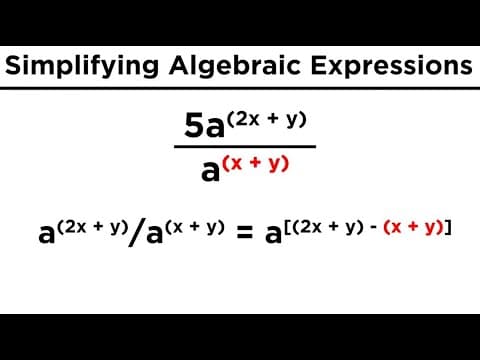
[0:10]We just learned what roots and radical expressions are, as well as the basic rules for how to manipulate them. So now it's time to practice simplifying expressions containing radicals and exponents. Let's go through a few examples and highlight the strategies we must use in each case. First, let's try something simple: 6x^3y quantity squared. When we say the word quantity this way, it's to distinguish between a whole term or set of terms undergoing an operation, rather than just the last thing we mentioned. If I had simply said 6x^3y squared, this is what that language would imply, with the squared applying only to the y. But by inserting the word quantity, we can communicate the presence of these parentheses, and the fact that all of this is being raised to this exponent. The first thing we must understand about exponents that operate on parenthetical terms is that while they do not distribute across sums or differences, they do distribute across products and quotients. In other words, (a + b)^2 is not equal to a^2 + b^2. For example, 5^2 is 25, but if we change 5 to 3 + 2 and try to distribute the exponent, 3^2 + 2^2 is 9 + 4 or 13. So we clearly weren't allowed to do what we did. To evaluate the square of a sum, we need another technique that we will learn later. But (a * b)^2 is indeed equal to a^2 * b^2. This is easy to prove, because (ab)^2 is ab * ab, and since multiplication is associative, we can shuffle these around to get aabb, or a^2b^2. So we can look at this term and rewrite it as 6^2 * (x^3)^2 * y^2. Now we continue to simplify: 6^2 is 6 * 6 or 36. For (x^3)^2, let's remember that (x^a)^b is equal to x^(a * b), meaning that we multiply the two exponents together. That means x^(3 * 2), which equals 6, or x^6, and y^2 stays as it is. So we are left with 36x^6y^2. Let's try a trickier one. We have 4x^3y times this fraction in parentheses: (3xy^2)/(2x^3), all of which is squared. The first thing we want to do is distribute this exponent over everything in the fraction. If the whole term is squared, then each individual term can be squared. 3xy^2 becomes 9x^2y^4, and 2x^3 becomes 4x^6. Now we can combine like terms for this term on the left and the numerator of this fraction. Remember that when multiplying a fraction by a number, the number only multiplies the numerator, and this is no different. 4 * 9 is 36, x^3 * x^2 is x^5, and y * y^4 is y^5. Now we can simplify a bit further, since 36 divided by 4 is 9, and x^5 divided by x^6 is x^-1, since 5 - 6 is -1. This is the same as leaving x in the denominator because x^-1 is the same as 1/x. So we are left with 9y^5/x. How about this one: (x^6)/64 all raised to the -2/3 power. There are a few ways to approach this, but let's first address the fact that the exponent is negative. If this were a single term, we could put 1 over the term and then make the exponent positive, the way we said that x^-1 is 1/x. But since we already have a fraction, let's just flip it over. If we turn this upside down, we can change the exponent to positive 2/3. Now, as we recall, raising something to the 2/3 power is the same as squaring it and taking the cube root in some order. Since it's easier to work with small numbers, let's take the cube root first, making sure to do it for both top and bottom. The cube root of 64 is 4. The cube root of x^6, which is like x^(6 to the 1/3), is equal to x^(6 * 1/3), which is 2. So we get x^2. That takes care of the denominator of the exponent, so now we just square the top and bottom. That leaves us with 16/x^4, which can't be simplified further. Let's try another: 10a^(2x + y) / 2a^(x + y). Here we can see that 10 over 2 can be done separately, which gives us 5. Now to deal with this part of it, again we can just use the rule for dividing some base raised to two different exponents. We just subtract them. So a^(2x + y) / a^(x + y) gives us a^[(2x + y) - (x + y)]. This only works because a is the base in both terms. If the bases were different, we couldn't do this. Then remember that we have to subtract the entire exponent in the denominator, so we need parentheses to do this. The negative sign will then distribute, leaving us with a^(2x + y - x - y). Combining like terms, y - y goes away and 2x - x leaves us with simply x, so the final answer is 5a^x. How about this one: 3x^2 root(32y^2) - 4y root(18x^4). First with the roots, we can't take out 32. But if we make it 16 * 2, we can take out a 4 and a y. We can combine like terms to get 12x^2y root(2). Again with the other term, 18 doesn't work, but 9 * 2 means we can take out a 3 and an x^2, and combining like terms gives us 12x^2y root(2). These terms are the same, and anything minus itself is 0, so this whole expression actually simplifies to 0. I think by this point, we get the picture. Even when expressions seem very complicated, we just go one step at a time, simplifying according to the rules we know for manipulating roots and exponents. Now try a few on your own to check comprehension.
[7:51]Thanks for watching guys, subscribe to my channel for more tutorials. Support me on Patreon so I can keep making content, and as always, feel free to email me: ProfessorDaveExplains@gmail.com.


