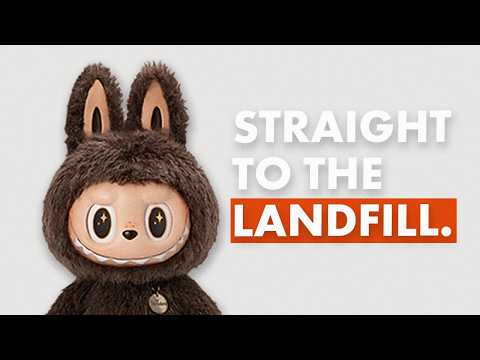
[0:00]Labubu was very possibly the most viral consumer product of the year. These cute stuffies with a vaguely threatening expression absolutely exploded onto the news feeds and into the online carts of consumers last summer. Celebrity sightings, insane market growth, billions of dollars getting thrown around all within the span of months. But here we are, just a season later and the craze is over. The stock is down, the billionaires are now losing billions, and the tech dads have jumped on board the trend, which really is the sign of the end times. People are already moving on. We're predicting the new toys that are going to replace it. But now, I want to know, really, where does this go? Because the Labubu story is different from the other consumer trends that we've seen recently. Is this going to be a forgotten chapter in our consumer history, or the beginning of a brand new Labubu legacy? Thank you to Ground News for sponsoring today's video. So, when we first covered the Labubu thing, around the peak of its hype, we weren't even entirely sure that it was going to be the big thing that it was, because when you're watching these things blow up, you're blinded by the hype and the chaos of the moment. But now that we've seen it all play out, we can break it down and show you exactly how this was by design and what might come next, because it's it's pretty interesting. This was blindbox mechanics at their peak. Scarcity, marketing manipulation at its finest, and an absolute lesson in how to go viral on the internet. And if you've watched this channel for even a little bit, you're starting to recognize some of these patterns, because the Labubu pump and dump fever dream represents a new normal. This is now just the marketing standard that we see companies and brands across the board trying to employ, and you're going to be seeing a lot more of this kind of stuff in the future. Now, there is a CNN article that I found that I think summarizes this pretty well. They have five graphs to show the Labubu craze, and uh, and and it's right here, so let's take a look at it. The first one shows their revenue since 2017, with the 7X jump in the last five years before their peak. That's exponential growth, baby. But as you see from the next graph, this explosion is met with a huge spike in the number of Labubu created in a rush to meet this demand, and this factor can't really be overlooked here. And why we may not be seeing the end of Labubu anytime soon is the company that brought it into existence. So many of you probably do know, but I would guess probably an equal number of you don't know that Pop Mart is the parent company for Labubu, and while they are not exactly a household name here in the United States, here in the United States, I'm fucking Canadian, dude. I don't fuck with that shit. This is a publicly traded company, with over 50 million members that are signed into their rewards program in mainland China alone. They have an amusement park that was open even before the Labubu hype happened, and they just opened another one in Bangkok. This isn't a Dubai chocolate situation where something just got popular out of nowhere. This is not a Crumble Cookie situation where we have a startup that's trying to lay the tracks down so that the train can keep moving. This is an institution that has been selling toys for 15 years. And in 2024, they made 1.8 billion dollars. So Pop Mart is working very hard right now to prove that they're not just a one-trick pony, that they can do more than just create Labubu's. A key example of this is how they positioned their Labubu alongside a bunch of their other characters during the Macy's Thanksgiving Day Parade. and of course, uh, Peach Riot? I love that you know all the Pop Mart names. We found this story through Ground News. We've been working with Ground News for years, and we love them because they're a service that brings all of the news of the internet and gathers it into one place. But crucially, they show you that news with the proper context and all of the diverse perspectives that exist on the internet as well. We keep working with them because we love what they stand for and the service that they provide, and we think you will too. So, scan this QR code to check it out, or visit them through ground.news/LH. Take a look at this story, for example. It's got over 100 articles covering it, and you can see who each of these sources are backed by and their level of factuality. This is extremely helpful when trying to understand the bias of the news source that you are engaging with on the internet. It seems like the left and the center cares a whole heck of a lot more than the right does about Labubu and what floats uh are at the parade this year. But another awesome feature is their blind spot feed, which shows you what the right and the left are and are not talking about. Here you get easy access to the other side's news reality, helping you get a full picture of what's going on in the world. We love Ground News because they have a similar vision to us, to help you make more informed decisions through sharpening your critical thinking skills. Plus they're based in Canada, just like us, so if you want to check them out, go to ground.news/LH or you can scan this QR code right here. You can join for less than a dollar a month or use our code to get 40% off their unlimited access vantage plan, which is what we use here on this channel. A huge thank you to Ground News for sponsoring today's video. Now let's get back into it. Now, I'm willing to bet that of the millions and millions of Labubu's that were sold, only a small fraction of those buyers understood the collectibles world that they were just seeing the tip of. If you take a scroll through the Pop Mart website or you're lucky enough to go to an actual Pop Mart location, you will see that this is not just some Etsy creator gone viral or something. This is a culture that has been dominated by this company for quite some time now. Now we talked about this in our first Labubu video, but the blindbox experience, which is sort of a hallmark of Pop Mart's thing, right, is an inherently perfect content tool for online marketing. All a creator or influencer or just like regular person has to do is buy one, open it in their car and film the reaction to get a bunch of views from people living vicariously through that experience. But the blind boxes are just one of the tools that they employ, because Pop Mart knows how to sell shit in 2025. Listen to the head of US Pop Mart operations describe their vending machines. We want to make the buying process theatrical and something people enjoy, which is why our Robo stores are very different from a typical vending machine, and you often see people filming as they make their purchases, he adds.
[7:05]These people know what they're doing. They know how to create a shopping experience that is going to be shared. They understand that people don't just want to buy something, they want to buy something and have fun at the same time. Like it's not good enough for us nowadays to just throw our money into a pit, we want to feel like something special happened along the way. Also, side note, the the vending machine idea is just brilliant. Like you can test out a location to to see how your product works in a market before you go and make the huge investment to get a location there, right? Like, guys, isn't that smart? Come on. But you were saying that other companies do this too? Yeah, Sephora has vending machines. How many vending machines, though? I don't know, they put them in like airports. So Pop Mart didn't start with Labubu, and they won't end with it either. But Labubu is undeniably unique for the company, right? And there are a few moments that came together to really make this happen. The first is going to be our gambling culture that we happen to be living in right now. Going back to that CNN article, they then go on to show how much a person might have to spend to get a secret Labubu. And it's about $2,000 on average, based on the simulation that they've created, where a person has a 1 in 72 chance of pulling one of these rare dolls. Now, these are way better chances than you winning the lottery or hitting a big on Rainbet or whatever. But it's still tapping into that same gambling psychology that we're seeing everywhere nowadays. We've made a full video about this gambling phenomenon, and you can watch that if you want to more fully understand how this is playing out in more ways than you're probably aware of. But this cute collectible doll was just the perfect platform for this. Their next graph shows how only a very small fraction of the available Labubu dolls can be purchased at any given time. And as they point out, this scarcity is a deliberate and manufactured situation to drive further excitement. Like we talked about in our Starbucks bear episode, limiting the stock of a hot item is not a new idea, but it is an increasingly common marketing strategy today. The resale market for these dolls was absolutely bananas. People were buying these dolls for the specific purpose of reselling them, and they became like an investment strategy, like a, like a legitimate side hustle for people. Like, God forbid, we just have a a a funny little interest in dolls and we go out and buy a couple of them and and put them on our shelf and enjoy them every now and then. No, we we got to turn it into some kind of money-making scheme. But this is like the next layer, right? Because at the same time that we have people buying these dolls, hoping for a quick buck, you see people buying into the stock for Pop Mart doing the same thing. People were buying into the hype with their portfolios, and the stock price grew by 1,500%, which is crazy. I thought I wrote it down wrong when I when I first saw it. 1,500%, like a 1,500%. I I know you understand what 1,500 is, but I just have to, it's crazy. Now, of course, this has dropped off, and now all the investment bros are betting against the stock to try and make money off of its downfall. Stock Bros, I feel like are just like any Canadian hockey team fan base. It's like, if they're winning, they're just they're already starting the cup parade. They're already marching in the streets, but as soon as they lose, they're the fans that are slashing the team's tires in the parking lot. And this is the multi-tiered money trickery that is just considered normal nowadays. And it wasn't always this way. Like Hello Kitty and Barbie are sort of considered household staples, and they're like the gold standard within the toy collector culture. As one expert in a article put it, there's no speculative marketing with these brands, no scarcity, no blind box mechanics, and no dopamine-driven purchasing. And it's funny because in the article he's sort of saying this is like, this is why Labubu's not going to be successful, because like, look, these these institutional names didn't have to use all that stuff to to get to where they are, right? Except the irony is that today, there are, in fact, blind boxes for both Hello Kitty and Barbie's. But what I think is probably the most interesting thing about this Labubu story is not that it's crazy addictive, or that it's hype cycle is way in it. Labubu is dying, but that we might be seeing the beginning of a whole new storytelling industry coming out of China. Because in a lot of ways, what Pop Mart is trying to do with Labubu is what Disney is doing with whatever fucking new character they're pushing in their latest movie. They're trying to become a storytelling enterprise that creates narratives around characters that people fall in love with and eventually carry with them throughout the course of their lives. Like, you know how there's Disney adults? Pop Mart is trying to create a ecosystem in which pop adults, I guess, could live, you know? They're trying to create a world, an ecosystem within which these characters are slowly developed and curated to an audience that grows with them. Like, my generation is defined in many ways by the Disney characters that we grew up with. And right now, we might be seeing the beginning of a new dynasty of storytelling and sadly, the consumerism that will follow with it. They've already greenlit a TV show and a full-length feature film based around the Labubu character, and their Popland theme parks are an homage to Disneyland too, right? So what I'm speculating here is that what we're going to see is not that this was just another viral character that booms and bust within a season, but the continued evolution of Labubu lore within a world of characters and stories that they have already developed through their collectibles. It's like they launched the merch store before they launched the movie. And if you go onto their website, it's already happening. There's dozens of characters, original IP that Pop Mart owns that they have been cultivating and developing for years. They have a world that's already firmly established, that's already driving sales, that's already infecting and persuading people to buy stuff.
[13:41]And on top of all of this, this is undeniably a symbolic shift in the media and consumerism landscape, away from US domination to these Chinese companies. This is just another foothold in the US market from a company with Chinese roots. Alibaba, Tmu, Shean, Lucky Coffee, BYD cars, even though they're not allowed to be sold there yet. These are signs of the times, as this new global powerhouse starts exporting their culture around the world. And this is all happening at the same time as people are losing faith in US brands. Amazon, Starbucks, Airbnb, basically any tech startup of the last 10 years, has some kind of vitriolic hatred behind it, because we feel so disillusioned with the story that they no longer tell properly. This shift in power feels so perfectly correlated to the institution of American democracy that's falling apart right before our very eyes, right? It feels like something's about to happen, and these silly-looking keychains that are hanging off of our bags are just a symbol of that change. Thank you so much for watching today's video. Look forward to more uploads until the end of the year. Then we're going to be taking a quick two-week break. We will see you in the next one.


