[0:05]Okay, so imagine this, you walk up to your enterprise system, your ERP, but instead of clicking through, you know, a dozen different menus,
[0:14]you just, you just talk to it. Yeah, and we're not talking about some, uh, some basic chatbot that's just bolted on.
[0:21]No, not at all. This is deep, secure, conversational interaction. Something that actually understands your business.
[0:28]Right. Like picture saying show me open purchase orders for plant 1010.
[0:32]Or maybe take me to supplier invoices that are blocked for payment.
[0:35]Or even something like summarize sales trends for this quarter. And you get a response that's instant, context aware and, you know, totally secure.
[0:43]Well, that's pretty much here. It's called SAP Joule. And today, we're really going to dig into the architecture of this new AI co-pilot that's built right into S4 Hana Cloud Public Edition.
[0:54]It's a huge shift, right? Moving from all that manual navigation to to intelligent guidance.
[1:00]It really is. And I think for, you know, for the architects and the decision makers listening to this deep dive, the real question isn't just, is this cool? I mean, it obviously is. The real question is, what does it actually take to get it running? It sounds like it could be a massive integration project.
[1:14]And that's exactly our mission today. We're here to answer that one question. What does it take to get SAP Jewel securely up and running in a live environment?
[1:23]Okay. We've gone through the architectural docs, the implementation guides, all of it to really unpack the prerequisites and, um, what it takes to build those necessary trust connections.
[1:35]Great, so let's do it. But before we get into the, you know, the plumbing of it all, we should probably ground ourselves in what Joule actually is.
[1:41]Because the source material is very clear, this is not just another off-the-shelf AI tool.
[1:46]Exactly. We have to establish that this is a contextual enterprise grade assistant. It's built for the, you know, the complex world of a real enterprise. It's not just looking for keywords, it's understanding intent.
[1:59]That's a critical distinction. There are three main things Joule does for a user. And I think that really defines its value.
[2:04]First up, and maybe the biggest win right away, is just intelligent navigation. You can ask it in plain language to take you somewhere, and it finds the right Fiori app. No more T-codes, no more menu paths to memorize.
[2:16]And that alone is a game changer for training. But like you said, it goes deeper. The second big function is secure, real-time data retrieval.
[2:24]Right, this isn't cached data. No, it's pulling live business data directly from the S4 Hana Core, real-time inventory, live cash positions. It's the actual data you need for decisions.
[2:37]And the third piece is that guided help. It's like having an expert sitting next to you, helping you start a workflow or fill out a form right inside the application.
[2:45]And what's really fascinating here is the why, you know, why it's enterprise grade. It's because it understands your specific business context before it even answers. It knows your role.
[2:55]It knows your permissions. Exactly. It knows what you are and are not allowed to see. That part is non-negotiable in SAP world. It has to respect the rules. It can't just give a procurement person access to HR data because they ask nicely.
[3:07]And that's the whole value proposition right there. It's that combination of plain language with, you know, rock solid enterprise security. And it means the setup isn't about installing software.
[3:18]It's about connecting things. It's about making sure that security framework is flawlessly connected across the whole landscape. That's what defines the architecture.
[3:27]Okay, so that brings us right to the architecture. The four foundational pillars that have to be in place.
[3:32]Let's get into it. So we're moving from the what it does to the how it's built.
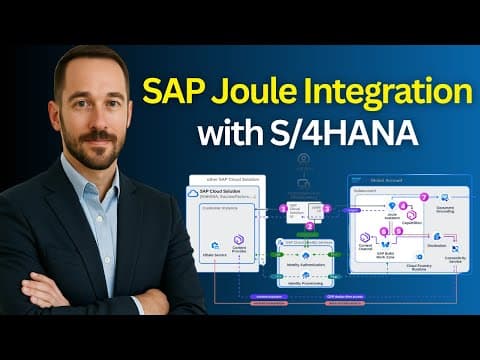
[3:37]Yeah. And the docs really hammer this point home. Setting up Joule is about securely integrating four essential SAP Cloud pillars.
[3:47]It's a total shift in thinking, right? It's not about monolithic installation anymore, it's about connectivity. And you need these four services to be perfectly integrated for Jewel to work.
[4:00]Oh, by the way, if you're looking to upgrade your skills in SAP AI, check out the SAP AI Masterclass, the number one best-selling and top-rated SAP AI training on Udemy. Built by XSAP employees, this course gives you lifetime access and includes all future SAP AI updates so you stay relevant as SAP AI continues to evolve.
[4:24]If you're an SAP professional, this course helps you stay ahead of clients with real-world SAP AI use cases, clear architecture insights, and hands-on skills you can apply immediately, whether you're looking to boost your resume, earn internal or customer recognition, or explore new career opportunities.
[4:44]This is your edge in the competitive SAP market. A special discount coupon is available at www.zequance.ai.
[4:52]And you need these four services to be perfectly integrated for Jewel to work. I mean, let's start with pillar number one. This is sort of the brain, the home base. We're talking about the SAP business technology platform BTP.
[5:04]BTP is, uh, yeah, it's absolutely non-negotiable. It's where the Joule service actually lives and executes. And to get it ready, you have to do three things: create a BTP sub account, enable cloud foundry, and then activate the Joule service itself.
[5:18]Why this specific focus on cloud boundary? What does that do?
[5:21]Well, cloud foundry gives you that managed, scalable environment for cloud native apps. Joule needs that platform to reliably run its, you know, it's advanced logic and integrations. Without BTP, the brain has nowhere to operate.
[5:34]Got it. So if BTP is the brain, then the next pillar is kind of like the map, SAP Build Work Zone.
[5:39]That is a perfect analogy. Work Zone is Joule's internal directory. It's the service that knows which Fiori apps exist, who can access them, and how to organize all that content for the user.
[5:50]Okay, but hold on, why do you need Work Zone for that? Wouldn't the roles inside S4 Hana already know which apps a user can access? What's Work Zone adding that's so essential?
[6:00]That's a great architectural question. So S4 Hana knows what roles exist, sure, but Work Zone is what aggregates the content and crucially provides the semantic layer for Joule.
[6:08]The semantic layer? Yeah. So when you ask Joule to handle supplier invoices, it's the Work Zone structure that tells it the exact URL, the app ID, and the role context it needs to launch that specific task. It's the single source of truth for the user interface.
[6:25]Ah, okay. That makes sense. It unifies the front-end experience for the AI.
[6:29]Mm. Okay, so pillar three, the security guard, SAP Cloud Identity services.
[6:33]This is probably the most critical piece for any enterprise. We're talking about IAS, the identity authentication service and IPS, the identity provisioning service.
[6:43]Authentication and provisioning? Right. It handles both who you are and what you can see. It ensures single sign-on works, so when you log in, your identity and permissions just flow seamlessly and securely across the landscape.
[6:55]So we're not just logging in once, we're creating a chain of trust that follows the user everywhere.
[7:00]Exactly. It avoids that nightmare of separate logins and ensures Joule's context is always current.
[7:05]And that brings us to the last pillar, number four, the source of all the data, the SAP S4 Hana Cloud system itself.
[7:11]Yep, the engine room. It's job in this setup is to securely expose the business roles, the Fiori apps and of course, the actual business data to Joule. And the keyword there is securely via APIs.
[7:24]And why APIs? Why not some other kind of integration?
[7:27]Because APIs are the modern standard for secure cloud-to-cloud interaction. They're like controlled gateways. They make sure Joule only requests and receives very specific defined pieces of data for the conversation.
[7:40]It limits exposure and gives you a full audit trail. So, to sum it up, Okay.
[7:44]We've got the brain, BTP, the map, Work Zone, the security guard, identity services, and the data engine S4 Hana.
[7:54]It sounds like linking all four of those could be a really complex, error-prone project.
[7:57]It absolutely can be, and that complexity is precisely why the implementation guides push you towards using automated tools, which leads us right into the setup journey.
[8:05]Okay, let's talk about that simplification piece right away. If connecting those four pillars is the main pain point, what's the solution the documentation offers?
[8:12]The big takeaway here is the automated help you get from the booster tool. Now, it's not a magic wand, but it's a very powerful wizard that is designed specifically to simplify that whole connection process.
[8:24]And how does it do that in practice? What is it automating?
[8:27]It's all about that security handshake. It automatically builds the destinations, sets up the communication arrangements, and exchanges the security certificates you need to link BTP, S4 Hana, and identity services. It just, it cuts down so much on the potential for manual errors.
[8:45]So the booster tool basically runs through the four-phase journey for you.
[8:49]That's a good way to put it. It automates the execution of that journey.
[8:52]Okay, then let's walk through that journey. It seems like a very logical sequence, starting with trust and then ending with validation.
[8:59]Exactly. You have to establish the lines of communication before you can worry about what flows through them. Right. So, phase one is the foundation. What's the main goal here?
[9:07]The goal here is establishing secure mutual trust. It's making sure S4 Hana, BTP, and identity services all recognize and trust each other's credentials. You're setting up the secure channels, the certificates. Think of it like exchanging diplomatic keys between three digital countries.
[9:24]Okay, once that trust is there, we can move on to phase two, content exposure. This sounds like it's all about feeding the map, the Work Zone.
[9:31]That's it. Exactly. This is where you synchronize that semantic layer. You're taking the business roles, the Fiori apps, the user mappings from S4 Hana, and syncing them up to the SAP Build Work Zone. This tells Joule what content exists, where it is, and who's allowed to see it.
[9:46]So if Work Zone is the map, this phase is basically loading all the current streets and addresses into it.
[9:53]Perfect analogy. Then you get to phase three, identity sync. So we've got trust, we've loaded the content, but, you know, business is dynamic, people change roles, new people get hired. This phase is all about making sure users and their roles are constantly aligned across all the systems.
[10:07]So if a user security profile changes in the ERP, this guarantees Joule knows about it immediately.
[10:13]Instantly. Continuous alignment is crucial to avoid security gaps. And then finally, you wrap it all up with phase four, security validation. This is the last non-negotiable check.
[10:25]What are the key checks in this final phase? You're validating that all the trust certificates are active, you're enabling single sign-on across the whole environment, and you're guaranteeing that all the data privacy settings are correct. It's the final step to make sure the system isn't just working, but it's compliant and safe.
[10:42]And the result? The outcome of running through those four phases, either with the booster or manually.
[10:47]The result is that little visual confirmation everyone's looking for. That sparkling diamond Joule icon appears right there in your Fiori launchpad, ready to go. It's the signal that all four pillars are securely connected and synchronized.
[11:01]So if we zoom out, what does this whole deep dive really tell our listeners about the long-term impact of SAP Joule?
[11:07]Well, the bottom line from the source material is pretty clear. Joule isn't just some AI add-on that got bolted onto the side. It really represents the future of how users are going to interact with core SAP systems.
[11:20]It changes the whole paradigm. Yeah, from clicks to conversation, it's an intelligent workspace. And it's built on BTP, powered by responsible AI, and deeply integrated with S4 Hana. It's core to the platform strategy.
[11:32]Which means for you, the architect or decision maker on S4 Hana Cloud, the message is clear. The architecture is ready. The time is ripe to start exploring this because Joule is designed to lift productivity in every single role in the company.
[11:47]And it's such a significant shift. We're not talking about managing software installs anymore. We're talking about managing the constant sync, the trust relationship, and the secure connection between all these separate cloud services.
[11:57]That transformation in philosophy from monolithic installs to a synchronized ecosystem, that's the defining feature of this whole new intelligent workspace.
[12:06]Which I think raises a really important final thought for you to take away from this deep dive. Given that Joule's success relies entirely on managing the continuous trust and synchronization between these three cloud services, S4 Hana, BTP, and identity services, what new considerations does this connected architecture introduce for your long-term maintenance, governance, and scaling strategies?
[12:28]The conversation really moves from deployment to continuous operational alignment. Thanks for joining us for this deep dive. We'll catch you next time.


