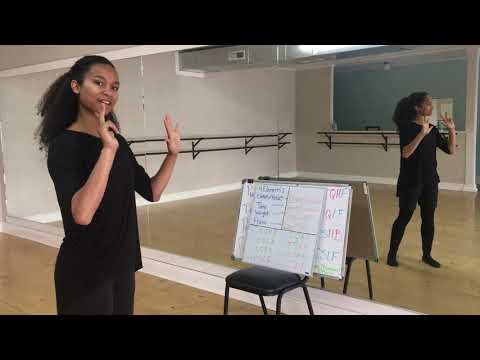
[0:00]Well hello, I want to teach all of you the eight elements from the Laban movement efforts that we were talking about the other day. So if you can come over here, I want to show you the chart. And there are four F- or sorry, four elements that go into all of the elements. And so, I just this is more for my notes, but just so you can see them. Um, we have space in your focus, which some people call it the direction that you're moving. And in that direction, you can either be direct or indirect. And so you can be direct getting from point A to point B, just right there, or you can be indirect to get from point A all the way to point B. Okay? And so that's your space or your focus in how you're moving. Now, the second one that we'll talk about, there's four of them. First one is with your space and your focus. The second one is your time and your time can be quick or it can be sustained of how you're moving in your, um, with your body. The third is weight. It can be heavy. I want you to know these terms. It can be heavy or light. So something heavy, moving around very heavy, or it can be very light of how you're moving. Okay? So, space focus is the first one. Then you have your time, then you have your weight, your last one is going to be your flow, your fourth one is your flow. Your flow is either bound or free. And so, whenever you're moving in a very bound way, it has a lot of tension, and there's less tension whenever it's free. Okay? And so, all of these, the four elements are going to be used in the efforts that you put into your movement. So I'm going to go over the eight. There's punch, dab, press, glide, slash, flick, ring, and float. Now, I made a different chart for you, and I'm going to demonstrate each one, just so that it's clear. So, let me put this board here.
[2:30]And mainly, just take a look, you can see with your body, you can move through space, using, let's say punch. You don't have to just do a punch, just that. But punch can be with your foot or any part of your body. Now, let's break it down. Your punch is direct. It's quick, it's heavy. So, I'm not going like this, but it's heavy and it's bound. In the tension that I'm using is bound. Now, the second one is dab. And dab, think of touching raindrops is a good way or typing. And when you do a dab, it is direct. Is getting there very directly, but it's also quick, just like a punch. It's light, and that's where the huge change from going from a punch to a dab. So, it's light, but it's still bound. So, we have our dabs, dabs, dabs. Okay? So, the third one is press. And whenever you're doing a press, it is direct to get there. Press, but it's also sustained. And so, instead of it being quick, now it's sustained. And so, when you're pressing, you have direct, sustained, it's heavy, like you're trying to push a wall down. But and it's bound. Now, you have punch, dab, press, let's go over glide, the fourth one. And so, glide, when you do a glide, it is direct. Kind of like a gleasa. But it's sustained, light, and free. Sustained, light, and free. So, glide in hip hop, gliding is very direct of where your feet are going. But it's sustained, it's light, and free. Okay? So, we did the four that are direct. Now, let's do the four that are indirect. There's slash. You can do, it's very indirect, meaning it doesn't have a stopping point of where you end that slash. It's quick, it's like a kick, or, um, anything that you do is heavy, and it's also free. Slash, just slap, slap. Yeah. Flick is indirect. It's quick, it's light, and free. Ring, this is our seventh one, ring. Ring is indirect. It's sustained, it's heavy, which is a big difference, and it's bound. Think about ringing a towel. Ring, ring, ring. Indirect, sustained, heavy, bound. Anything you want to do. So, float is indirect, sustained, light, and free. Sustained, light, and free. And it is still in that indirect category. So, I'm thinking light if I'm coming up. Think of being on a cloud. Floating. So, those are your eight, those eight elements. And I want you guys to study them and remember them and I'll be looking forward to meeting with you soon.