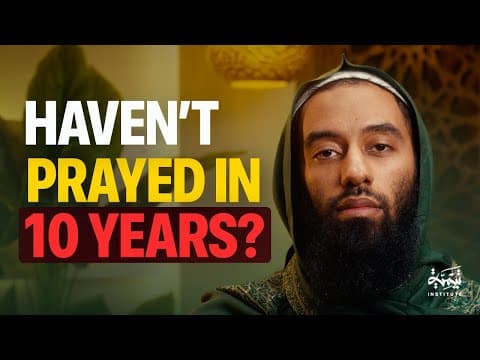
[0:00]Anyone who deliberately abandoned prayers, even for a prolonged period, it could be ten years, it could be 20 years, it could be 30 years, it could be 40 years. is still obligated to make them up regardless of how many were missed. This is when my brothers and my sisters, fiqh comes in extremely handy when dealing with the quickly changing reality on the ground. How does one now make up their missed prayers following the majority view? Sit down and try to remember the amount of years that you have missed obligatory prayers.
[0:42]The first thing that one is going to be held to account on is his prayer. Allah Azza will say to the check does he have any that can perhaps complete the deficiency in his obligatory acts? this is one of those issues that I spent a lot of time thinking about speaking to about and each one has their different views. And I'm hoping this is a solution to the problem that we have and this very commonly asked question.
[1:23]As-salamu 'alaykum, I have a question regarding missed prayers. A family member of mine has not been praying for over 12 years. Alhamdulillah he is now trying to return to practicing Islam. I have read that missed prayers must be made up, but I'm worried that telling him this right away might feel too overwhelming and discourage him. What is the correct approach in this situation? Should I encourage him to focus on establishing his daily prayers first, or should I inform him immediately about making up the past ones? Jazākum Allāhu khayran.
[1:59]Assalamu alaykum warahmatullahi wabarakatuh. My brothers and my sisters, welcome back. Inshallah taala, in this video, we're going to be continuing our series on fiqhi related discussions and issues and questions that people send in. Today's topic is about making up missed prayers that were intentionally left off. As you can see, my brothers and sisters, this is indeed one of the most frequently asked questions in almost every Q&A session. Especially after I released the video on the five scenarios related to making up missed prayers, I deliberately left this specific case out of that video due to its complexity and commonality. Intending to address it in a separate, dedicated explanation. And I hope inshallah Ta'ala, this will bring clarity especially for those who have recently returned to practicing their faith and are unsure of how to move forward. So what is the ruling, my brothers and my sisters? I'm going to mention these two views inshallah Ta'ala, and I'll explain why I'm also mentioning this minority view, even though some have declared that this majority view that I'm going to start with, has been unanimously agreed on. So the first, my brothers and my sisters, the majority of you, according to the majority of scholars across the four schools of thought, the Hanafis, the Malikis, the Shafis, and also the Hanbalis, right? Anyone who deliberately abandoned prayers, even for a prolonged period, it could be ten years, it could be 20 years, it could be 30 years, it could be 40 years. is still obligated to make them up regardless of how many were missed. And we should not take the position of the majority, my brothers and my sisters, lightly. I always say to our brothers, even let's just say and argue that there is no ijma. The fact that the four great Imams are taking a position, don't take it lightly. This did not come out of thin air, especially if all four have come together on a particular matter. This is very, very important. Don't make it a habit, even if they took it, I'm just going to follow this. They would not generally speaking adopt a view unless it is what backed up with substance, with evidence. As I previously mentioned, my brothers and sisters, some scholars even reported in ijma, a consensus on this point. This is the default position, especially for those who are able to fulfill this duty. Those who are able to make up these prayers, right, then, I'm saying, my brothers and my sisters, they should do this. And I tell you all to fear Allah Azza. If you have the capability, don't take this lightly. Because there will be a day when we stand in front of Allah Azza, and Allah Azza knows what's in our hearts as to whether we were capable or not. Then you have, my brothers and my sisters, the second minority view. This comes in handy when it comes to dealing with the reality on the ground. And I'll explain why, inshallah Ta'ala, shortly. This is the position of a group of scholars, including the Dahiri school, Al-Hasan al-Basri, Abu Bakr al-Humaydi, Ibn Taymiyyah, Ibn Rajab, and scholars like Ibn Baz and Ibn 'Uthaymin, all held the view that no makeup is required for intentionally missed prayers.
[5:18]Instead, they should focus on repentance, abundant voluntary prayers, and righteous deeds. Their reasoning is, my brothers and sisters, that once the prayer's time has passed deliberately, I'll say it again. Once the prayer's time has passed deliberately, the opportunity has now been lost. And one cannot make up for an act of worship that was bound to a specific time. Allah Subhana Wa Ta'ala has appointed each prayer for a specific time. Every prayer has its beginning time and also has its end time. And because this individual hasn't prayed in that time, you cannot make it up. Some of my brothers and sisters, why mention this view despite the claim of it being the overwhelming view? We mentioned that you have the majority view, and then you have this minority view. Why even mention it? I'll tell you guys, my brothers and sisters. This is when, my brothers and my sisters, fiqh comes in extremely handy when dealing with the quickly changing reality on the ground. In pastoral settings, dealing with real people, especially with weak and returning Muslims who are vulnerable. This is a key word here, my brothers and sisters. Not everyone is a weak Muslim, and not everybody is vulnerable. This view can become vital when one is struggling spiritually or mentally, right? It provides, my brothers and sisters, a merciful opening rooted in sound scholarly tradition. How many times, my brothers and sisters, has somebody come up to me saying that if I tell my brother who's just started practicing that he needs to make up ten years of prayer, I fear that he might what, just fall off again? He might even end up leaving the religion. And this is not just claims that are being made. I've engaged with them personally, right? So I'll come back to this, inshallah Ta'ala. My brothers and sisters, how does one now make up their missed prayers following the majority view? Pay attention, my brothers and sisters, sit down and try to remember the amount of years that you have missed obligatory prayers. Get a pen and paper and start writing it down. Start making these calculations, right? At the end of that sitting, you'll have somewhat of an idea of how many obligatory prayers you missed, right? Likewise, my brothers and sisters, this part is very, very important and crucial. This is when your fiqh studies really pay off. Normally when I teach about the pillars and the recommended acts of the Salah, right? We go through the pillars, we go through the wajib, and then we have the Sunnah acts of the Salah. Not everything in the prayer is a must. However, we always encourage for one to have the most complete of prayers, by doing the many sunnahs that he can, so that he may be successful, right? As Allah mentions this in the Quran. Follow him and you will be successful, meaning the messenger. also mentions, follow him and then you will be guided. So I always encourage students to split their nose into two parts. Quick message, my brothers and sisters, people always ask me, is there a structured way to learn Islam properly? that's exactly what we've built at Taymiyah Institute. A step-by-step curriculum grounded in the Quran and Sunnah structured to guide you from foundational knowledge to deeper understanding and application step by step. What sets us apart is that we connect classical Islamic knowledge with the realities and challenges of modern day life. So it's relevant, practical and easy to adjust. Lessons are released weekly, supported by live Q&A sessions so you're not alone in your journey. If you're serious about learning your religion, visit Taymiyyah Institute or click on the link in the bio, and you can begin your journey today. I'll see you all on the other side. As-salamu 'alaykum warahmatullahi wabarakatuh. The first part would be writing down the bare minimum that is required, like the pillars and the acts that are mandatory, right? This includes, my brothers and sisters, Suratul Fatiha. However, my brothers and sisters, however, anything after the Surah Fatiha isn't mandatory. So if somebody now, my brother, for whatever reason, he had to hasten his prayer. We would say, in this exceptional circumstance, right, read your Fatiha and then move on to the next stage of the Salah and your Salah is still valid. According to the Hanabila, you have to say in your sujud and in your ruku at least once in the bowing position and in the prostrating position, right? In order for you now to come with the bear minimum. I hope inshallah Ta'ala, that's clear, my brothers and sisters. And of course, the basic conditions that validate a prayer. So you would have to come with that which is mandatory, right? Then the second part, my brothers and sisters, that I would normally tell them to write down is what completes the prayer. This includes additional adhkār, recitation beyond Fatiha, and more, right? So if someone has years of prayer to make up, advise them to perform the bare minimum to fulfill the obligation. This eases the burden significantly. So after each prayer, let's just say you prayed Fajr, right? And you're probably very tired. Pray the two rakaat but with the bare minimum. You read Surat Fatiha, right? And this helps you, my brothers and sisters, uh, speed it up, even though, my brothers and sisters, we're standing in front of Allah, but it lessens the time that you're going to be what carrying out these prayers, and it's a lot more lighter on the soul, right? This eases the burden significantly. That brings me on to, my brothers and sisters, when it comes to having a balance and wisdom. When it comes to having in these situations, especially when dealing with the weak of the using wisdom is vital. Imposing this obligation on everyone, especially those who are new to practicing, right? Or those that have just returned, sometimes you may find that this will do more harm than good. For someone vulnerable, this could be spiritually crushing and even push them away from Islam altogether, right? In such a situation, my brothers and sisters, scholars across all four madhhab allowed the use of less strong opinions in times of need or hardship, right? This principle is especially when a person is genuinely unable to cope. This is a very, very important principle, my brothers and sisters. It might be a weak position. However, in a case of exceptional circumstances, to help the situation, there is a level of adaptability, right? There's a level of adaptability within our religion based on legal maxim and so on and so forth. And the religion, my brothers and sisters, isn't rigid. There is a level of accommodating that you find within our Sharia.
[12:40]So my brothers and sisters, what would the alternative be? If a person, my brothers and sisters, follows the minority view and doesn't make up past prayers. They should focus on abundant nawafil, supererogatory prayers, the voluntary prayers. He should do as much as he can. This is of course after having made an abundant amount of Tawbah, right? This would be my advice, my brothers and sisters, due to the Hadith of the Prophet, when he said, The first matter for which the servant will be brought to account on the Day of Resurrection is his prayer. If he has completed it, it will be recorded for him as voluntary deeds. If it is incomplete, Allah the Exalted will say to His angels, "Look and see if My servant has any voluntary prayers, and complete with them whatever is lacking from his obligatory prayers." So the missed obligatory prayers may be covered at least partially by one's voluntary prayers, as a sign of Allah's mercy and justice, right? So just to summarize now, my brothers and sisters, it is mandatory for a person who is capable to make up all past prayers, even for years, and Allah knows what's hidden in your hearts. Keeping them brief and fulfilling the minimum. If it's going to be a burden. However, if the individual now can pray the prayers in its most complete form with the Sunnah, then we say to you, do that, and you're the one that's going to benefit most. Secondly, my brothers and sisters, if the person is spiritually fragile, overwhelmed, or newly practicing, and you giving him this, my brothers and sisters, meaning the majority of you, could lead the situation to that which is more problematic. It is permissible to give them the lighter option while advising them to make sincere tawbah and to perform as many Sunnah and nawafil prayers, right? This is one of those issues that I spent a lot of time thinking about, speaking to mashaykh about, right? And there is a spectrum of mashaykh that I spoke to, a variety of them. And each one has their different views.
[14:54]Some will be on the right side of the uh, spectrum, you can maybe call it far right, some are more left right, right, or center left, center right, far left, et cetera. And I'm hoping inshallah Ta'ala, this is a solution to the problem that we have and this very commonly asked question inshallah. If anyone has any more fiqhi related questions that needs researching, that needs looking into, then inshallah Ta'ala, I can perhaps maybe take some time out to look into this. I am extremely busy, my brothers and sisters, and I try my utmost best with these videos to cover as many of the questions that gets asked. Hopefully, inshallah Ta'ala, you guys will benefit. You will find an email inshallah in the description box or in the bio. Take care, as-salamu 'alaykum warahmatullahi wabarakatuh.


