[0:00]Guccio Gucci, the founder of Gucci, was born in Florence Italy in 1881. Growing up, Guccio was not interested in leather making despite having a father that was a successful leather craftsman and milliner. Instead, he wanted to explore Europe and find himself. By his late teens, he had traveled to Paris before later settling in London where he lived for many years. In London, Guccio would work at the Savoy Hotel, one of the first luxury hotels in Britain that housed royalty and upper class guests. He worked as a bus boy at the hotel, always observing things around him, including the fact that the celebrities and royals that would visit the hotel always had expertly crafted luggage. Exploring London would also build his love for leather craftsmanship, and he admired the work of local leather makers, including H.J. Cave and sons, who would supply the luggage for high society customers in London. He also built a fascination around aristocrats playing polo and racing horses. All of these elements inspired a young Guccio to dream of starting his own leather goods company, and he would eventually return to Italy and set out a plan to learn the leather trade. He went to work for a huge leather manufacturer in Milan called Franzi and learned all the different aspects of the leather trade. Over the next 10 years, he built his name in the industry and created his own designs, working diligently in pursuit of reaching the goal of starting his own business. In 1920, Guccio returned to his hometown of Florence to plan the opening of his first store, which eventually opened doors in 1921. Many of the inspirations of Guccio's early designs hearkened back to his experiences in London, with some of his earlier leather creations being saddles and saddlebags, as a reference to British high society playing a lot of polo and racing horses during the time he was in London. It's also important to bring into context what was happening in this period of time. In the 1920s, the popularity of cars in Europe and North America skyrocketed, which eventually forced Guccio to expand his product range. He initially started with luggage, also inspired by his time in London, and eventually further expanded into making handbags, shoes, gloves, and belts. The 1930s saw more involvement from his son in the brand, Aldo Gucci, who would help take the business to another level. Aldo, a savvy businessman and skilled designer, saw a missed opportunity with the lack of branding on the goods and designed the original Gucci logo by taking his father's two G's from his initials and creating an interlocking double G that is timeless and still popular today. The success of the brand was high in the 1930s, and people would travel from all around the world to Florence for Gucci leather products. But things started to slow down as the Second World War intensified. Italy had an allegiance with Germany, which led to the League of Nations imposing sanctions that severely restricted the importation of leather to Italy. Puzzled on what to do, Guccio started experimenting on how to make his products with different materials. After a lot of trial and error, he would find a plain hemp fabric from Naples that was a suitable choice and printed the first of many signature patterns onto the fabric. The print was a series of small interconnecting diamonds in dark brown on a tan background. This is now known as the famous Gucci diamante print and still remains one of the most classic prints in fashion today. However, this experimentation didn't stop at hemp fabrics. He also created what is now known as the Bamboo bag, which featured a semicircular handle made of bamboo with the shape of the bag resembling a horse's saddle. The success continued, the Gucci brand continued to grow, and new stores were opened across Italy, with a store also opening in New York. Unfortunately, at the age of 72, Guccio Gucci passed away in 1953. Following his death, much darker days in the Gucci story were to come. From the moment the Guccio dies, there was already a lot of contention over which of his children should take over the brand, especially after many of them found out that they were not left shares by their father. Two of his sons, Aldo and Rodolfo, took over the business with Vasco also owning shares but involved to a lesser extent. Aldo, a man already famous for his Gucci logo, continued to innovate at the brand, creating different iterations of his original Gucci print and designing the famous Gucci Horsebit loafer in 1953, which was created in memory of his father's fascination with horse riding. This also became the base for many future Gucci products that would incorporate a horsebit. Designs inspired by Gucci's time in London didn't stop there. A green, red, green striped gross grain was created inspired by a horse girth, which is the strap that keeps a saddle secure and stops it from slipping side to side. The colors of green and red were inspired by British fox hunting jackets, which are normally red in color, but with iterations of the jacket that have green collars. Many other innovative Gucci designs were created during this time, including the Gucci Flora print, which was initially created for Grace Kelly. The 60s and the 70s were prosperous times for the Gucci family, and the success remained high with the biggest celebrities and royals from around the world continuing to wear the brand. In the 1980s, drama and fighting within the family, squabbling for control of the company, and others like Paolo Gucci forming his own company and copying all of the Gucci signatures led to a huge fallout within the family. Things only escalated even further when Rodolfo's son and Guccio Gucci's grandson, Maurizio Gucci, tried to take the company for himself and tried to oust his uncle, Aldo Gucci. The constant fight for power and constant issues within the family led to the downfall of Gucci and almost bankrupted the company. The story has a sinister ending with the assassination of Maurizio Gucci. The brand would later be saved financially by an investment by Investcorp and with Tom Ford becoming the creative director of the brand. Products were frequently named after the A-listers that wore them regularly, and this helped in the success of Gucci and associated it with high society. And so I hope you enjoyed the video, I hope you learned a lot about Gucci. If you want to learn about fashion more effectively, I'd suggest my ebook on effective ways to learn about fashion. The link is in the description below, and I definitely recommend it. To learn more about Gucci, check out my video on Alessandro Michele's vision of Gucci and stay tuned for more content in the future.
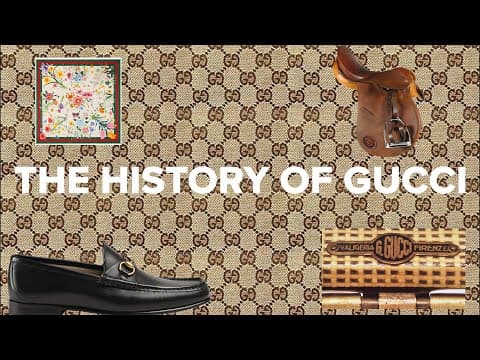
The History of Gucci
Fashion Roadman
6m 38s1,153 words~6 min read
YouTube auto captions
Transcript source
YouTube auto captions
This transcript was extracted from YouTube's auto-generated caption track. The transcript below is server-rendered so it can be read, searched, cited, and shared without opening the original YouTube player.
Pull quotes
[0:00]Growing up, Guccio was not interested in leather making despite having a father that was a successful leather craftsman and milliner.
[0:00]By his late teens, he had traveled to Paris before later settling in London where he lived for many years.
[0:00]In London, Guccio would work at the Savoy Hotel, one of the first luxury hotels in Britain that housed royalty and upper class guests.
[0:00]He worked as a bus boy at the hotel, always observing things around him, including the fact that the celebrities and royals that would visit the hotel always had expertly crafted luggage.
Use this transcript
Related transcript hubs
Watch on YouTube
Share
MORE TRANSCRIPTS


