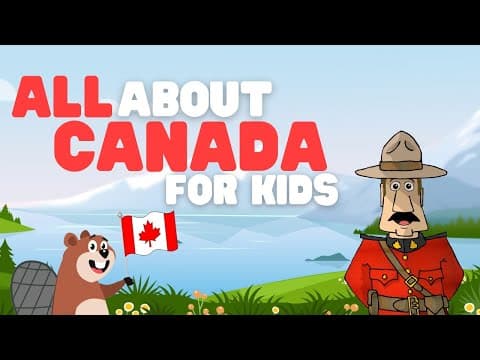
[0:06]All about Canada for Kids. Can you guess what country has the longest street and the longest coastline in the world? Here is a hint. This country is located just north of the United States. Any guesses? That is right. It is Canada. And today, we are going to learn more interesting facts about this cool country. Canada is the second largest country by area in the world, with Russia being the largest. It spans across almost 4,700 miles and six time zones. Though, it only is home to around one-half of 1% of the world's total population. That is a lot of land and not a lot of people. Canada is divided into 10 provinces and three territories. The capital city is Ottawa, Ontario. The largest city is Toronto, Ontario. Here is an interesting fact. Montréal, Québec, is the second-largest city in Canada and is also a major seaport. It is one of the biggest French-speaking cities in the world. Bonjour, mon ami! Nearly half of the people in Canada have British ancestors, and almost one-fourth have French ancestors. Not surprisingly, English and French are both the official languages of the country. Canada is the northernmost country on the North American continent, sitting just above the continental United States, with the state of Alaska on its northwestern border. It is surrounded by three oceans: the Pacific, Atlantic, and Arctic, along with the Labrador Sea. Canada's terrain features mountains, plains, lakes, rivers, and forests. And in the very northern part of the country, it is pretty much just ice, snow, and glaciers. Here is an interesting fact: The Canadian Shield, which is a hilly area in Northern Canada filled with lakes and swamps, is home to some of the oldest rock on Earth. And here is a bonus interesting fact: Canada's lakes and rivers contain 20% of all fresh water on Earth. Whoa! Canada's climate varies because the country is so big. But most regions of the country have very long, cold winters. The temperatures are the mildest near the Pacific Coast. Animals like bears, wolves, beavers, deer, moose, mountain lions, lynx, and bighorn sheep can all be found in Canada's forests. Its prairies are home to bison and pronghorn antelope. Musk ox, caribou, Arctic foxes, snowy owls, and even polar bears live in the frozen north. There are also a lot of salmon and other types of fish. Canada has 41 national parks and three conservation areas throughout the country. Canada also has quite the history. The first people to come to Canada arrived between 15,000 and 30,000 years ago. They used a land bridge that joined Asia and North America. Around 1000 CE, Viking explorer, Leif Eriksson, arrived in Newfoundland, Canada. But he and his fellow travelers did not stay in the area. The country recognizes three main groups of indigenous peoples: Inuit, First Nations, and Métis. For thousands of years, Inuit have lived in Northern Canada. First Nations peoples, including Cree, Ojibwe, Iroquois, and Mohawk, have lived in the south. The Métis are a much younger group because they are the descendants of First Nations people and French settlers. French colonizers didn't arrive in Canada until about the 1500s. Here is an interesting fact: In 1608, explorer Samuel de Champlain founded the city of Québec, which was France's first permanent Canadian colony. By the 1600s, both French and British colonizers had arrived, each country set on claiming the land for themselves. After lots of fighting between the French and British that culminated during the French and Indian War in 1763, Britain claimed Canada as part of the British Empire. That area that the French had previously been in control of became the province of Québec. Similar to what was happening in the United States, settlers began to move westward, displacing indigenous peoples along the way. By the 1930s, Canada included the provinces of Prince Edward Island, Manitoba, Saskatchewan, Alberta, British Columbia, and the Yukon and Northwest Territories. In 1982, the British government granted Canada control over its constitution, effectively making it an independent country.
[6:20]The British monarch is still considered the ceremonial head of state, though. Today, people travel from all around the world to ski, explore, and see natural wonders, like Niagara Falls, which is the largest waterfall by volume in the world! And the Rocky Mountains at Banff National Park. Sounds like a really cool place to visit. Okay, we have talked about lots of fascinating facts about the second-largest country in the world. Let's test our knowledge! True or False: Canada has two national languages. True, they are French and English. Fill in the blank. One of the most popular tourist attractions in Canada is blank Falls, which is the largest waterfall by volume in the world! Niagara. Name one of the oceans that border Canada.
[7:34]Possible answers are Pacific, Atlantic, and Arctic. Great job, friends! Canada is a vast country, filled with natural wonders and an array of animals. It is no wonder that so many people travel there to see all of the amazing things that Canada has to offer. Maybe you have already been to Canada, or maybe you will visit one day. No matter what, it is a country with an interesting history and a bright future. Hope you had fun learning with us! Visit us at www.LearnBright.org for thousands of FREE resources and turnkey solutions for teachers and homeschoolers.