[0:02]Welcome back to FTFM. I'm joined by Helena Morrissey, chief executive of Newton Investment Management. Thanks for joining us. Pleasure. You have recently launched an initiative to get more women onto corporate boards. Will this be effective in and of itself do you think without any legislation to back it up? Well, my hope is that we'll get there um without a quota, um stipulating how many women or what percentage of women should be on boards. I think there's a lot of momentum around this issue at the moment, and I think a lot of us, um, would like to see um a a big leap in the proportion of women on boards and in senior levels generally without resorting to a quota. And you're aiming for 30% in five years. Where are we at at the moment? 12 and a half%, if you look at the FTSE, the top 100 companies, and I'm afraid the numbers dwindle somewhat if you look at the next 250 uh companies by size. A Cranfield report, which recently came out, has got a lot of statistics, and we haven't moved um very much at all in the last five years, really. And before that was there a a gradual increase or have we have we? It's been a bit leaps and bounds, but definitely a sense of plateauing, and obviously 10% or 12% isn't very much where we are at. So it hasn't been as if we've we've really leaped, and we certainly haven't fallen back, but it's been just a very glacial pace over the last decade, really. And what is what's seen as the main problems that are stopping women get onto boards? Well, I think there's more than one. That's part of the problem, and a lot of time and energy are spent trying to diagnose what is it that's really an impediment to uh further penetration. Um, I think one of the big reasons that we can never get around of course is the fact that, you know, women often take a a career break if they do have children. But I think many of us, um, and particularly the chairmen who've signed up to the 30% initiative recognize that at that point, people might, or when they come back to work, have built up a lot of experience and a lot of knowledge that is a great shame then not to encourage further development. I do think that often women look ahead and there's a point of cultural sort of concern they might have as whether they actually want to be on the boards. And that's why I think having a a more than a token representation is so important, otherwise you get to the board, or you look ahead and see the board and don't particularly want to get on it necessarily. Um, so the idea is to have more women on it and it's then it just becomes a group of people who are making decisions about a business rather than a sort of all male party that people are joining. And there's one of the statistics you've quoted is that boards with three women, I think, have an 80% higher return on equity than those with no women. Is there is it possible to to prove that cause and effect or is it just coincidence? Well, of course, you can never quite prove the order of cause and effect and um just to be perfectly honest, there aren't a huge number of companies that have more than three women or three or more women on the board. So the sample size is relatively small. But I think intuitively, um, the idea of having more perspectives, more types of people, not just a better gender balance, but international experience, people with different social and educational backgrounds, uh to inform and make better, more robust decisions just makes business sense. Is this something that do you think in the investment community is signed up for, because clearly they should be driving to some extent board composition and whether it's the right mix of people or not? Well, I hope that that will become one of the further drivers for change. It's certainly the composition of a board, the confidence that an investor has obviously in the management, including the board of a company, um is a very big part of the decision to invest. I think it needs to be a bit more overt. Um hopefully the uh the guidance around the revised governance code that the FRC, the Financial Reporting Council, I believe, is working on now, will include some guidance for investors um for when they're assessing the diversity of a board. Um, but in the meantime, I think it's incumbent on all of us as investors to be looking at um the the depth, the the strength and the variety um of members of a board, the companies we invest in. And finally, this presumably some of this is up to women as well. Now what what exactly what are we doing wrong? What are we why are why are we not getting ourselves into these positions? Well, of course, it's always impossible to generalize completely, but I do think that there's a tendency for us women not to necessarily push ourselves forward, not to be quite as sort of working the political side of of things. Um, I think if women do want to make a difference in in terms of shaping a company's agenda, to to be considered for a board appointment, then, you know, we need to get out there a bit more, shout a bit more loudly. Thanks very much indeed, Helena. Thank you.
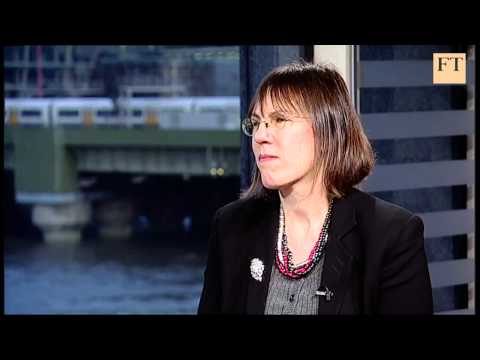
More Women Makes Business Sense - Financial Times Report
Financial Times
4m 45s955 words~5 min read
YouTube auto captions
Transcript source
YouTube auto captions
This transcript was extracted from YouTube's auto-generated caption track. The transcript below is server-rendered so it can be read, searched, cited, and shared without opening the original YouTube player.
Pull quotes
[0:02]I'm joined by Helena Morrissey, chief executive of Newton Investment Management.
[0:02]You have recently launched an initiative to get more women onto corporate boards.
[0:02]Will this be effective in and of itself do you think without any legislation to back it up?
[0:02]Well, my hope is that we'll get there um without a quota, um stipulating how many women or what percentage of women should be on boards.
Use this transcript
Related transcript hubs
Watch on YouTube
Share
MORE TRANSCRIPTS


