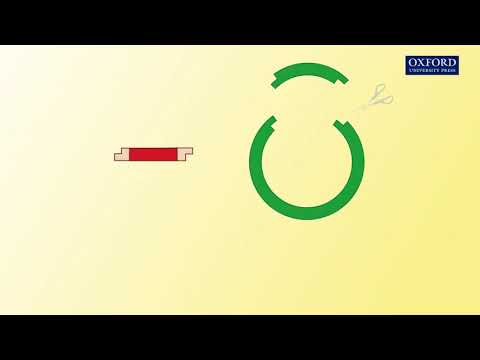
[0:06]Recombinant DNA technology is a technique in which a fragment of DNA from a donor cell or organism is isolated.
[0:16]and then inserted into the DNA of another cell or organism. This allows scientists to introduce a new characteristic into an organism by inserting a new gene into it. Recombinant DNA technology involves four major steps. Firstly, a DNA fragment containing the gene of interest is obtained from a donor cell. Secondly, a suitable plasmid is obtained from a bacterium. Plasmids are commonly used as vectors to transfer the gene of interest into a host cell for expression. Thirdly, the DNA fragment containing the gene of interest is cut using an enzyme called restriction enzyme. This enzyme acts like 'scissors'. It recognizes a specific base sequence and cuts the DNA at a specific point. On the other hand, the same restriction enzyme is used to cut open the plasmid. Lastly, the DNA fragment containing the gene of interest is inserted into the open plasmid with the help of another enzyme called DNA ligase. This enzyme acts like 'glue'. It catalyses the joining of the DNA fragment and the plasmid. A recombinant plasmid is finally formed. This recombinant plasmid can then be introduced into a host cell for different purposes, such as producing proteins of other species like human insulin or producing genetically modified organisms that possess new characteristics.


