[0:11]Do you know what electrical harmonics are and how they occur in power systems? Picture this. You're supplying your electrical equipment with a perfect sine wave current, but what you're getting out is far from perfect. This distorted wave form is what we call an electrical harmonic. Now, these harmonics are unwanted guests in our power systems. because their frequencies are higher than the fundamental frequency. You might be wondering, where do these uninvited harmonics come from? Well, they're produced by non-linear electronic loads such as electronic pallets, variable frequency drives or VFDs, battery chargers and other electronic devices. You see, when these devices convert AC to DC or vice versa, they use high-speed switching, which can distort the waveform and create these harmonics. Now that you know what electrical harmonics are, let's delve deeper into the different types, starting with the fundamental harmonic. The power we receive from the generator operates on a frequency known as the fundamental frequency. This is the rhythm at which our electrical world dances. Typically, this fundamental frequency, also called the first harmonic, is either 50 Hz or 60 Hz. depending on the country you're in. Now, this isn't a random choice. It's a carefully considered standard. You see, all our electrical and electronic appliances are designed to operate at this frequency. It's like a global electrical heartbeat that keeps our devices running smoothly. Whether it's your refrigerator preserving your food or the traffic lights managing the hustle and bustle of the city, they all rely on this fundamental harmonic. It's the conductor of our grand electrical symphony, setting the pace for everything else. Understanding this is crucial to appreciating the impact of other harmonics. Now that we know about the fundamental harmonic, let's move on to the second harmonic. opening. The second harmonic wave has twice the frequency of the fundamental harmonic. Now, let's delve deeper into this concept. You see, the second harmonic wave with a frequency of 100 Hz behaves quite differently from the fundamental harmonic. When the fundamental harmonic reaches zero, the second harmonic reaches its peak and vice versa. This creates a reverse direction in the wave, which results in a negative sequence current flowing in the electrical circuit. This negative sequence current isn't a team player. In fact, it's quite the troublemaker. It opposes the rotating magnetic field in induction motors, and what's the result of this opposition? It's a reduction in mechanical torque, less torque means less power to do the work we need from our motors. This second harmonic with its negative sequence is a key player in the distortion of our wave forms, impacting the performance of our electrical systems. closing. Now that we've looked at the second harmonic, let's move on to the third harmonic. The third harmonic, also known as triplen's harmonic, has a frequency that's triple times that of the fundamental harmonic. That's right. We're talking about a frequency of 150 Hz if our fundamental frequency is 50 Hz. Now, the third harmonic is a bit of a rogue player. It creates what we call a zero sequence current in the power system. This means that when the fundamental harmonic current reaches zero, so does the third harmonic current. Not only that, but when the fundamental harmonic reaches its peak, the third harmonic hits high at the negative side. So, what's the impact of all this? Well, this zero sequence current leads to an increase in the neutral voltage in the system. And we all know what happens when the neutral voltage increases, our trusty relay activates the circuit breaker. Now that we know about the third harmonic, let's move on to the fourth harmonic. The fourth harmonic frequency is four times the fundamental frequency. In other words, if our fundamental frequency is 50 Hz, the fourth harmonic frequency would be a whopping 200 Hz. This means that when the fundamental harmonic reaches its peak, the fourth harmonic is also hitting its stride, and this sync isn't just for the highs, it's for the lows too. This simultaneous peak and trough pattern causes an increase in the flow of current in the conductor. More current flow equals more heat, and this rise in temperature can be a real concern for your electrical equipment. This is why it's crucial to keep a keen eye on these fourth harmonics. Fun fact, the fourth harmonic is also known as a positive harmonic. Not because it brings any positive effects to your electrical system, but because of its phase sequence. The fifth harmonic frequency is 250 Hz. See the waveform, when the fundamental come to zero, it goes too high and vice versa. So that fifth harmonic we will get the reverse phase order, and it will rotate in opposite direction. Thus, fifth harmonic will be found in breaking region. Fifth harmonic cause opposite rotation of the induction motor. Same like second harmonic. In conclusion, harmonics are unwanted distorted current or voltage waveform, which causes increasing conductor temperature, caused to produce less torque and increasing the neutral voltage. Unlike the positive and negative sequence harmonics that cancel each other out, third order or triplen harmonics, third, sixth, ninth, do not cancel out. To do stop third harmonics current, generally high inductive reactor, are used in power system. However, the flow of unwanted harmonic current in the power system reduces the system efficiency. I hope you found this video informative. If you did, don't forget to hit the like button, subscribe for more content and ring the notification bell to stay updated. Thanks for watching and we'll see you in the next video.
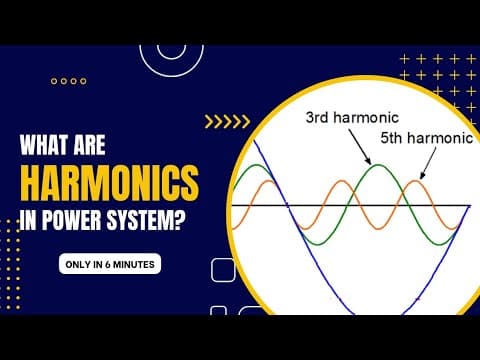
What are the harmonics in Power system? Type, Cause and Effect of Harmonics #electrology explained
Electrology
6m 34s936 words~5 min read
Auto-Generated
Watch on YouTube
Share
MORE TRANSCRIPTS