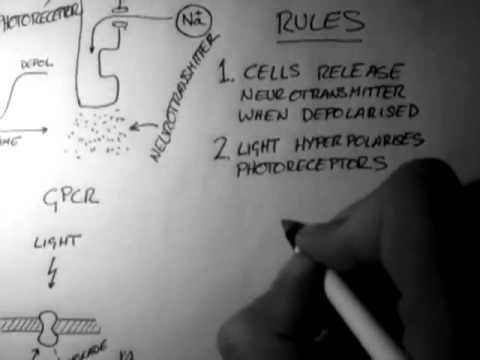
[0:04]In this video, I'm going to talk about photo receptors. Photo receptors are located within the retina. This is a very back of the eye. So I'll just draw one out here.
[0:33]We're going to look at what happens to the photo receptor when it's in the dark. So here we have a sodium channel.
[1:13]Now, the sodium channel allows sodium ions, which are positively charged to enter inside the photo receptor. This makes the inside of the photoreceptor more positive. So if we look at the voltage over time, it's going to get more and more positive inside.
[1:55]So I'm going to introduce a few rules that are really important when considering the visual system. The first one is that a cell will release neurotransmitter when depolarized.
[2:20]All right, so this cell is now depolarized. When the voltage inside is much more positive, that's what we call being depolarized.
[2:32]So according to rule number one, this cell will have to release neuro transmitter. And there it is, coming out the bottom.
[2:55]Now let's see what happens when light hits the photo receptor. This channel is controlled by what we call a GPCR, which is a G protein coupled receptor. So let's see just quickly how this works. When light comes into the photoreceptor, it hits this protein called an opsin.
[3:40]Now, through a series of events which I don't want to go into here, this controls whether the sodium channel is open or closed. So when light hits this opsin, it closes this sodium channel. This means that sodium, these sodium ions trying to get into the cell can't. I should say that this is a cascade of events, not just one single event. So I want to introduce my second rule. This is that light hyperpolarizes photo receptors. And when looking at these visual systems, it can get really confusing, so it's really important to remember these two rules. And then you can kind of work things out from these principles. So let's look at the situation where light hits a photo receptor. So here's our light and it hits a photo receptor.
[5:14]So this blocks off the sodium channel. So there's nothing happening there. Now let's look at the voltage inside the cell. If there's no sodium going in, then the cell will become more negatively charged.
[5:50]So the cell is hyperpolarized and that's rule number two. Now, if we look back at rule number one, that cells release neurotransmitter when depolarized, it follows that a cell won't release neurotransmitter when hyperpolarized.
[6:28]Now let's have a think about this neurotransmitter. The neurotransmitter used is called glutamate, which is an amino acid. But it's a very common neurotransmitter in the brain. Not that it's important, but it's got a structure that looks like this. Now, one last thing, there are two types of photo receptors. Rods and cones. Rods kind of look like what I've shown here. And there are three types of cones, cones that respond most to red light, to green light, and to blue light. And then there are rods, and they respond to very little light, so they're used for night vision. And that's a summary of photo receptors.


