[0:05]The ability to insert or knock in a gene at a specific locus is a tremendously useful method for dissecting disease mechanisms. However, in previous years, the insertion of a foreign gene has been far too tedious and expensive for many labs to perform. Thanks to the recent development of CRISPR Cast 9 technology, gene knock-in experiments have now become a very popular technique in modern molecular biology. In contrast to random integration events by the viral system, CRISPR utilizes a guide RNA that directs gene insertion with extraordinary specificity. In particular, the AAVS1 safe harbor site is often a preferred target site for genekins. This is because it enables consistent and robust transgene expression with minimal toxic effects. At this safe harbor site, the surrounding DNA maintains an open conformation enabling stable expression of the newly inserted transgene. This makes safe harbor sites such as the AAVS1 locus on human chromosome 19 and the ROSA 26 locus on mouse chromosome 6, very popular sites for targeted knock-in experiments. In this case study, we will walk you through how a red fluorescent protein gene was knocked into human nic kidney cells at the AAVS1 safe harbor site. We will also demonstrate how the knock-in was verified using a PCR based method. To begin, an RNA was designed to target the human AAVS1 locus. Software analysis was performed to ensure maximum efficacy of on target cleavage while avoiding any off target effects. The resulting guide sequence was used to construct ABM's AAVS1 targeting all-in-one vector. This vector expresses the Cast9 under a CMV promoter and the sgRNA under a U6 promoter. To achieve the knock-in, a donor plasmid containing the gene of interest is required to provide a template for homology directed repair. The HDR pathway is a mechanism in cells that repairs double stranded breaks by using a DNA repair template homologous to the sites flanking upstream and downstream of the break site. To enable HDR mediated gene insertion, the gene of interest must be flanked by such homology arms. Therefore, a second plasmid was constructed by cloning an RFP pure expression cassette into ABM's repair template plasmid for the AAVS1 locus. The resulting AAVS1 donor RFP plasmid had the RFP gene under a CMV promoter and a resistance marker under a PGK promoter. Once both plasmids were ready, they were introduced into HEK 293 cells using ABM's transfection reagent, DNAfectin. Following transfection, the cells were passage 10 times to dilute out the episomal donor vector. Following, the resulting HEK 293 cells were given three to four weeks to grow in the presence of puromycin to select for the cells with successful knock-in of the RFP puromycin resistance cassette. Cells transfected with both AAVS1 targeting all-in-one vector and the AAVS1 donor RFP plasmid were healthy after four weeks. And greater than 95% of HEK 293 cells were successfully expressing RFP. Control cells that were not transfected with the vectors died after puromycin treatment. PCR genotyping was carried out to confirm that RFP was successfully knocked in at the AAVS1 site. In this method, two primers were designed. Primer 1 targeting the 5 prime homology arm upstream of RFP and primer 2 targeting a site within the RFP resistance cassette. Gene knock-in was confirmed when a PCR product of 1.1 KB was observed, indicating that primers one and two were both able to bind into the edited genome to enable successful PCR amplification. In the case of an unsuccessful knock-in or in the presence of wild type control cells, no PCR products were observed as primary 2 could not anneal to the target site and enable amplification. We hope this case study has demonstrated how the CRISPR-based gene knock-in technique can make your exploration of gene function amazingly easy and efficient. CRISPR Cast 9 mediated gene knock-in allows for bic modifications of some genes to be generated with ease, with phenotypic changes in mice observed in a single generation in an unprecedented time frame. Let ABM's team of CRISPR scientists help you knock-in any gene into any cell line you want, all with minimal toxic effects at the AAVS1 or ROSA 26 safe harbor sites. Explore ABM's extensive portfolio of customizble CRISPR services and products today and start knocking in genes, tags, markers and more. To make it even easier for you, simply describe your desired knock-in and we'll take care of the rest.
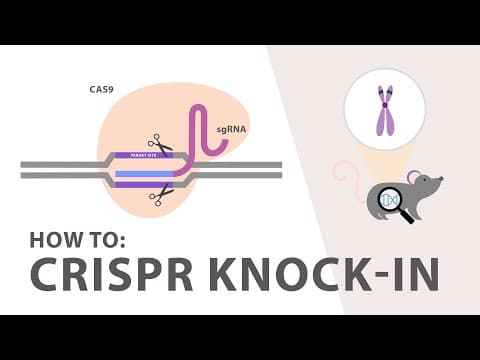
How to perform a CRISPR Knockin Experiment
Applied Biological Materials - abm
5m 30s733 words~4 min read
YouTube auto captions
Transcript source
YouTube auto captions
This transcript was extracted from YouTube's auto-generated caption track. The transcript below is server-rendered so it can be read, searched, cited, and shared without opening the original YouTube player.
Pull quotes
[0:05]The ability to insert or knock in a gene at a specific locus is a tremendously useful method for dissecting disease mechanisms.
[0:05]However, in previous years, the insertion of a foreign gene has been far too tedious and expensive for many labs to perform.
[0:05]Thanks to the recent development of CRISPR Cast 9 technology, gene knock-in experiments have now become a very popular technique in modern molecular biology.
[0:05]In contrast to random integration events by the viral system, CRISPR utilizes a guide RNA that directs gene insertion with extraordinary specificity.
Use this transcript
Related transcript hubs
Watch on YouTube
Share
MORE TRANSCRIPTS


