[0:03]His name was Pericles, and he was so influential in ancient Athens that the Golden Age of that city-state from 449 to 429 BC is known as the Age of Pericles. Pericles, a name that means surrounded by glory. And from his birth in the first years of the 5th century to a noble Athenian family, Pericles lived a life of glorious splendor and privilege. There was military glory too, in the last years of the Persian Wars. Before he was 30, Pericles achieved the rank of strategos or general. A position he would use to become the de facto leader of Athens and restructure the city state in profound ways. Some of them are still visible more than 2,000 years later on the Acropolis, the high hill above the city. The Erechtheum, the Temple of Athena Nike, the Parthenon. White marble marbles of engineering that were part of nationwide public works and fortification projects, Pericles initiated. But stone monuments, said Pericles, were not as great a legacy as what is woven into the lives of others. And Pericles changed the lives of Athenians by reforming the city's constitution and government. Pericles moved to replace the aristocrats on Athens' leadership council with a majority vote assembly that, he said, favors the many instead of the few. He opened civil service positions to all citizens, regardless of class, pushed for laws that afford equal justice to all in their private differences. Arranged pay for those serving on juries. He championed freedom of speech, political opinion and action. "At Athens, we live exactly as we please," the historian Thucydides quotes Pericles as saying. "Our constitution does not copy the laws of neighboring states. We are rather a pattern to others than imitators ourselves." One neighboring state, Sparta, saw the increasingly powerful Athens not as an ideal to follow, but a threat to eliminate. In 431 BC, the powerful Spartan army invaded Greece, to fight its way to Athens and found a deserted countryside. Pericles had collected all the residents within the walls of Athens. It was the grand strategy of strategos Pericles. Take a strong defensive position, exhaust the attackers, fight to the death. Hundreds did. In his famous funeral oration, which Thucydides recorded and paraphrased in the history of the Peloponnesian War, Pericles honored the war dead for choosing to die resisting rather than to live submitting. Pericles and those massed behind the walls of Athens could not resist what attacked from within, the plague. It killed thousands and finally, Pericles himself in 429 BC. The Peloponnesian War finally ended in 404 BC. The walls of Athens destroyed, the Spartans victorious. The Age of Pericles was over. But the ideas and ideals of Pericles on freedom, equality, citizenship and civic duty live on. Echoed in codes of laws and constitutions written in the centuries since. Produced by NBC learn, brought to you by Pearson.
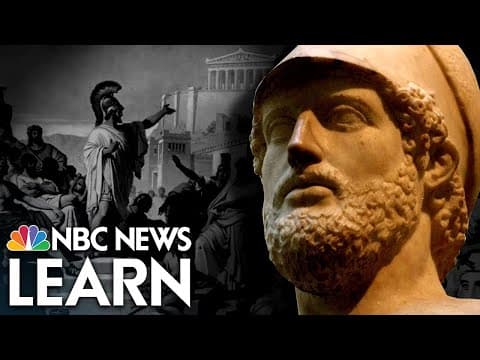
Pericles, the Golden Age of Athens
NBC News Learn
3m 54s483 words~3 min read
YouTube auto captions
Transcript source
YouTube auto captions
This transcript was extracted from YouTube's auto-generated caption track. The transcript below is server-rendered so it can be read, searched, cited, and shared without opening the original YouTube player.
Pull quotes
[0:03]His name was Pericles, and he was so influential in ancient Athens that the Golden Age of that city-state from 449 to 429 BC is known as the Age of Pericles.
[0:03]And from his birth in the first years of the 5th century to a noble Athenian family, Pericles lived a life of glorious splendor and privilege.
[0:03]A position he would use to become the de facto leader of Athens and restructure the city state in profound ways.
[0:03]Some of them are still visible more than 2,000 years later on the Acropolis, the high hill above the city.
Use this transcript
Related transcript hubs
Watch on YouTube
Share
MORE TRANSCRIPTS


