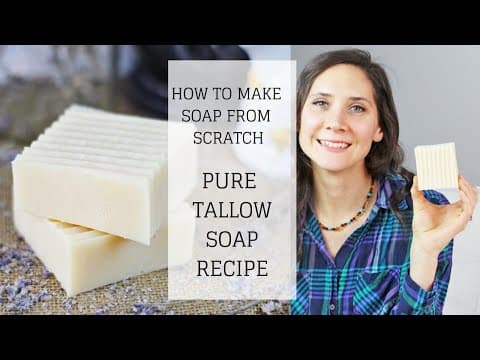
[0:00]Hi everyone, it's Marissa from the blog Bumblebee Apothecary.com. Welcome back to my channel. Today, I wanted to show you how to make a soap that is made with pure tallow, no other oils or anything, just a pure 100% tallow soap.
[0:23]So I also have a skin care shop. There is a section on my blog that will take you to that shop. On Bumblebee Apothecary.com and I offer a variety of different skin care products. One of the things that I offer is soap, and the 100% pure tallow soap was actually a suggestion by several different of my customers. I have another recipe and a video for how to make a soap that uses tallow plus a few other oils. And that makes a really beautiful soap too, but I wanted to show how to make this particular one, because it's a little bit different. So why would you want to use tallow in a soap? It is actually one of the most ideal fats for using in soap making. It produces a really nice hard bar and it has awesome skin benefits for the little bit of super fat, which just means the moisturizing part of the oils that is left over after the process of turning the rest of the oils into soap. I have other videos which I'll link below where I talk about the benefits of tallow and it's really popular, people request it quite a bit. So it's great for soap making. So I'm going to jump in and show you how to make this. So with soap making, all of the ingredients are measured by weight. I'm going to start by measuring my tallow that I'm going to use. I like to have the tallow melted for measuring just because it's so much easier to pour liquid tallow out into the bowl to measure the weight, rather than trying to chisel hardened tallow out of a mason jar. You can never get it all out that way, usually, and it's just so much easier to just pour it. Once I've measured the amount of tallow that I need for my recipe, I'm going to pour that right into my crock pot. And after that, I'm going to check the temperature of it, if it's hotter than 100 degrees, I'm going to let it sit and if it needs to be warmer, I'm going to turn the crock pot on low. Either way, the goal is for the tallow to be 100 degrees. Next, I'm also going to weigh out my water. In the description box below, I'm going to have a link to the blog post where I have a full written recipe with all the instructions and all of the measurements.
[2:42]Next, I'm going to measure my lye and it's very important to follow certain safety precautions when you're handling lye. You want rubber gloves, you want to wear eye protection. And you want to keep some white vinegar, just like this on hand, so if you did get any of the lye on you, you could neutralize it quickly by dabbing on some white vinegar. So now I'm just measuring out my lye.
[3:10]Now that I have everything set up and measured, I'm going to be checking the temperature of my melted tallow. I'm going to stir it around here just so I get an accurate temperature reading since I did have the crock pot's heat on and I'm checking for it to be 100 degrees. Once it's 100 degrees Fahrenheit, I'm ready to go mix my lye water. When mixing the lye water, you want to make sure to do this outdoors, begin wearing gloves and eye protection. And it's very important to make sure that you pour the lye onto the water. You can remember it by the snow falls onto the lake. For me, I know that this was the most intimidating part of soap making when I first got started. So I just want to reassure you that if you follow the proper safety precautions, it's really not a big deal. So you don't have to let being scared of lye prevent you from trying soap making, because it's really, really fun. But you're going to slowly pour the lye into the water and just stir. You will see that the mixture is going to turn cloudy. It's going to get very hot. You can see steam coming off the bucket here since it's cold outside and it's gradually going to start to turn clear. Once it looks like it's well mixed and all of the lye is dissolved, you can just let it sit. You'll want to set your timer for 10 minutes and let the lye water sit for 10 minutes outside. Once the 10 minutes is up, it's time to bring the lye water inside and again, still wearing our safety gear. Carefully pour the lye water into the tallow. After this, we're going to mix the lye water into the tallow using an immersion blender. Now, I am tripling this recipe. The written recipe that you'll find on my blog is for one third of the amount, so don't worry your crock pot will not be this full. But I'm just carefully stirring. What you're looking for is for the mixture to reach something that is called trace. And that is when it looks like a light pudding where you can see the marks of your stirring utensil left in the mixture when it's pulled across, and you'll see what I mean in just a second. So now you can see after I've been mixing for a little bit longer, it really doesn't take that long, but a certain amount of time, it's getting a lot thicker. There's still a little bit of mixing to do and since it's so full, I'm going to switch to a rubber spatula and just finish mixing. But you can see that it has technically reached trace. I just have to continue incorporating the rest of that oil that's still sitting on the top so that it's all completely mixed. So I'm going to finish that by hand. And now you can see after a bit more mixing, it's all completely incorporated and it's the nice light pudding texture, which is trace. So at this point, you can add the essential oils if that's what you're deciding to do. I am dividing this batch into three different portions and scenting them three different scents. So that's why I have part of it out in the glass pitcher. But the process would be the same if you're using one scent. You would just add that to the crock pot rather than dividing it. So I'm just going to mix that in well. Once those essential oils are mixed in completely, if you're deciding to use them, you just pour it into your mold. You can use these silicone soap molds that I'm using, which I'll link below, or you can even use a bread pan lined with wax paper. You just want to spread the soap out in there. After that, you're going to cover the top of the mold with wax paper.
[6:38]And then since the goal is to have the soap cool slowly, you're going to move the mold or several molds, like I have, onto a towel. And then you're going to wrap the molds in the towel. This way, it keeps the heat together. You're going to notice if you feel this that the mixture starts to become very warm and that's just the process of turning the oils into soap starting. But you want them to stay warm and to cool very slowly. So you're going to wrap them in the towel and then leave it for 24 hours. It's important to not leave it longer than 24 hours because the soap can get very hard and be really difficult to slice if you leave it too long. So 24 hours is the perfect time. So I'm going to just take the soap out of the mold and then start slicing it. I really like this soap slicer that I have that leaves the little ridges. I just think it's a really nice looking texture and it kind of helps the bar lather up really quickly when you first start using it. So I'm just going to peel this silicone part of the mold off. And then we're ready to start slicing. Since I have this ridge slicer, I'm just going to start by taking the ends off. I usually save the best looking bars to sell in my shop and then I use the little ends and other scrap pieces for ourselves. And with this particular mold, I'm just going to start by slicing in half and then each of those portions in half and then each of those pieces in half again, so that I end up with eight bars altogether. But it depends on what you used for a mold. If you're using a bread pan, you can use a knife to slice and just slice whatever size bar that you would like to have. And now you can see what it looks like. It is a beautiful 100% pure tallow soap, just like homesteders would have made. Once it's sliced like this, that it just needs to be kept at room temperature to cure for four weeks and then it's ready to use. Okay, so I hope you enjoyed seeing that process, and I hope you give it a try. If you have any questions about anything, please leave me a comment below. I always respond to all the comments that I get, and I love hearing from you guys, so let me know what you think. If you like this video, hit that like button and share it with your friends. If you're new here, please hit the subscribe button. I make new videos every week on living a sustainable handcrafted lifestyle. Thanks so much for watching. See you next time. Bye.