[0:00]The greatest minds in history didn't become who they were simply because of their natural genius. They became who they were because of how they trained their minds. Over my more than 13 years as a peer-reviewed scholar and educator, I've come to appreciate that many of these figures, in fact, were reading many of the exact same books. And in this video, I'm going to show you 10 of them, who read them, why, and what specific capacity each one builds for your mind. Starting with the first book on this list, Plutarch's Lives written around 100 AD. This is a book that arguably built more great leaders than any military Academy in history. Napoleon called it his manual of military and civil rule. George Washington modeled himself so deliberately on Plutarch's heroes that his contemporaries noticed. Shakespeare used it as the direct source for Julius Caesar, Anthony and Cleopatra, and Coriolanus. And in some passages even lifting Plutarch's prose almost word for word. US presidents Hamilton and Madison both drew on it heavily in the Federalist papers. And Charlotte Corday, who assassinated the revolutionary leader Jean-Paul Marat during the French Revolution, spent the entire day before she did it reading Plutarch. And regardless of the actual moral character we might judge of any of these individuals, the point here is about how Plutarch's work affected their strategic and intellectual growth. You see, Plutarch doesn't teach through principles, instead, he teaches through lived examples, through the stories of how extraordinary people actually behaved under pressure, made decisions and faced failure. And so what it trains in you is a certain kind of character modeling, namely, the ability to construct a vivid internal image of what a certain kind of excellence looks like and to measure yourself against it. Yet the second book on this list teaches you through proof rather than biography. Euclid's Elements, a geometry textbook written around 300 BC, shaped some of the greatest non-mathematical minds in history. And the story of how is one of the most surprising intellectual stories I know. Abraham Lincoln carried a copy in his saddle bag as a traveling lawyer and studied it by lamplight at night. But the thing is, he wasn't trying to learn geometry. Yet he later explained why he nonetheless carried it around with him. As he stated, you can never make a lawyer if you do not understand what demonstrate means. Einstein called his childhood copy of this book, the Holy little geometry book and named it alongside a magnetic compass as the two gifts that most shaped his mind. Newton, Hobbs, Spinoza, Copernicus, Galileo, all of them read this book. And all of them emphasized that it changed how they thought. And so what the elements actually trains is the understanding that a claim is not knowledge until it has been demonstrated step by step from first principles. Most people never learn this distinction. Lincoln did, and it showed up in every argument he ever made. Which brings us to a somewhat related book, at least in spirit, which is the third book on this list, Lucretius's De Rerum Natura, or in English, On the Nature of Things, written around 60 BC. Which was actually almost destroyed during the Middle Ages. In fact, it survived through a fragile manuscript tradition and nearly disappeared from active intellectual circulation in medieval Europe. In 1417, an Italian humanist named Poggio Bracciolini found it in a monastery library and brought it back into circulation. And how this subsequently affected some of the world's greatest minds is extraordinary. Thomas Jefferson owned five Latin editions of this book and described himself in letters as an Epicurean. Montaigne's heavily annotated personal copy still exists at Cambridge University Library. In fact, he quoted it 149 times in his essays. Machiavelli actually hand copied the entire manuscript for himself, and Newton, Galileo, and Darwin all read it. Stephen Greenblatt in his Pulitzer Prize-winning book The Swerve, argues that the rediscovery of this single poem helped ignite the scientific revolution and planted the seeds of the American founding. And what it trains is a sort of scientific thinking, the ability to explain the world through natural causes with evidence and method. Okay, so now the fourth book on this list is one I encountered way back during my undergrad philosophy courses, and I really think it's one of the most underrated books in philosophy. And that book is Boethius's Consolation of Philosophy, which was written in 524 AD, while its author waited in prison for his execution. Boethius was one of the most powerful men in Rome, a philosopher, statesman, and scholar, who was falsely accused of treason and condemned to death by torture. And yet the book he wrote in that cell contains no bitterness, no despair, no rage. Instead, it is a philosophical dialogue about what fortune can and cannot take from you, and what remains when everything external has been stripped away. Alfred the Great actually translated it into Old English. Dante cited it extensively in his divine comedy. Chaucer translated it into Middle English. Thomas More read it while himself imprisoned in the Tower of London awaiting execution. Queen Elizabeth I also translated it herself, and Thomas Aquinas wrote extensive commentary on it. In fact, for a thousand years, it was the most widely read book in Europe after the Bible. And I think one of the reasons for this is because of what it trains you in mentally, namely equanimity under radical adversity. The ability to understand that what fortune gives, fortune can take away, and perhaps most importantly, to locate your identity in something fortune cannot reach. But the fifth book on this list may have the broadest documented influence of any secular book in Western literary history. Montaigne's essays, published in 1580, were read by Shakespeare. Nietzsche said Shakespeare was Montaigne's best reader, which is a quintessentially brilliant Nietzschean observation. Descartes inherited something from the intellectual world Montaigne helped create. The willingness to doubt inherited authorities and rebuild understanding from the ground up. Pascal argued violently against him, which means he read him obsessively. Nietzsche, Emerson, Rousseau, Virginia Woolf, Darwin, Freud, and Marx. All of these thinkers cited Montaigne's essays as a direct influence. And I think that what makes this particularly interesting is that Montaigne's subject was himself, his internal contradictions, his changing opinions, his uncertainties, and so on. In other words, he was trying to understand what it actually felt like to be a thinking human being in an uncertain world, rather than building a system or constructing some grand argument. And so, what I think we can say that this book trains is a sort of intellectual honesty, the discipline of examining your own internal contradictions, rather than hiding them, and following your thinking wherever it actually leads, rather than where you want it to go. Yet, it's the sixth book on this list that is the least well known, relative to the scale of its influence. Xenophon's Cyropaedia, the Education of Cyrus, written around 370 BC, can be thought of as a sort of leadership manual. Alexander the Great read it before his campaigns. Scipio Africanus carried a personal copy. Caesar and Cicero both drew on it. Machiavelli knew Xenophon well, and The Prince can be read in part as a Renaissance response to Xenophon's model of rulership. Jefferson actually owned two copies. Benjamin Franklin read it. And Peter Drucker, widely considered the father of modern management, said that despite reading every leadership book published in his lifetime, Xenophon remained the best. And what it trains you on is the understanding that leadership is fundamentally a problem of character, rather than technique. And also that how a leader treats people when it costs something is the only reliable measure of who that leader actually is. Yet, it's the seventh book on this list that presents you with the most extreme real world test of any book here, namely Epictetus's Enchiridion. Marcus Aurelius, who as emperor, had access to virtually every Western philosopher alive, credited it as the foundation of his thinking and thanked his teacher specifically for lending him his personal copy. Frederick the Great never went on a military campaign without one. Theodore Roosevelt brought it to the Amazon. Montaigne had a line from it carved into the wooden beam above his study. And then there is Admiral James Stockdale, who was shot down over Vietnam in 1965 and held as a prisoner of war for seven and a half years, subjected to systematic torture. Stockdale later wrote that he survived because he had memorized Epictetus before deploying and recited the arguments to himself in his cell. And so what the Enchiridion trains you on is the dichotomy of control, the ability to distinguish in any situation what is genuinely within your power from what is not, and to stop wasting your energy on the latter. The eighth book on this list is one that most Western readers have never seriously engaged with, which is unfortunate. You see, the Analects of Confucius, compiled by Confucius's students around the 5th century BC, shaped the entire intellectual foundation of East Asia for two millennia. But what is less well known is what it did to Western minds when it arrived in Europe. The prominent thinker Voltaire was so taken with Confucius that a portrait of him hung on the wall of his library. And he called him the greatest sage who had ever lived, using Confusion rationalism deliberately as a weapon against Christian dogma and European religious intolerance. Leibniz also drew from Confucian philosophy in developing his own metaphysics, seeing in it evidence of a universal rational morality that transcended culture. Ralph Waldo Emerson read the Confusion classics extensively and cited them throughout his essays. And the 1687 Latin translation of the Analects became, in the words of historians of the Enlightenment, one of the primary intellectual resources for an entire generation of European thinkers trying to imagine a moral order that didn't depend on revealed religion. And so what the Analects trains is something simple, yet extraordinarily rare. The understanding that how you govern yourself determines how you relate to others, which determines how institutions form, which in turn determines how civilizations hold together. The ninth book on this list is the one that Thomas Hobbs, who had read virtually everything, chose to translate at the age of 40. Stating that it was the most instructive work he had ever encountered, namely Thucydides' History of the Peloponnesian War, written around 400 BC. A history of a war between Greek city-states. This is a book I personally was assigned readings from in my undergrad history of Ancient Greece class. Alexander the Great kept this book with him while on campaigns. Frederick the Great studied it carefully. John Adams called it essential reading for any serious statesman. And what Thucydides trains is political realism, the ability to see power as it actually operates, rather than as it is officially justified. He was the first Western historian to strip away mythology and moral decoration from political events and simply describe what was happening, who wanted what, who had what, and what they were willing to do to get it. And the fact that it was written 2,400 years ago and still reads like an account of last week, kind of says a lot. But finally, the 10th book on this list might be the most surprising, The Arabian Nights, compiled across centuries between roughly the 9th and 14th centuries. The poet Goethe read it repeatedly and said it permanently changed how he thought about narrative. Charles Dickens cited it as one of the most formative reading experiences of his life. Marcel Proust drew on its structure. Jorge Luis Borges said it shaped his entire understanding of how stories work. Franz Kafka, J.R.R. Tolkien, Alfred Lord Tennyson, Samuel Taylor Coleridge, and Marie-Henri Beyle, better known by his pen name Stendhal, all read it deeply. And so what The Arabian Nights trains you on is narrative imagination, the ability to think in different frames, different structures, and also stories in general, rather than in isolated facts. And this insight is embodied in Scheherazade, the fictional narrator at the heart of the collection. A young woman who survives a murderous king by telling him a captivating story each night and stopping at a cliffhanger before dawn, keeping herself alive through the sheer power of narrative. She survives not through strength or strategy, but through her ability to construct an endless, self-generating story and keep the listener inside it. And often, it is narrative, not simply analysis alone, that truly makes us alive. If you want to keep leveling up your critical thinking to make a massive impact, not only on your own life, but also on the lives of countless others, then be sure to watch this next video.
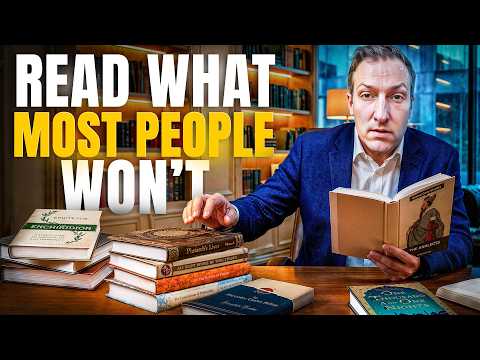
10 Books That Secretly Built History's Greatest Minds (and how they'll build yours)
Stephen Petro
13m 28s2,159 words~11 min read
AI audio transcription
Transcript source
AI audio transcription
This transcript was generated from the video's audio because no usable YouTube caption track was available. The transcript below is server-rendered so it can be read, searched, cited, and shared without opening the original YouTube player.
Pull quotes
[0:00]The greatest minds in history didn't become who they were simply because of their natural genius.
[0:00]Over my more than 13 years as a peer-reviewed scholar and educator, I've come to appreciate that many of these figures, in fact, were reading many of the exact same books.
[0:00]And in this video, I'm going to show you 10 of them, who read them, why, and what specific capacity each one builds for your mind.
[0:00]Starting with the first book on this list, Plutarch's Lives written around 100 AD.
Use this transcript
Related transcript hubs
Watch on YouTube
Share
MORE TRANSCRIPTS


