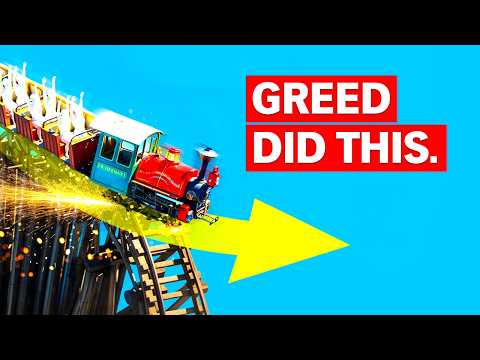
[0:01]This is the Big Thunder Mountain Railroad.
[0:07]A mine train roller coaster rattling down the tracks at 45 km per hour.
[0:15]One guest will not make it through this next ride alive.
[0:29]Disneyland calls itself the Happiest Place on Earth. This kingdom of fantasy and imagination is the happiest place on Earth. Lifesize movie characters, blissful kids, and carefree parents. Safety on the rides is supposed to be the park's top priority. But something has changed over the past few years. During the Big Thunder Mountain Railroad crash, riders suffer broken ribs, facial cuts, and painful chest injuries. One person dies. And this is not the only fatal accident in the park. How did this happen? How did the happiest place on Earth turn into a nightmare at the turn of the millennium? We talked to journalists, engineers, and writers to piece the story together. It seemed like every couple of weeks there was some new headline of some horrible thing that happened at Disneyland. He warned them in writing several times, and they ignored him. They ignored him because it didn't fit into their proposal. As it turns out, these accidents were no unfortunate coincidence. They appear to have been the result of calculated corporate cost-cutting and disastrous negligence by the staff. And at the center of it all sits one of the world's most powerful consulting firms. McKinsey.
[1:51]My first time I visited Disneyland was in the summer of 1969. Uh I was uh six years old. I just remember the feeling of being someplace unlike any place I'd visited ever before in my life. It was it was truly a magical feeling. For many, a trip to Disneyland California is a lifelong dream. Something they travel from all over the world to experience. Walt Disney, the legendary founder of the entertainment empire, once said, "I don't want the public to see the world they live in while they're in Disneyland. I want them to feel they're in another world." Disneyland is just able to tap into something that no place else has. A combination of joy, nostalgia, innocence, color, light, music, all with a a story personalized for each person uh playing in the background that sews it all together through familiar images and characters. This is David Koenig. He's written several books about Disneyland. And over the years, he has interviewed around a thousand Disney employees. Disneyland California opened in 1955, and for decades it was considered one of the safest theme parks in the world. In 1991, an expert magazine even recognized the park's facilities division as the world's best maintenance organization. But at some point, others start calling the shots. This is Paul Pressler. He's been Disneyland California's top executive for three years now. On paper, the numbers don't look bad. The park's division is turning a healthy profit. But Pressler is determined to squeeze out more, because Disney stocks aren't doing so well. He wanted to impress the board, and the way you do that is by cutting expenses. It's the quickest way, and the way to do that was by cutting maintenance. That's Walt Bogdanich, a New York Times journalist. We interviewed him and his colleague Mike Forsythe for this video. They co-authored this book, a key source for our research. You'll find the link in the description. Pressler is a former toy industry executive, and known as a hard-nosed cost cutter. And for that, he brought in help from McKinsey. McKinsey is one of the most prestigious consulting firms in the world. The company hires only the best of the best. Clients pay up to $1,200 per hour for their expertise. Now, a few of those consultants have drawn up a plan to make Disneyland even more profitable. And today, they're pitching their ideas to Pressler. They spent over a year studying every facet of Disneyland, looking for ways to cut costs. Initially, uh McKinsey and Company came in and targeted the maintenance division that was known as one of the most respected facilities divisions of any company anywhere. And yet, the consultants aim to slash the division's budget by 25%, mainly by cutting staff. To do that, they borrowed a concept from the aviation industry called reliability-centered maintenance or RCM. The idea is that maintenance decisions should not be based on the intuition of experienced employees, but on the analysis of repair histories and breakdown rates. According to McKinsey, the resulting increase in efficiency would allow the park to let go or transfer about half of its maintenance staff. And that would save Disney up to $16.9 million per year. Pressler goes on to put many of those recommendations into practice. In the past, maintenance workers were each assigned to one specific ride, which they ended up knowing inside out. Now they're floated between several attractions to maximize efficiency. Also, most maintenance workers are transferred to the night shift. Only a small emergency response team remains to handle mechanical breakdowns during the day. That way, the mechanics can work undisturbed after the park closes its gates. Moving more folks to third shift probably made some sense, but not moving almost everyone. Because there are many things that can't be done in the middle of the night, when it's dark and cold and wet, you're not going to effectively painting a building in the middle of the night. Many employees complain. It's a harsh change for people who've worked days almost their entire lives. Many of them were devastated by these changes to suddenly have your working conditions worsen by tenfold. You know, if you're working suddenly graveyard shift and never able to see your family, being exhausted on your job, being rushed through what you had to do. McKinsey responds by granting all overnight workers a free annual subscription to the Working Nights newsletter. It features leading experts sharing shift work wisdom on nutrition, sleep, and a healthy family work-life balance. To no avail, according to David Koenig, more and more employees are soon being treated for high blood pressure and other stress-related symptoms. Night work significantly increases the risk of chronic health issues, and it's simply not very healthy. So management brings in psychological counselors. They advise insightful suggestions, such as to use caffeine to stay alert and have their loved ones videotape daytime family activities, so the workers can stay connected to them.
[7:09]Robert Klostreich is part of Disney's maintenance crew. One day he's interviewed by a McKinsey consultant to review his routine on the Big Thunder Mountain Railroad. The consultant asks him, why do you inspect the lap bars every single day? Those are the restraints that hold passengers in their seats. And according to McKinsey's data, they have never failed. And the maintenance worker said, well, the reason there's no accidents is because we check the lap bars every day. And it was almost as if, you know, we're not going to do if we were an airline, we're not going to do pre-flight checks because we haven't had accidents in a while. In 1997, Klostreich sends an internal memo to warn his supervisors. The ongoing staff shortage and labor distribution could no longer guarantee effective daily preventative management. He warned them in writing several times, and they ignored him. Um they ignored him because it didn't fit into their proposal, which was, look, cost cutting, if we do it in a rational way, is a good thing. There are better ways to make an organization more efficient. Odoo is an all-in-one business management software that replaces countless scattered tools with one seamlessly integrated platform. It offers over 45 apps, from project management and HR to accounting, website, sales, and much more. It's all in there. One of the easiest apps to start with is invoicing. Odoo's invoicing app lets you create and send invoices in seconds. Pick the customer, add your product or service, set quantities, price, billing terms, and email it off instantly. A dedicated portal lets customers pay using their preferred method. Payments are easy to track by synchronizing your bank account. Odoo also supports Peppol for B2B electronic invoicing, helping businesses stay compliant with upcoming European regulations. Your first Odoo app is free for life with unlimited hosting and support. And starting at 19.90 per month, you can unlock the full Odoo suite as your business grows. Find out the link in the description to get started. Back in 1997, Klostreich is concerned that the new system can no longer guarantee proper maintenance. And unfortunately, time will prove him right. But who exactly are these consultants, and how do they work?
[9:26]This is Eric Edstrom. He holds an MBA and a master's degree in environmental science from Oxford. Edstrom has served as a soldier in Afghanistan. He returned disillusioned and is now determined to make a difference. He wants to help fight climate change. McKinsey promises him exactly that. Dream with me for a second. What if we could be the largest private sector catalyst for decarbonization in the world, to change the world to make the world just a little bit better place to bring a new future to life, doing something that's meaningful to our clients, and ultimately the society act on and being an enabler for that kind of change, for the change that matters.
[10:07]In 2018, after working for another consulting group, Edstrom joins McKinsey. He's full of energy and optimism. If there's one thing McKinsey does very, very well, it's recruit the best and brightest. From elite universities uh in Europe and the United States, and in Asia as well. They appeal to young people, really bright people, you know, with a very attractive package that you'll be able to learn about uh business in the world, and you might also make a positive difference in the world. It's not money. McKinsey is one of the most coveted employers on the planet. Each year, nearly a million people apply for just a few thousand spots. The firm claims to serve 90 of the top 100 corporations worldwide. McKinsey also advises governments around the world. From Ice in the US, and the German Defense Ministry, to past stints with Saudi Arabia and Russia. They're doctors for companies, they're corporate doctors. That's how they like to view themselves in the most simple terms that they have knowledge that for many reasons companies pay for, and they pass on that knowledge for good or ill uh to their clients. Hiring McKinsey means getting support from a small army of exceptionally smart and highly trained advisers. These consultants help managers with some of their most challenging tasks. Acquire other companies, drive innovation, or cut costs, or at least they try to help. One of the problems is that when you hire McKinsey, you're hiring young people who don't have experience. You're hiring people who don't know your industry, and you're paying them a lot of money because supposedly they have this genius. Because they're McKinsey, they know what to do, but often they don't know what to do. And frankly, they're just doing what management tells them to do. Because management doesn't want to take responsibility for layoffs or for cost cutting. So it's easier to say, hey, when McKinsey told us to do it. Disneyland Chairman Paul Pressler and McKinsey go on to form a highly profitable alliance. The consultants deliver good numbers, which appear to legitimize the layoffs and budget cuts. Meanwhile, Pressler continues to climb the ranks inside Disney.
[12:27]The effects of the rigid cost cutting slowly start to show throughout the park. Paint is peeling here and there. Rides break down more often. And when the lights on Main Street go dark, no one replaces the bulbs anymore. Most of that preventive maintenance was gone, and it was just sort of emergency last minute slap dash. Get this thing working in the middle of the night maintenance, uh things were breaking down constantly. In the late 90s, you would walk through Disneyland, and it would be a third of the attractions could be closed. Unfortunately, um there were consequences for these many decisions of moving to people in charge who didn't necessarily have a familiarity with how to operate the attractions. Christmas Eve, 1998. Luan Dawson is 33 and works as a software engineer at Microsoft. He and his wife and son are standing in line for a ride called Rivers of America. The Columbia, an old-fashioned river boat, is approaching the dock. According to David Koenig, management significantly reduced the number of crew members to the bare minimum of three. Today, one of them is running late. Another colleague agrees to fill in at the last minute. She's standing at the dock, holding a nylon rope and ready to dock the ship. Disneyland's safety protocol says she should wait until the Columbia has fully stopped and reversed. But she's new to this section of the park. Two months ago, she completed a 10-day crash course covering seven different attractions. She has never docked the Columbia before and has not been trained to operate the ride. The four-kilogram iron cleat on the ship's hull is loose. The wood around it is rotten. She throws the rope too early. The ship is still moving. And the cleat is torn from the ship.
[14:17]It shoots back towards the dock and hits the employee's foot and ankle. Then it ricochets upwards, crushing Luan Dawson's skull and striking his wife across the face.
[14:31]The dock is almost immediately cleaned by Disneyland personnel. According to Koenig, they also brief witnesses on what to say to the police. But officers don't arrive for five hours. Apparently, they only heard about the accident from the paramedics. Forty-eight hours later, Luan Dawson is declared brain dead at the hospital and taken off his respirator. An investigation by the competent authority blames the accident on inadequate staff training. Several employees will later remember having noticed the loose cleat and the rotten wood around it. But it was obviously never repaired. The weak wood is never formally identified as a cause of the accident. The new regime and the McKinsey recommendations had made so many cutbacks, everything sort of accumulated into this perfect storm of terror. It was horrible. The Dawson family sues the park for damages. Disney settles out of court and pays an estimated $20 to $25 million. The exact terms of the settlement are sealed. At first, Disneyland reacts by updating ride procedures and bringing back experienced ride operators across the park. But according to David Koenig, many of these safety measures are quietly rolled back soon after. Some new procedures were instituted immediately, um as far as uh extra precautions in how to operate the ship. But unfortunately, many of the most important reasons that allowed this accident to happen, related to the cutbacks, those were allowed to continue. It was forgotten because it was believed that McKinsey was doing the right thing and Disney was doing the right thing by listening to them. And accidents do happen. I mean, that is a fact. There's no way that you, you know, a company can avoid all all problems. What they really tried to do, at least try to interpret their actions from the outside, appeared to be doing was to protect their own bad decisions and cutbacks and sort of cover their backsides.
[16:35]Two months after the Columbia tragedy, maintenance worker Robert Klostreich resends his warning. This time, he submits it directly to one of the park's senior managers. He writes, I am concerned that the attractions are deteriorating even more. Shortly after, Klostreich is fired. Disney claims he was let go because he refused to work night shifts. Klostreich himself believes he was dismissed for blowing the whistle. The cost cutting doesn't seem to slow down Paul Pressler's own ascent. By the time of the Columbia accident, he had just been promoted to president of the entire Disney theme park division. But this is only the beginning. In 2000, a four-year-old boy named Brandon Zucker falls out of a spinning car on the Roger Rabbit Cartoon Spin. He's trapped under the following car and stuck there for 10 minutes before first responders can get him out. Brandon suffers severe brain damage and can never walk or talk again. He dies at just 13 years old. There's no evidence that ties the accident directly to the cost cutting measures. But an official investigation once again cites grave mistakes committed by the staff. Brandon Zucker should never have been seated closest to the cutout entry way of the car. Also, ride operators probably failed to properly lower his lap bar. It stands to reason that better training might have prevented the tragedy from happening. To my knowledge, the experts from McKinsey and Company that were brought in, none of them had any theme park experience. They were all folks who were trained in doing business better in general. In a sense, that's what Disney really wanted. Their company had been run by theme park experts since its founding 40 years before. McKinsey is hired to solve problems and make companies better. But better in what way, better for whom? McKinsey has made a lot of money working for the tobacco industry. It has advised authoritarian governments and has helped the Ice department in the US, quote-unquote, optimize its detention and deportation processes. But perhaps the most haunting example is this one. Since the mid-90s, US pharmaceutical company Purdue has been selling a drug called Oxycontin. The company said it had a low risk of addiction, but that claim turned out to be false. As of 2004, McKinsey was deeply involved in helping Purdue turbo charge sales of the highly addictive opioid. One strategy involved identifying which doctors were most likely to generate the biggest increases in Oxycontin prescriptions if actively targeted by Purdue sales force. We know all this because McKinsey admitted to it in court. McKinsey also helped Purdue avoid problems with the US Food and Drug Administration. The FDA also happened to be one of McKinsey's clients. You know, not only was McKinsey working with the regulator and then the industries, but also sometimes it was the same consultants doing that work. The same consultants who would be advising the Food and Drug Administration in the United States, and they would also be on a project with an opioid maker. Since 1999, more than 850,000 people in the US have died from opioid-related overdoses. Purdue isn't the only culprit, but the company played a major role in fueling America's opioid crisis. Eventually, thousands of opioid lawsuits were filed against Purdue Pharma and its owners, the Sackler family. They agreed to a $7.4 billion settlement after previously paying $5.5 billion in fines. The company is now bankrupt. McKinsey spent years shaping Purdue's strategy. Walt Bogdanich says they've always used the same exact excuse to dodge any sort of responsibility. They can always say and have said that we just gave advice, we didn't give orders. They can always slip out of responsibility by saying that, well, we recommended it, but we didn't carry out the orders. And that worked for a long time, until the opioid crisis. We were able to look at thousands and thousands of documents about that case, and it really did present a picture of these McKinsey consultants that were working extremely close with the management. They were part of the team, and the result was that they did have to pay a price. In 2024, McKinsey paid over $600 million to settle investigations into its role in the opioid crisis. The firm has since apologized for its involvement. The statement can still be found on its official website. It reads, this terrible public health crisis and our past work for opioid manufacturers will always be a source of profound regret for our firm. The statement also emphasizes that the company introduced comprehensive compliance reforms. And yet, McKinsey even advised Purdue Pharma on how to counter emotional messages from families who lost members to opioid overdoses. The firm also admitted to this in court. We don't know if McKinsey offered a similar service to Disney after.
[21:34]Well, by now, more and more Disneyland employees are speaking up against McKinsey. But hey, doesn't every business try to optimize?
[21:46]And what's the big deal with making the park more efficient?
[22:08]And McKinsey only ever gives advice. The final shots are always called by the park's management.
[22:29]Marcelo Torres dies at only 22 years old. His best friend was seated next to him and survives. Severely injured. Nine other passengers are hurt in the accident. That morning, staff at Big Thunder Mountain Railroad had noticed a strange noise coming from the train. But they didn't know how to respond and ended up hesitating too long. Torres's family sues Disney and investigators step in. They conclude the accident was the result of poor maintenance and insufficient staff training. But the family's lawyer goes further. This was not just one mechanic making a mistake. This was really systemic to how they were running the park. There's still a lot we simply don't know about the Disneyland case. Like, which consultants were involved, which of their recommendations were actually implemented. Neither Disney nor Paul Pressler responded to our questions. McKinsey denies any responsibility for the accidents. One of the biggest mysteries is the maintenance system known as RCM. The method the consultants borrowed from other industries. RCM is considered a gold standard in aviation, nuclear industries and railroad infrastructure. So why didn't it work at Disneyland? Sometimes that might be done as we would say, you know, in English, in cookie cutter fashion. And, you know, the same solution for for different industries, uh, and so, you know, perhaps what went wrong is they tried this cookie cutter approach uh to Disneyland that might have worked for another industry, but it it it didn't work, uh, there. Disney is not a normal factory, it's not an assembly line where you can just take things from other industries and say, oh, well, what worked there in this produce factory is going to work in operating the Indiana Jones adventure. We reached out to Marius Basson, one of the leading experts on reliability-centered maintenance. His company Aladon owns the trademarks for two major RCM protocols. Basson doesn't know all the technical details of what happened at Disneyland. But he strongly doubts that RCM was applied correctly. He thinks that in theory, RCM could work in a theme park environment. But he also writes, if RCM is used to reduce costs, it is probably applied incorrectly. RCM or reliability centered maintenance is not cost-centered maintenance. The problem with most RCM program implementations is that senior management and stockholders want to see immediate benefits and cost reduction. We don't know if RCM was applied incorrectly at Disneyland or is just used as a pretext for cutting costs, or whether it was the wrong approach to begin with. What we do know is that many people believe the cost cutting measures recommended by McKinsey have played a role in the accidents. But was the firm ever held accountable?
[25:16]Eric Edstrom joined McKinsey full of hope and idealism. But he soon realizes that the company was not living up to its promises. I joined McKinsey in 2018, and while I was there, I found that the projects that were available were not anything like what were advertised. And rather than what you might see on a McKinsey website, which talks about vaccine cold storage or renewable energy, that in practice is far and few in between. He grows increasingly disillusioned. He can only watch as McKinsey helps fossil fuel companies become even more efficient in extracting coal and oil from the ground. Even though the firm had originally recruited him with the prospect of fighting climate change. Eventually, he's had enough. He sends out a farewell statement that ricochets around McKinsey offices across the globe. We know it from the book When McKinsey Comes to Town. As an organization, McKinsey seems to talk a lot about values and principles without taking a valued or principled stand for much of anything. In my mind, McKinsey is an amoral institution. An organization that regularly takes on clients who bring harm to others. We would have loved to hear Disney and Paul Pressler's take on the allegations made against them. Unfortunately, neither responded. We also sent a laundry list of questions to McKinsey. For example, we were curious about what the consultants themselves thought about their work at Disney. But instead of giving concrete answers, McKinsey pointed us to a general statement of theirs from 2022. There it says that the book by Walt Bogdanich and Mike Forsythe fundamentally misrepresents the firm and its work. The statement also claims that McKinsey's clients contributed to 80% of global CO2 reductions in recent years. We can't independently verify that number, nor whether McKinsey's work for those clients has anything to do with climate mitigation. The allegation that McKinsey's work has directly contributed to mass layoffs is rejected as a stereotype about consultants. The statement says that McKinsey is typically hired to help clients grow their business and expand their workforce. The company has supposedly learned from its mistakes and invested around $1 billion in a new risk management and compliance system. The firm claims it now has the industry's most rigorous client selection policy. The statement further denies any form of responsibility for the incidents at Disneyland. So we decided to follow up again, asking what McKinsey had to say about the many reports suggesting the firm's recommendations did play a role. A spokesman replied, we aren't commenting on whether or not we served a particular client, but rather we reject the author's attempt to connect our work to events and issues in their book that we simply had nothing to do with. Hope that helps. The firm was never sued over its connection to Disneyland tragedies. Paul Pressley left Disney in 2002 and became CEO of the Gap clothing chain. He's currently the chairman of the Board of Directors of eBay. The family of Marcelo Torres has reached an out of court settlement with Disney for an undisclosed sum. The company accepts responsibility for the Big Thunder Mountain accident. Torres's parents have given $500,000 from the settlement to provide scholarships to aspiring talents at their son's former college. Marcelo Torres was a graphic artist.