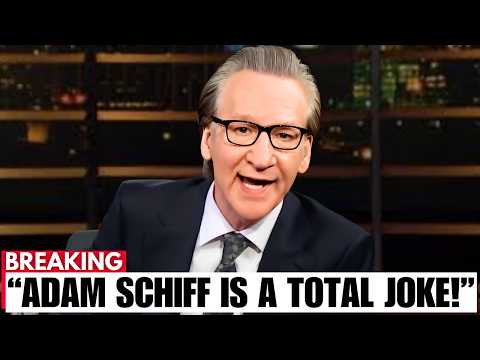
[0:01]For example, you. I've seen you on TV a lot in the last couple of years. I know everything you know or that you tell us about the Russian situation. I have no clue what you think about healthcare. I've never heard it. I don't know whether you're for Medicare for all or improve Obamacare or or get a chicken. I don't know what. How do we help you get this done? Not how do we put more obstacles in the way. I haven't forgotten about your roof. Uh all of that is important to keep in mind. And my pot store and what? And and the the the the pot store, the woods that I own with Woody Harold. It's the biggest problem we had was the government of California. Bill Mar has clashed with Adam Shiff before, and let's just say the encounters weren't exactly polite. Shiff, the junior United States Senator, represents the kind of hard line woke politics Mar loves to challenge head-on. And if you know Mar, you know he never lets that slide. So whenever these two share a stage, sparks are guaranteed, and the tension is unmistakable. Hit that subscribe button, settle in, and let's dive right into the showdown. statement from the administration. The President had the constitutional authority to direct the use of military force because he could reasonably determine that such use of force was in the national interest. That's too vague for you? Totally vague. Okay, because that's from Obama. Well, Mar practically set shiff up by reading a statement issued by Obama after he sent troops to Libya. When asked whether the statement was too vague, Shiff agreed it was vague. What he didn't realize, though, was that the words Mar read came from Obama, not Trump. The trap snapped shut instantly. You can practically see the shock flash across Shiff's face the moment the reveal lands. In a single beat, Mar exposes the glaring double standard, leaving Shiff scrambling as the audience realizes exactly what just happened. If you thought that was epic, watch Mar expose Shiff's hypocrisy in this next clip. And it was that moment. If film and TV productions continue to move out of California due to tax incentives and other states, what might the future look for Los Angeles? Is there a risk of it becoming the next Detroit? Well, But I I don't agree with the diagnosis of why the film industry is leaving. Uh they're leaving because they're getting richer incentives in other states and other countries. Uh and we haven't kept pace with that. So, if you want to film in the United Kingdom, you're going to get a tremendous tax break and our motion picture industry has left the country. Uh if you want to film in New York or Georgia, there are generous tax incentives. If we want to keep the industry here, uh we're going to have to compete uh with tax incentives. California has started to do that. Nope. Hollywood isn't fleeing California for fun. It's running from the crushing taxes. Everyone in the industry is complaining about it. This isn't some mystery. Sure, Georgia and the UK offer incentives, but the real issue is simple. Filming in California has become ridiculously expensive, so expensive that Europe suddenly looks like a bargain. Every year, California loses people because they're being driven away by a high tax, high high regulation state where public services don't reach the standards that they uh that they should. That should be a signal that we shouldn't have one favorite industry or another. We should have a favorite state. California should be competitive. Before Mar even jumps in, this guy is already challenging Shiff. Let's be honest, California has been bleeding businesses and residents for years because of sky high taxes and suffocating regulation. Even Mar has blasted that over-regulation countless times. So, why on earth did Shiff feel the need to frame the issue that way? forgotten about your roof. Uh all of that is important to keep in mind. And my pot store. And what? And and the the the the pot store, the woods that I own with Woody Harroldson. It's the biggest problem we had was the government of California. I imagine your producers are saying, oh God, I can't believe Shiff brought up his roof. Uh yeah, I mean, we want, we love it here. We want to live here. This, I mean, we, you know, the West Coast has the sunshine and the girls all get so tan. I don't know what how I could. But we we just got to make it friendly here. All right. Yes, California absolutely needs to become friendlier to businesses and residents again. And that responsibility starts at the top with leaders like Gavin Newsom and allies such as Adam Shiff. For years, people have watched cost spiral, while the state's leadership keeps insisting everything is fine. But clearly, something has to give. Housing prices across California have climbed to levels that ordinary families simply cannot afford. At the same time, taxes remain among the highest in the country, putting pressure on homeowners, workers, and businesses alike. Then there's the mountain of regulations that make it painfully difficult to build, expand, or even operate efficiently. When you combine expensive housing, heavy taxes, and suffocating bureaucracy, it's no surprise that companies and residents start looking elsewhere. If California wants to keep its talent, its industries, and its reputation as an economic powerhouse, serious reforms are needed: lower costs, smarter regulation, and leadership willing to admit the current system isn't working. The panel agreed with the UK's proposal to impose a social media curfew for kids. How realistic is it to enforce? here one night suggesting I was going to open a place called Bill Mars' Catholic school.
[5:33]Let me finish. Because Catholic schools are popular now, even with people who aren't Catholic. It's the last place you can send your kid to get an old school education. And they just tell the kids, you know, forget about the Jesus stuff. Just, you know, they to them that's that's okay indoctrination as opposed to some of the other indoctrination that goes on. And also the Catholics don't put up with bullshit. They take your phone. You have to learn your P's and Q's and your grammar and all this kind of stuff. And that's what I just don't understand that parents don't, they don't have the whip hand anymore. Not that you should actually use a whip. It was liberal policy makers and education reformers who first pushed for phones and constant digital access in classrooms, promising it would modernize learning. Instead, many classrooms turned into distraction zones where attention spans collapsed and serious learning took a back seat. Now, the consequences are impossible to ignore. That's why Bill Maher raises a pointed question. Should the United States follow the lead of the United Kingdom and start banning kids from social media until they reach a certain age? free movie and TV show that has a teenager in it, cannot be mischaracterizing this. And the kids just, they don't listen to their parents, they they turn their back on them, they walk out of the room. Things that would just get me shut down when I was a kid. And and I think it starts with the phone. It's a simple question, but one loaded with uncomfortable implications. As Mar presses the issue, you can practically see Adam Shiff shifting uneasily in his chair. Mar doesn't ease up either. He fires off one blunt observation after another about discipline, focus, and what real education is supposed to look like. In his view, schools should be places for learning, not endless scrolling, and the current system has clearly lost its way. The reason why Joe Biden is going to beat Donald Trump is because at the end of the day, America is going to want a president who is a decent human being, who doesn't who doesn't shit on other people, who has has some uh interest in the American people, some interest in something beyond himself. Now, this was before the elections, when Adam Schiff was absolutely convinced that the Democrats were going to win. Watch Bill Mar as he methodically tears that confidence apart and exposes the cracks in that illusion for everyone watching. put out an article last year and it was called separating sports by sex doesn't make sense. And talked about how we separate sports like the WNBA and the NBA. It's just because it's just socialization. This is insane. I agree. Okay. That's why people vote for Trump. Because there's stuff like that on the left that people just go, Uh, I know Trump's horrible, but separating by sports by sex makes perfect sense. And if you think it doesn't, uh you can't lead the country. That's cutting off your nose to spite your face. Well, okay, okay, I'm just I'm just giving you the answer to the question you're asking all night long. Why do they vote for Donald Trump? It's not always because they like him. It's because stuff like that is coker. And just like a biblical prophecy, Bill Maher's prediction ended up coming to pass. While many voices on the left were confidently predicting victory, Mar took a far more grounded view of the political climate. He warned that frustration was building among ordinary voters and that ignoring it would come at a cost. In the end, that frustration translated into strong support for Donald Trump at the ballot box. Mar's argument was simple: A lot of Americans felt exhausted by what they saw as political excesses and ideological rigidity. Many voters believed that common sense was being pushed aside in favor of culture wars and partisan talking points. Others felt that debates around science, policy, and everyday issues were becoming increasingly politicized. Whether one agreed with Mar or not, his point was that ignoring these frustrations was risky. When voters feel dismissed or unheard, they eventually respond at the ballot box, and that's exactly what happened. Here, Bill Maher is nudging Adam Schiff to do something many politicians quietly avoid. Step outside the friendly media bubble and appear on Fox News. Shiff, however, looks noticeably reluctant, and the reason isn't hard to guess. It's far more comfortable to appear on networks like MSNBC or CNN, where the tone is generally friendlier and the questions tend to be far less confrontational. In those environments, interviews often feel predictable, with hosts who share similar political assumptions and rarely push guests too hard. Mar's point is simple: If you're confident in your arguments, you should be willing to defend them anywhere, even in front of a skeptical audience. That's where the real test happens. Facing tough questions, critical hosts, and viewers who may strongly disagree, forces politicians to sharpen their reasoning and explain their policies clearly. Mar is essentially calling out what he sees as a comfort zone, one where political figures speak mostly to audiences that already agree with them. on TV a lot in the last couple of years. I know everything you know, or that you tell us about the Russian situation. I have no clue what you think about healthcare. I've never heard it. I don't know whether you're for Medicare for all or or improve Obamacare or or get a chicken. I I don't know what. Here's what I was telling my colleagues, um and particularly these wonderful candidates we had running in the midterms. Don't talk about Russia. Um you're not going to persuade people to vote Democratic Republican based on Russia. What about Trump? No, I get asked about it because, you know, our investigation the last two years was the only investigation into what Russia did. Right. And people ask me about it. But what I urge the candidates and what I urge our nominees to talk about is how are you going to help American people put bread on the table? That wasn't the question, and Adam Shiff clearly knows it. But instead of answering directly, he does what politicians often do. He sidesteps it. Bill Mar asks a very simple question. What exactly is your message? It's not complicated, yet Shiff suddenly seems completely at sea, trying to respond. Instead of laying out a clear vision, the answer drifts into the usual political talking points. Mar's question matters because it gets to the heart of a bigger problem within the Democratic National Committee. For years, much of the conversation before elections and after elections has revolved around one figure, Donald Trump. Criticizing Trump may energize a political base, but Mar's point is that criticism alone doesn't automatically translate into a compelling agenda. Voters eventually want to hear something more concrete. What policies you're proposing, what direction you want the country to move in, and why your vision is better than the alternative? Virginia Governor-elect Abigail Spanberger, who before the 24 election said things like, if the party didn't shift to the center, we will get fucking torn apart. We need to never use the word socialist or socialism ever again. Well, she was right, but they didn't listen. At least the party has a clear choice here. One wing is saying don't ever use the word socialist again, and one is saying I am. I am a Democratic socialist. Here, Bill Mar turns his attention to the latest trends sweeping through the Democratic Party, a sudden a growing interest in socialist leaning policies. He's genuinely puzzled and not without reason. Mar asks the hard question: Why would liberals embrace socialism so eagerly, fully aware of the potential consequences it could bring for their party? This isn't just about ideology, it's about strategy and practicality. History has shown that policies labeled as socialist often trigger backlash from moderate voters, independents, and even disillusioned members of their own base. Mar's critique is sharp but measured. He isn't dismissing ideas outright. He's questioning the wisdom of jumping on a political bandwagon without fully grappling with its implications. The Democratic Party risks alienating crucial swing voters, undermining economic credibility, and painting itself into a corner politically. For Mar, the question is simple: If socialism comes with serious risks, why are party leaders rushing headlong into it, seemingly blind to the possible fallout? It's a moment of political reality check that fewer are willing to voice. How do we decide who's right? Well, it turns out we don't really have to flip a coin. We have the evidence in 2024. 13 Democrats won in districts Trump also won. All moderates. This isn't rocket science. All the left leaning think tanks have done autopsies on 2024 and they all came up with the same message. Move to the center. Even the New York Times, which did so much to promote woke politics, now says the partisans are wrong. Moving to the center is the way to win. Democrats should recognize the party moved too far left on social issues after Obama left office. In this whirlwind of political confrontation, Bill Maher highlights what he sees as contradictions and strategic missteps of prominent Democrats like Adam Shiff. From questioning Shiff's selective outrage to highlighting California's tax-driven exodus and over-regulation, Mar consistently presses leaders to face uncomfortable truths. He doesn't shy away from calling out double standards, whether it's comparing Trump to Obama, challenging the left's social media policies for children, or probing the Democratic Party's flirtation with socialism. Shiff's discomfort, evasions, and reliance on friendly media networks only underscore Mar's point. Too often, the party prioritizes optics, narratives, and predictable talking points over clarity, accountability, and connection with the average voter. Mar's approach is fiery but grounded in realism. He reminds audiences and the politicians themselves that voters are tired of ideological excess, unclear messaging, and avoidance of tough questions. And on this note, we draw the curtains on today's video. If you enjoyed it, then hit the like button and subscribe to this channel for more videos like this. Thanks for watching, and I'll see you in the next one.


