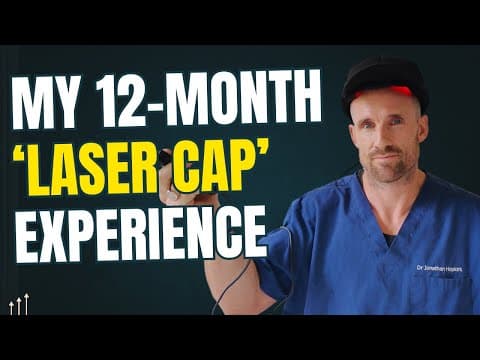
[0:00]Why do I believe that low-level laser light combs and included devices are a waste of your time and money? Hi, I'm Dr. Jonathan Hopkirk, Australian-based hair loss doctor, and I love nothing more than to give people the opportunity to regain their confidence through restoring their hair. After watching this video, you're going to gain four valuable insights and opportunities. Number one, is you're going to get my 12-month experience using this particular low-level laser light cap and how it impacted me and my hair loss routine. You're going to also gain a good understanding around what are the best low-level laser light cap devices, or devices in general, and which are the ones that are going to just steal your time and money with very low yield. You'll also get the opportunity to save $300 on a device exactly like this. If you watch to the end and you follow the prompts. Not only will you get that, but you also get the opportunity to get your hands on our medical board with over seven years experiences hair loss ebook. Which we can send you directly to you after you've watched to the end and you follow the prompts. So, let's dive right into it.
[1:10]So why do I believe that low-level laser light combs and low-level laser light devices used in clinic are a waste of your time? Well, before we jump into that, why don't we get a better understanding around why low-level laser light caps, or low-level laser light devices actually work in the first place? So I was the medical director globally of one of the biggest laser clinic companies in the world, which performed over 4 million laser treatments each year. So I have a very good understanding of lasers and their potential and their capacity for being able to both trigger hair growth, but also remove hair. One of the most interesting things is that you would find that for some individuals, obviously the majority of the individuals of this particular company, they would lose their hair in this area almost permanently with recurrent use of lasers with a higher power. Now, on the opposite end of the spectrum, though, when you had these anecdotal cases where patients were treated on a lower setting, a setting which was too low for them to achieve laser hair removal, they sometimes actually got what is called paradoxical hypertricosis, so it would stimulate hair growth, rather than causing hair loss, or permanent hair loss in this area. So what we know about lasers is, dependent on the power output and the type of laser and the wavelength, amongst other things, it can lead to either triggering hair growth, or causing disunion of the hair bulb within the follicle and leading to hair loss. So why is this little background story important with respect to low-level laser light caps? Well, as we know, low-level laser light caps harness low-level laser energy to be able to produce or stimulate the follicle to produce more hair.
[3:02]So how does it actually trigger the follicle to produce more hair? Well, interestingly enough, the light which is best at the 650 nanometer wavelength or infrared, but the light is absorbed into the hair follicle, and that follicle, then is triggered to produce more energy. So what it does is it actually has influence on this little tiny thing which exists in pretty much every cell within your body, and that's called mitochondria. Mitochondria are the powerhouse for producing energy within our system. So what happens is this energy is absorbed into the hair follicle, and within this hair follicle, mitochondria then become higher functioning, and they have a better output. So that then leads to the hair follicle having a better output and better turnover. It's also said to trigger the release of growth factors. So, in essence, what you're getting is a follicle which has a better output, and also potentially releases growth factors into that area which support further growth of hair. And this entire process is something called photobiomodulation.
[4:12]So, what is the evidence for low-level laser light caps or low-level laser light devices for restoring hair? Well, there's actually a really good growing body of evidence to support the use of low-level laser light caps and devices in hair restoration, and that can apply to people with male or female hair loss, alopecia areata, and chronic telogen effluvium. When you look at the data more broadly, you would generally say that low-level laser light caps can be as effective as minoxidil in the sense that they achieve results in about 40% of people that use them as prescribed or as instructed. This study performed on 44 women with female pattern hair loss, looked at the results achieved in this group of women after using a commercially available low-level laser light cap over 17 weeks for 30 minutes every second day. And what they revealed was a 51% increase in their hair count, pretty impressive. A similar study conducted on 44 men with male pattern hair loss found a 35% increase in hair density after using a red light therapy helmet for 60 sessions. So when you do the digging, there's some really solid evidence to support the use of low-level laser light caps or devices. However, not all low-level laser light devices are created equal, and there's a risk that you could lose both time and money by picking up some of these gimmicks online that don't have the evidence to support them.
[5:44]So what are the best low-level laser light devices to use? First of all, the low-level laser light device needs to produce light in the 650 nanometer wavelength, which is red light, for instance. It needs to have at least 300 diodes, which will then give you the ability to have full coverage of your scalp. If there's less diodes or significantly less diodes, well, then there's a risk that you're not going to get coverage of the entire top of the scalp. It's said that the best devices actually produce a pulsed light rather than a continuous light, because then it allows for the heat to dissipate over the scalp, rather than producing continuous heat into the scalp, which could potentially overheat the skin. It's also said that devices need to be used for at least 30 minutes, three to four times a week. However, there are different devices which will come with different instructions based on the intensity of the light that's been produced and the power out. Which was always advised to follow the instructions of the device that you've purchased.
[6:50]So what is my experience been like for the last 12 months using this grow Laser Pro Flex 302 cap? Well, to be honest, it's been really good. In terms of results, it's actually hard to quantify what the results have been like, because I'm already on a regimen where I've had Duteide, I've had Minoxidil, I've had growth factors, and peptides and amino acids, micro needling. So I've had a lot of other things that have been doing behind the scenes. However, I will say this. I have had to come off Duteide, because I'm currently in the stages of trying to make babies, which is very exciting. So, whilst I've come off the Duteide four months ago, I am yet to notice a decline. Now, it's not to say that I won't notice a decline, and God forbid that day happens, but I am yet to notice a significant decline. And that may well be because I've supplemented my regime with using something else to stimulate hair growth. Now, obviously low-level laser light caps are not necessarily going to flush out DHT from my system or from the hair follicles. So it may be that I'm one to two months away from seeing a decline. However, what I have found is that these devices are incredibly easy to use. It's recommended that you use this for six minutes a day. Now, me being me, I like to do things, you know, at a turbo level, if I can. So what I've actually done is I've used it more like, you know, probably 18 minutes every second day. And this is actually not a pulsed light device, it gives a continuous delivery of the energy. However, because it's just short stints of six minutes, you don't build up significant amounts of heat in the scalp. Now, it's a robust device, as you can see, it's got the cap on the top, so you get a baseball cap like a fitting. You can wear it around the house, you could take it shopping with you if you want. I'm going overseas in my honeymoon soon, and I dare say I'll be taking it with me then. The plugging adapter is very easy to connect and use. It's very easy to turn on. And they also actually send it out with a nice travel case like this, so you can plump it in the travel case when you're heading away and take it with you on the plane or on your travels. So, when compliance is the science for your hair and getting good results, I find that having something like this, because it's so passive and easy to use, is what can actually help you achieve really good results. Because the barrier to using it is so low, it's simple. You have it planted on your desk or you have it planted in your kitchen. Every time you see it, you're reminded to use it, and let's face it, it's not painful, it's not risky, and it's a very, very easy way to stimulate growth. You can also do it when you're playing with the kids, you can do it when you're on the couch watching TV. There's not many other hair loss devices that you can use effectively whilst doing those things. So, it's a thumbs up for me for this particular device. If I was earlier in my hair loss routine, it would have been really good to have done a trial for six to 12 months without using anything else to just see how good the results were. But what we know from the evidence is these caps do support hair growth, provided that meet these really important parameters that I'll talk to you earlier. So why do I think that laser light combs, this is just a white tooth comb, it's not a laser light comb, because I didn't want to waste my money on buying one just for the purpose of this video. But why are low-level laser light combs and low-level laser light devices use in clinic a waste of your time and money in my view? Well, when I've just told you that the entire part of the scalp that is losing hair or is DHT sensitive or is subject to hair loss, if the entire scalp in that area requires 30 to 40 minutes of complete red light saturation three to four times a week, obviously device dependent, then it's a much harder task to provide that entire surface area with a device that just emits a very small amount of light. You're going to have to use it for significantly longer periods of time to be able to actually get the benefit from it, of which just most people don't. The other thing is that there's actually far less evidence for the combs than there are the low-level laser light caps. So, so the grading of the evidence, if you like, goes from combs being the least evidence supported to those arc-based devices being the next least evidence supported. Then going to low-level laser light caps being the best in terms of the evidence that has been found for the results that have achieved for people suffering from hair loss. So, if I was to be putting my money and time behind a device that wouldn't be a comb, it wouldn't be an arc, but it also wouldn't be doing it in clinic with a low-level laser light device. Why not? Well, if you were going into clinic, even if it's the state of the art device that these guys have got, and they've got the best device that you can possibly use. Well, are you going to go in there for 30 to 40 minutes, three to four times a week? Likelihood is with your schedule, no, not many people are. And if you do, it's going to be a very, very expensive way to do it. So what happens is people often get into a situation where they'll purchase one or two sessions a fortnight. They'll go in, they'll have their 30 minutes under this device, and yes, it's a great device, and yes, providers can say it's got great evidence behind it. But when it stacks up, you're actually going to get very low yield from it because you're probably not going to be doing it enough to actually get the results that you want. So sure, it might supplement the treatment that you're having in that clinic on the day, but as a standalone measure, and as something that's going to give you great results ongoing, doing it in the clinic is not the best way to do it. And in my view, it's a waste of your time and money. So whilst I just sit here and tell you then what is the best device to use? Well, you're not going to like hearing it, but often the best devices are the devices that cost most. So this device, for instance, costs $1,600 retail price in Australasia. If you want to learn how you can get $300 off that using a discount code that I can provide for you, simply like and subscribe to this channel, and then follow the prompts in the show notes. But this device, as I said, costs $1,600. The best devices often are expensive. The best devices often require for you to have doctor clearance or a doctor's prescription or authorization, if you like. And what that says is a couple of things. One, doctors won't often associate themselves with brands that don't actually produce efficacious or effective devices or products or treatments or ingredients. They're also got their reputation on the line, so they're not going to affiliate themselves with their brand out of risk of reputational damage. Two, if it requires doctors authorization, well, it's probably pretty good. Otherwise, they wouldn't go to the links of getting doctor's authorization for it. So devices which are actually expensive or in the more expensive range, the $1,600 and above devices that are associated with doctor's authorization. And devices that meet all those other specifications as I listed earlier. Some that have been touted around the world to have great evidence behind them is the I restore caps. The Capillas, I've heard a lot of doctors talk about them and put their names behind them and some, you know, big dermatologist across the globe talk about these devices. And then the grow laser caps, I believe, and Australasia are really good cap to use after my personal experience with it. Now, yes, the cost is high, the one-off cost is high, and you can sit there and, oh God, that's really expensive. However, when you break it down, and the pay per wear, the value offering is actually quite high. Say if I use that for 40 weeks, four times a week, well then that actually that $1,600 or if you break it down to the $1,300 discounted amount, that breaks down to be about $8 per wear. Then if you double that over the next year, that drops down to about $4 per wear, and then the following year and the following year and the following year. These devices are usually built with a warranty in them, so if they break down that time, you'll be able to send them back and they'll be able to send you out a replacement or or repair the one that you've got, and they're very robust. So you're going to get a lot of use out of this device, just one cost upfront, then you get a lot of use out of this particular device over time, much cheaper way than doing it in clinic. So who has the best chance of success with low-level laser light caps?
[16:29]Well, obviously it goes without saying, anyone who starts using devices like this or more conservative approaches to hair loss sooner in their hair loss journey, the better the chances of them having success. If you use low-level laser light caps in isolation because you're worried about taking hair loss drugs or using other ingredients because you're worried about the risk they could have in your body, well, this is a great option. If you're already using certain ingredients or hair loss drugs, and you've found that you've plateaued or you're wanting to take your hair restoration results to another level, whilst supplementing your routine with something like a low-level laser light cap is a very good idea, because it acts in different pathways then other devices or other treatments or ingredients on the market. So it triggers hair growth in a different way. And what we know, like with any chronic condition, whether it's hair loss or otherwise, having a combined approach is often what brings you best results. So implementing this into your current hair loss routine could be a really good way for you to take your hair restoration results to a new level. Now, it's important to note the caveat that, as I alluded to in my story earlier, low-level laser light caps don't counter the underlying hormonal components that lead to hair loss in both male and female pattern hair loss, as well as some other conditions. So it's always really important to be guided by your hair loss professional, because they can give you a sound understanding around what's going to give you the best results. Low-level laser light caps are great, however, they don't have an impact on the body's hormones or the hormones that lead to hair loss, that's a really important thing for you to understand. So if you have rapidly progressing hair loss that has an underlying hormonal component, it's essential that you get on top of that for you to achieve best results. The last thing I'll say is that once you stop using a low-level laser light cap, like with any device or any hair loss treatment, if that's been supporting your hair growth to a level, and then all of a sudden you stop for whatever reason, well, you can expect that your hair will regress some four to six months after stopping the use of that device. So I hope this information has helped give you a better understanding around how to use low-level laser light caps. What the best low-level laser light caps are to use, and then how to save time and money by avoiding the use of what I've considered more gimmicky devices in nature. Or devices that might not be giving you the best yield because you're not able to achieve the cadence in which you need to to be able to get the results from them. And if you would like to get your hands on our medical board's hair loss how to guide ebook, just like and subscribe and follow the prompts and the show notes. And also, if you'd like to get your hands on the grow laser cap Proflex 302 cap, just simply follow the prompts in the show notes, and I will give you an understanding around how you can get $300 off this device. I hope this helps you in your hair loss journey. I look forward to seeing you again soon.


