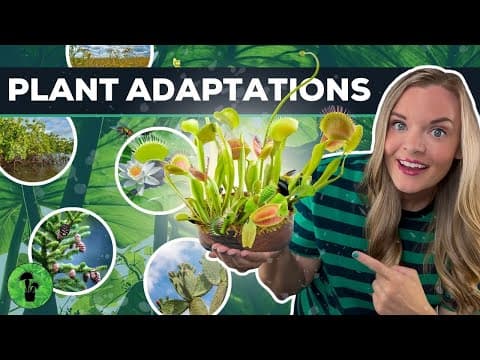
[0:00]Have you ever wondered why there are so many different plants? There are plants with leaves, needles, thorns, and even hair-like structures. Plants that float, climb, tower, and even snap. But what purpose do these different traits serve? Let's find out together in this episode all about plant adaptations. Plants are essential to life here on Earth. They are at the beginning of every food chain and food web. We never really think about it, but plants aren't any more excited to become dinner than this chipmunk. Plants like this blackberry bush can't exactly pull up their roots and move to a better neighborhood. They do, however, have strategies or adaptations like these thorns to deter hungry herbivores. An adaptation is a physical or behavioral trait favored by natural selection for its current function. Something that is helpful for an organism that gets passed on to its offspring. Adaptations help an organism to survive their environment and or reproduce successfully. In plants, this looks like flowers attracting pollinators with specific colors, scents, and nectar, or the tips on this passion flower vine rotating around to find a suitable place to attach and help the vine climb. These are just the plants in my garden. What about plants in other environments? As the environments change from one place to another, so do the adaptations or strategies for survival. Let's take a look at a few different environments and the plants who have adapted to live there. The extreme lack of moisture in this desert environment means that the plant friends need to get creative in order to survive. The adaptations that allow desert plants to deal with drought are numerous, but all focus on retaining as much moisture as possible. Precious moisture is lost through leaves, in particular, through stomata. Stomata, or the breathing holes in leaves, exchange carbon dioxide for oxygen. Leaves are like solar panels for plants, turning light energy into food. Most plants have large leaves, allowing them to capture as much sunlight as possible. But when there is an overabundance of sunlight, plants have adapted to have small leaves or no traditional leaves at all. Cacti have stomata on the surface or skin.
[2:36]These plants have adapted to only open their stomata at night, allowing much less of the plant's stored moisture to be lost. Other plants are adapted to store as much water as possible in their plant tissue. This is a defining characteristic of plants called succulents. Succulents have chunky, fleshy stems and leaves. In order to capture as much rain as possible, cacti have broad shallow root systems. These roots rapidly absorb large quantities of water during brief rains before the sandy soil drains it all the way. As you can see, cacti have traded in their leaves for spines. These modified leaf structures help protect the plant from hungry herbivores. Sometimes you have to trade in your luscious leaves for grumpy spikes. A wetland is an area of land that is either covered by water or saturated with water. They are transition zones, never totally dry land, but also not totally underwater. They have characteristics of both. These unique environments are home to equally unique plants. The mangrove trees behind me dominate this estuary because of their ability to tolerate brackish water. The brackish water of saltwater swamps isn't entirely seawater, but isn't entirely fresh water either. These areas form where water from a river or stream meets ocean water, like here in this estuary, located on Florida's coast. Most plants can't survive in salty seawater, but mangroves have some tricks up their sleeves. The leaves of some mangrove trees can also store unwanted salt. Salt is drawn to the leaves to balance the salt concentration inside the plant. Eventually, the leaves age and fall off the tree, taking the salt with them. Mangroves also have two types of roots, breathing roots and stilt roots. Breathing roots grow above the ground to absorb oxygen from the air, and wide spreading stilt roots provide structural support to the trees. If you're still here liking this video, let us know and hit that subscribe button so you never miss an episode. Plants are autotrophs, meaning that they can create their own food from air, water, and sunlight. Many bug plants have adapted to the poor nutrients in the soil and water by turning to another food source. These pitcher plants are carnivorous, they trap and consume insects. This deep basin is actually a modified leaf structure filled with digestive enzymes. Insects venture in looking for food, drawn to the pitcher's coloration and alluring scent, just like they are with flowering plants. Eventually, it falls down the funnel into that pull of liquid enzymes and drowns. Those enzymes slowly begin to break its body down into microscopic particles the pitcher plant can consume through its leaves. That's rough. Thigmotropic responses are plant structure movements in response to touch stimuli. These Venus fly traps have hinge-like leaf structures which emit a sweet smell that attracts insects like flies. When a fly lands on the leaf, it brushes against trigger hairs, sending a little electric charge through the leaf. Each charge causes water to move from one part of the leaf to another. This change in water pressure causes the hinge to snap shut in under a second. The struggling prey touches more hairs and the flow of digestive juices begins. Aquatic plants like these water lilies have adapted to keep their flowers above the water surface to be pollinated by insects. Water lilies have wide, flat, floating leaves to let them gather the maximum amount of sunlight and strong roots to anchor them in the stream or lake bed. Their leaves are also extremely hydrophobic. See how the water just rolls off so the leaf isn't weighed down below the water surface. Bromeliads are a type of plant that mostly grow on trees to take advantage of the sunlight in the canopy. Small roots anchor plants to supporting branches and their leaves form a container that holds water. These little containers of water support a thriving mini ecosystem of bacteria, larva, and amphibians like frogs. Grasses are some of the toughest plants on Earth. Many prairie plants have roots as long as they are tall, or longer. These crazy long roots help grasses reach moisture that is trapped deeper underground, allowing them to survive drought conditions. It's not unusual for many parts of the prairie to experience wind gusts of 60 miles per hour or more. Deep roots keep the plants in place as well as the soil. This also helps to combat erosion by keeping the soil from blowing away. The growing point of most grasses is located right at the soil level. Wildfires and grazing by animals are two factors that maintain grasslands. Both of these factors can remove most, if not all, of the above-ground vegetation, which makes roots an invaluable way for plants to have the energy to regrow quickly. Remember all of the wind we were talking about?
[8:00]Grasses have figured out a way to use it to their advantage. These plants place their flower spikes with many small flowers high in the air. Anthers poke out of the flowers and bob in the wind, releasing pollen grains. The pollen floats in the air until, hopefully, landing on the feathery sticky stigmas of another grass. The tropical rainforest is hot, and it typically rains just under 200 inches per year. All this moisture can promote growth of bacteria and fungi, which could be potentially harmful to plants. Two common leaf adaptations to help protect plants from the excess moisture are a waxy cuticle and a drip tip. The cuticle is the outer protective layer of a plant. Think of it as the plant's skin. A waxy cuticle feels like an umbrella or a rain coat, which is exactly the purpose it serves. All of the rain that lands on this waterproof leaf will just roll off. The leaf shape also helps water along. Many tropical rainforest leaves have a drip tip that enables raindrops to run off quickly. The emergent layer and canopy receive the most sunlight. The plants at this level must be able to survive 12 hours of intense direct sunlight every day of the year. Under these top layers, the tropical rainforest is very dense. Very little sunlight is able to make it through all of the layers of vegetation to the forest floor. So, plants at this level have to find ways to capture what sunlight is available. One option is to have very large leaves to absorb as much sunlight as possible. The other option is to climb to where the sunlight is. Most plants exhibit phototropism, or the ability to grow towards light without muscles. But these climbing woody vines take it to another level, literally. Lianas attach themselves to trees by little sucker roots called tendrils, where they'll grow leaves to absorb sunlight. Many large rainforest trees have tall ridges near their base that can rise 25 feet high before meeting the trunk. These buttress roots provide increased stability to the tree. There are four distinct seasons in the temperate deciduous forest. Spring, summer, autumn, and winter. In the fall, the days are getting shorter, and there's less daylight happening in general. These deciduous trees actually stop photosynthesizing and begin to retract nutrients from their leaves to store for the winter. Chlorophyll is highly valuable, so in extremely general terms, the tree just slurps it back into its main tissue. As it travels out of the leaf, it starts to expose other pigment molecules. This means that the yellows and the oranges of the carotenoids can start to show through. As the weather continues to get cooler, the broad leaves cause too much water loss and can be weighed down by too much snow. So the tree cuts off water supply and leaves just dry up and fall off. The tree then enters a time of dormancy.
[11:22]The extreme climate and challenging soil really limits the type of vegetation that can survive here in the boreal forest. Coniferous trees such as fir, pine and spruce dominate this landscape. Because evergreen trees keep their needles year round, they can begin growing early in spring, just as soon as temperatures are favorable, rather than wasting a bunch of energy growing new leaves. The dark green color of their leaves and triangle-shaped sides help them catch and absorb as much of the sun's light as possible. Their shape also helps to distribute snow across the body of the tree, preventing too much weight from resting on the top branches that would otherwise cause them to break. Needles offer a smaller surface area than leaves, which also helps with snow distribution. So the next time you travel to a new environment, take a moment to observe all of the new plants and the ways that they are adapted to live there. And if you want to learn more science, you can check out this video next. Hello?