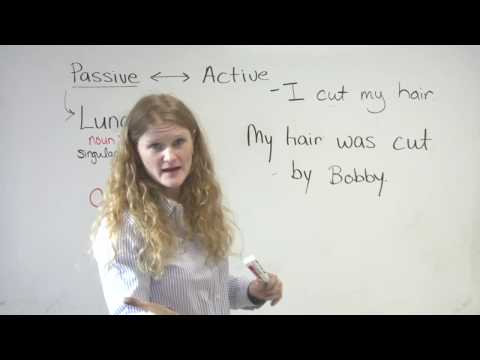
[0:05]Hi there. My name's Ronnie and today English is going to be taught. By me. I'm going to teach you English. Um, this is going to be a grammar lesson. Oh, everyone shudder. Oh, not grammar. It is. I think this is a very difficult, hard to understand lesson. I don't want to teach. I give up. I'll try. Okay. Today we're going to learn about passive. The opposite of passive is active. In our everyday goings on, we usually use active sentences. An example of this is I eat lunch. Okay. In this sentence the focus or the importance is on the subject or me. Okay. So I want to make it very clear that it was me who did the action. So I put me first. Next comes the verb and lunch is our noun. When we want to have a passive sentence, we don't want to tell who did the action. What's important is that the action was done. So to make the sentence, passive, we're going to change the verb position, the noun position, and we're going to even eliminate or take out the subject. This is how we do it. We start with the noun and we say, not long, lunch was eaten. In this sentence, we don't know and we don't care who ate the lunch. What is important is that it was eaten. To form a passive sentence, we take the noun plus to be verb and we use the PP or the past participle. The past participle is the third tense of the verb. For example, eat, ate, eaten. The way that I like to remember this, we pronounced this like the number 1, 2, 3, 4, 5, 6, 7, 8. Eat, ate, eaten. So when we make the passive sentence, you always have to put was and the past participle of the verb. You also have to know when or why, very important, we actually have to use the passive. As I said before, we use it when we don't want to tell the person who did the action. Maybe we simply don't know who did the action or it's a secret. For example, when I was a child, my brother and I were given cookies. Okay? And we would both eat all of the cookies. My brother, he would eat the last cookie. So my mother would say, "Who ate all the cookies?" My brother say, "I don't know." And I would say, "It was him, he ate the cookies." Now, if he was smart, he could answer in the passive and he could say, "Cookies were eaten." All right? You have to be careful here because cookies is plural, you need to use were. Lunch is singular, so with a singular noun, we use was. And you always need the PP or the past participle. One really good example of when you really need to use the passive is this. Um, we have hair. Sometimes it grows very long. We need to go to a place to have our hair cut. If I use an active sentence, I would say, "I cut my hair." But most of the times we do not cut our own hair. Probably because we can't get the back and it's pretty dangerous and you'd probably look funny as well. So, in this case, you need to use the passive. You need to say, my hair was cut. We don't know who cut it and we don't care who cut it.
[6:49]Okay? If you wanted to include who did it, you can say, by and then the person. So, for example, I can say my hair was cut by Bobby. Bobby the barber cuts my hair, it's active. But you can say my hair was cut. Cut is going to be a very nice verb because it doesn't change in every part of the verb, it stays the same, cut, cut, cut, easy. So, remember, the next time you go and get your hair done and you tell your friends, I cut my hair, they're going to say, "Wow, you did a good job!" And then you go, oh, no, I didn't cut my hair. My hair was cut. All right? So I hope this clarifies the difficult grammar that we have in English of passive. Please go to ingvid.com and you can have a quiz and you can test your knowledge on the passive. Bye.


