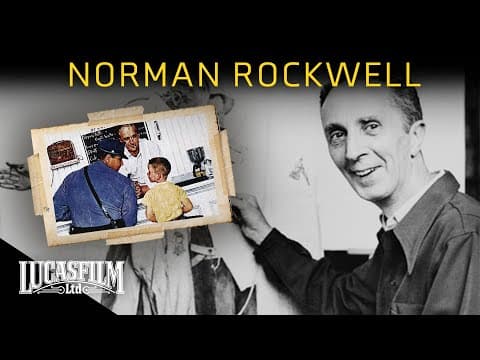
[0:03]America in the 1950s, decades of depression and war gave way to an age of peace and prosperity. Americans rejoice with new dance crazes, new fashions, new fads, and gathered in front of their new television sets to thrill to the stars and starlets, comedians, pop singers and politicians and flickered across their screens. Many would fade into obscurity, but on a night in 1959, a man with a more lasting claim to fame would join them thanks to legendary CBS reporter Ed Murrow. Good evening, I'm Ed Murrow. The name of the program is Person to Person. Tonight we'll be making our first visit. Murrow's guest that evening didn't win fame by doing TV shows or making movies or recording hit songs. He won the admiration of millions of Americans by making art that changed the way they saw their world. His name was Norman Rockwell. Norman Rockwell has been painting the American scene to the delight of millions of us for 48 years. And in recent years, his models, subjects, characters have been drawn from among his friends and neighbors in Stockbridge, Massachusetts. And if we've followed directions, we should find him at home, just around the corner from Main Street. Rockwell spent most of his adult life in remote towns like this, but the art he created here traveled far beyond this tiny Main Street to every corner of America and around the globe. There we are, are you there, Norman? Yes, Ed, we're here and welcome to Stockbridge. Thank you. To the Americans who saw their nation, their neighbors, and themselves in Norman Rockwell's art, he was more than just an illustrator or commercial artist. He was a trusted friend, an amusing neighbor and an inspiring teacher. To them, Rockwell wasn't just painting pictures. He was weaving American dreams.
[2:12]Stockbridge appears to be a most pleasant town, and I know. By the time Ed Murrow's cameras arrived in Stockbridge in 1959, Norman Rockwell had come a long way from a childhood spent in a series of shabby boarding houses around New York City. His mother had been aloof and unhappy, his father, a frustrated dreamer, who resigned himself to a modest career in business. Now, Rockwell was a household name, thanks largely to the hundreds of covers he had painted for one of America's most influential magazines, The Saturday Evening Post. The Saturday Evening Post from about the beginning of the 20th century through the 50s had a huge impact on the way Americans thought of themselves, thought of themselves as Americans, understood life and it was basically unrivaled. Ever since its founding by Benjamin Franklin in 1728, The Saturday Evening Post had seen both boom times and busts. In 1897, publisher Cyrus Curtis bought the struggling magazine for just $1,000, moved its headquarters to a stylish building on Philadelphia's Independence Square and started working to turn its fortunes around. Curtis made sure that each issue featured the best authors and illustrators money could buy. Articles entertained readers with all-American stories and homey advice, and worked to shape their thinking about social trends, culture and politics. Circulation soared from 2,000 in 1900 to 1 million in 1908 and 6 million in 1960. By then, The Saturday Evening Post had become one of the most respected magazines in America, and no single person played a greater role in the magazine's success than Norman Rockwell. Norman, you've been identified with the Saturday Evening Post for many, many years. When did you do your first cover for them? Well, Ed, uh, this happens to be the original of the first cover I did. I don't know whether it was before you were born or not. It was in 1916. Rockwell's first big success was his 1916 cover, Boy in a Baby Carriage for The Saturday Evening Post, that's when he really made it. He did this wonderful image of a little boy dressed up in a very dandified outfit. He had to push his brother or sister around in a baby carriage and he didn't want to do that. The public loved it. Fortunately for Rockwell, George Horace Lorimer, the Post's influential editor, liked it too. Rockwell's style fit right in with Lorimer's plans for both the Post and America.
[4:58]In 1916, America was being flooded with immigrants and torn apart by conflicts between country and city, capital and labor. Lorimer felt that the future of the nation depended on forging these factions into one United American people. For the next 45 years, Norman Rockwell's covers for the Post played a key part in George Lorimer's strategy to reshape the American public. It was a role Rockwell was perfect for, but wasn't always happy to play. Rockwell was a very complicated guy. He was trained as a fine artist. He started out his career really wanting to be a celebrated fine artist. It didn't work out for him. He needed to make money. He got into the commercial realm, and you know, that that was the history. But all throughout his life, he considered dumping his illustration and working just as a fine artist. He was doing art on demand, and you could even say art by the pound because he certainly did tons of it. Rockwell typically had to come up with the subjects on his own, and that's why he spent so much time worrying about them. And that's why he painted works like The Deadline, which depicts the artist, actually Rockwell, seated in front of a blank canvas with the Saturday Evening Post logo over it, a stopwatch, and uh, basically nothing on the canvas and his life in total disarray. Because he had to come up with his own ideas. Fortunately for Rockwell, the ideas always came and almost always seem to be just what George Horace Lorimer was looking for. Lorimer liked the fact that Rockwell's images could be read in an instant. You could look at these things and you could get immediately what they were about. He created magnificent vignettes. That's what he was brilliant at. He was brilliant at creating a frozen moment. In the early decades of Rockwell's career, most of these moments seem to have been frozen in a long ago and much simpler time. These images that harkened back to an earlier, more rural time were very comforting. That formula of looking at life the way you would like it to be was something that made the post so very successful. Because the stories in the post took you away or gave you an escape from modern life to another era. The fiction did it, the articles did it, and Rockwell's covers did it. When I was interested in Rockwell as a hero in the late 50s, very early 60s, I would look at his pictures and I would imagine being in those pictures and I would have a nostalgic feeling for a place that I've never been before.
[7:51]And that sense they are documents of an American culture that either did or didn't exist. Rockwell presented a very clearly definable image of America with certain values about the value of family for example, about loyalty, about love for animals, um, the joys of childhood and playing in nature and of course patriotism. That these were qualities that people felt all Americans should experience and that many Americans shared in common. Rockwell and his fellow Americans would need those common values to get them through some of our history's most difficult days. The outbreak of World War II called for images that acknowledged the challenges facing the nation, while reassuring the Post's readers that good old American values would win out in the end. But Rockwell wasn't content to just sit around painting magazine covers. All around him, Americans were gearing up for war, and he wanted to do his part. But how? Rockwell found the answer in words President Franklin Delano Roosevelt had used in a key address to Congress and the nation. We look forward to a world founded upon four essential human freedoms. Roosevelt's words inspired Rockwell to put his commercial work aside to paint the Four Freedoms as a gift to the country he loved. The first is freedom of speech and expression. The second is freedom of every person to worship God in his own way. The third is freedom from want. The fourth is freedom from fear. Rockwell struggled for months to get the four paintings just right. For him, this was more than just another cover assignment, more even than a patriotic contribution to the war effort. It was a chance to prove himself as a fine artist. Norman, that that's one of your wartime four freedoms paintings, isn't it? Well, this one is the freedom of speech that I did, well, I did it for the Saturday Evening Post and then the government used it. And this is the freedom of worship. Oh, yes, I remember that very well. What Rockwell did was to make something that is artificial without artifice. He created something that was ideal, but he made it seem plausible. The Four Freedoms are very broad concepts and he helped us through his images to bring those concepts into ourselves and actually believe them.
[11:09]Those were his opuses, those were his masterpieces. Do you have any idea of how many copies have been made of those paintings? I I don't really know. I know it it runs into millions and millions. When Rockwell painted the Four Freedoms, the idea of our freedoms being lost was right in front of our face. And so these paintings were reminding us that we had these freedoms certainly contrasted with what was going on in Europe. I imagine there are very few Americans who haven't seen those paintings at some time or other. I imagine so. And to the extent that he certainly helped the morale of the American public through those paintings, he is a hero.
[11:59]But to Rockwell, the real heroes in the war were the men fighting on the front lines and the women working on the home front. Soon after finishing the Four Freedoms, he decided to honor these unsung heroines in a post cover that became yet another unforgettable icon of the war years.
[12:20]Of all the Rosie the Riveter images, Rockwell's has the most impact and is the most remembered and is really the most written about. It's this enormous powerful woman and overalls wielding a rivet gun, and Rockwell modeled her on one of Michelangelo's figures from the Sistine Chapel. So she's big and powerful, wielding this weapon, yet she has a little dainty white hanky coming out of her pocket. Her nails are polished and carefully manicured and she's got lipstick on. He's feminized her. And a lot of other artists after that echoed that same Rosie the Riveter formula. Rosie the Riveter embodied a playful but sincere patriotism that was 100% American and 100% Norman Rockwell.
[13:22]But with the end of the war, America, Rockwell and The Saturday Evening Post would face new challenges. The return of peace ushered in an era of unprecedented change, and nothing was transforming the nation or its skylines faster than a new technology Rockwell featured in his November 5th, 1949 cover for The Saturday Evening Post. He called it New Television Antenna.
[13:51]In New Television Antenna, you have this kind of goofy looking guy, so excited leaning out the window of an old kind of gabled, dilapidated Victorian house. Looking up at this man on his roof who's installed a new TV antenna, saying, yeah, you did it, look. And in the background, you see this very hazy picture of a television and it's he's made it work and he's really excited. And it was really well received. The viewers of the post loved it. And people from all over the country wrote Rockwell and the post saying, I love the new television antenna because it looked like it was right in my backyard. It was a scene from my neighbors. By the 1950s, every Rockwell cover for the post was followed by a similar flood of fan mail. Americans loved his work and were eager to tell him so. I believe you can present Americans to the world as few men can, wrote one typical fan. Keep up the great contributions to our way of life. I can't think of an artist whose works are so meaningful to common people, wrote another. Your artwork, I feel is a part of Americana. Times when people were neighborly, movies were purely entertainment, and the world was a nice and cozy place to live in. By the mid-1950s, Rockwell was more popular than ever. Demand for his images was so high that the post was forced to increase its press run by 250,000 every time one of his covers appeared on the magazine. But for the post, the boom times the 50s seemed to promise would turn to bust, thanks to the new mass communication technology Rockwell himself had heralded. Television had a very significant impact because as it penetrated the average American household, fewer Americans were buying mass print magazines like The Saturday Evening Post or like Look magazine. Mass magazines could no longer support the large circulations that they had because advertising dollars were flying into television. You can put your whole meal in the Kalamazoo Electric's two up. Appetizing Chesty potato chips are cups with kids and grown-ups alike. Strews, roasts, fries, braises. And without those advertising dollars, you could have 10 million circulation, which many of these magazines came close to and not be able to support them. The overhead is just too great. For Rockwell, finding himself at the top of a dying field aggravated old doubts about choices he had made decades earlier. In interview after interview, Rockwell was constantly comparing himself to the great masters of the past, and coming up short. I can see why Bruel appealed to you. He liked to paint ordinary people, too, same as you do. Yeah, I uh, I'm very fond of Bruel. He's one of my favorite of the great painters. One of the fine arts painters. See, I I'm not a fine arts painter. I'm an illustrator. I illustrate stories and magazine covers. This is quite different from a painter. That's a very important point with you, isn't it? It is, yeah. Well, that doesn't make you any less serious though about your work than a fine artist painter, does it? I think I work as hard as Bruegel worked, but it doesn't come out fine arts, it comes out illustration. You know. Rockwell's private frustrations about his career often surfaced in a very public place, the cover of The Saturday Evening Post.
[17:31]One of the best was a cover Rockwell called The Connoisseur. In The Connoisseur, you have this man, impeccably fastidiously dressed, looking at an explosion of color on a canvas that's very Jackson Pollock like. You don't see the man's face, you see him from behind. He could be smirking and laughing at this work, because you don't see his face. He could be completely bewildered by it. Or he could be completely engrossed by it and loving it. And you just don't know. If he had put the guy going like this, you might have had a sense that perhaps he disliked this work. But, um, so this ambiguity, I think, was very deliberate. It's really um, a confrontation on one level between Rockwell's commercial illustration style, and art like abstract expressionism, that was considered the pinnacle of art by the art world, that Rockwell was so denigrated because he didn't paint that way. I think he really liked what he did. He liked he he really preferred painting in the way that he painted and he knew that he really was good at it. Rockwell summed up all of his inner conflicts about his work and his place in the art world in triple self-portrait, one of his last covers for the Post. Triple self portrait is a very complex painting and I think it's one of his great paintings. He shows himself seated in front of the canvas. He is shown with his back to the audience, so that you don't actually see his face. But then he shows another side of himself by painting himself or showing a painting on a canvas in front of him. And that painting is the kind of ideal image of the artist or of any individual as an individual would like to see himself when painted by a great artist. And he positions that painting next to a mirror. And in the mirror, you see yet another portrait of Rockwell. This time the mirrored reflection where you do see his face, but his eyeglasses are fogged up. You don't see his eyes. So another side of the artist that one would normally again gaze at to try to get some sense of what the artist is about is invisible. It's unattainable. Who is he really? Or the real Rockwell stand up? That's what that painting is about. Who is he? And it's not clear at the end. When Rockwell's triple self-portrait debuted on the cover of the Post on February 13th, 1960, it felt like a nostalgic goodbye to the American people that he and George Lorimer had helped to define. By then, even his greatest fans had to admit that Rockwell was starting to seem out of touch and out of date. I stopped seeing Rockwell as a hero because, uh, of the 60s. Uh, the tenor of the times, the uh, turmoil of the times, the schism of the times, the polarization of my generation from the previous generation. The generation that Rockwell represented so well, he no longer was a hero because he depicted that culture, that society that I was rebelling against. But by the time his final covers for the Post were published in the spring of 1963, the social movements rocking America were having their impact on Norman Rockwell too. The 60s really impacted him. He left the post. The conditions under which he left the post are really not clear. Everybody has a different story. But he was beginning to think really differently, and he was beginning to get engaged in social and political issues in a way that he had never before. And I think if he had gotten engaged in social and political issues earlier, he couldn't have worked for the Post, because the Post was so rigid in its very conservative point of view. Rockwell's departure from the Post marked the end of an era, an era in which he created some of the most influential images in the history of American art. Images that will continue to shape America's identity and ideals well into the 21st century and beyond. Americans loved Rockwell. They loved the the humor in his work. They loved the pathos of some of his images. They, in fact, began to see the world as he had seen it.
[22:31]Rockwell created icons. He had a way of touching a chord in people who looked at his work, and he did it with great intensity and great passion.
[22:46]Rockwell was able to come up with a formula that appealed to a broad swath of Americans. And he delivered it to them, week after week, or month after month. And he did this for almost three quarters of a century. That, I think, is a remarkable achievement.


