[0:03]Once you have an idea of the kind of car you want and roughly how much you're looking to spend, the next question might be, new or used?
[0:12]A used car will often cost less than a new one, but a new car may be more reliable and have fewer unexpected repairs that can impact your schedule and budget.
[0:21]For this example, let's take a look at two cars, one new and one used.
[0:26]And then compare and contrast all the variable expenses you might encounter with each car over the next five years.
[0:32]Like the cost of the car, the cost to finance it, the cost of gas, insurance, and finally, maintenance and repairs.
[0:41]But first, let's start with the cost of the actual car.
[0:44]So, over here, let's say we have a brand new car with a sticker price of $19,000.
[0:51]And over here, we have a used car that is the same make and model as the other one, just five years older, that we found for sale by its owner for $10,000.
[1:00]Now you may be wondering, why is the used car so much cheaper than the new car?
[1:05]There are a couple of factors. One is that the new car comes with a warranty, which will cover some of your repair expenses.
[1:11]But the biggest factor in this price difference is depreciation.
[1:16]As a car gets older, it loses value, that is, it depreciates.
[1:20]So this new car that costs $19,000, after five years, might only be worth about $10,000, even if you've kept it in good condition.
[1:30]And the same car might only be worth about $5,000 in another five years.
[1:36]As you can see, depreciation doesn't happen at a constant rate.
[1:39]Sure, it's almost always going to go down, but a new car loses value fastest the moment you buy it, but then slows to a more constant rate after the first few years.
[1:50]If you plan on driving your car until it falls apart, depreciation won't matter as much, because you're not going to resell it.
[1:57]But if you plan on trading it in or selling it after five years, it can make a big difference.
[2:01]With a new car, in five years, your car might be worth about $9,000 less than what you initially paid.
[2:08]And with the used car, over five years, your car might only be worth $5,000 less.
[2:15]Now, let's take a closer look at some other differences, starting with the financing.
[2:20]You may be wondering if you can finance a car you buy from an individual.
[2:23]Fortunately, you can get this kind of financing from a bank or a credit union.
[2:29]But when you purchase a used car, you're likely to get a higher interest rate than when you buy a new car.
[2:34]So, let's say that the annual percentage rate, or APR on a five-year loan for the new car is 3.5%.
[2:42]And the APR on a loan that you get for the used car could be something like 4%.
[2:47]Using an online loan calculator, you'll find that on the new car, you'll be paying about $20,700 over five years.
[2:55]That's $19,000 in principle and $1,700 in interest, with monthly payments of about $345.
[3:04]On the used car, you will pay about $11,050 over five years.
[3:08]$10,000 in principle and $1,050 in interest, with monthly payments of about $185.
[3:16]So even though you have a higher interest rate on the used car, you'll pay much less in interest and in monthly payments, because your principle is much less on the used car than on your new car.
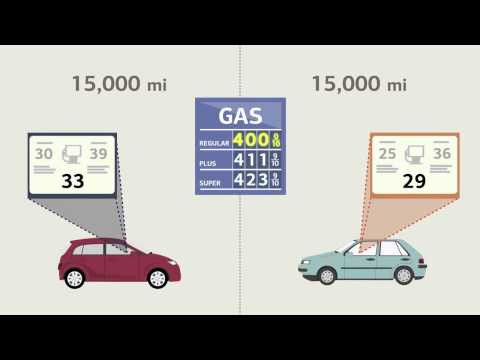
[3:27]Next, let's compare gas mileage. Let's say the new car gets 33 miles per gallon, and the used car gets 29 miles per gallon.
[3:35]And you drive about 15,000 miles per year. Let's also assume that gas will be a constant $4 per gallon.
[3:42]Over five years, taking the miles driven, divided by the miles per gallon, times the price of gas per gallon, we would be spending about $9,100 for gas for the new car, and about $10,350 for gas in the used one.
[4:00]Then there are insurance rates to consider.
[4:03]Insurance rates vary based on a lot of different factors. And in looking at new versus used, the difference in the rate for you will likely be based more on the replacement cost of the car.
[4:14]The more valuable the car, the higher the insurance rate. So while a new car might get you some discounts for new safety features, generally a used car that's less valuable is going to cost less to insure.
[4:25]So, with a new car, your insurance might cost $1,560 a year.
[4:30]Over five years, $7,800.
[4:34]And with a used car, your insurance might cost $1,200 a year, and $6,000 over five years.
[4:44]Now, let's look at maintenance and repairs. This is the trickiest cost to estimate, because it's unpredictable, and major repairs can have a big impact on your budget.
[4:52]With a new car, major repairs may be covered by a warranty in the first few years.
[4:58]So let's estimate that over five years, you spend $3,000 total on maintenance and repairs on the new car.
[5:05]Now, when you buy the used car, you do have the option of buying certified pre-owned.
[5:09]This will cost a bit more, but it'll also come with some sort of warranty.
[5:15]But for this example, let's just stick with the car you bought from its previous owner.
[5:19]The cost of regular maintenance typically increases as the car ages, and so does the chance of needing a major repair.
[5:27]Major repairs can be inconvenient too. They take time, and sometimes you might have to get a rental car while yours is in the shop.
[5:34]For the used car, you might be lucky and only need to spend about $4,000 on maintenance.
[5:39]But a more realistic number may be around $6,000 on the used car.
[5:44]So, adding this up, you'd spend a total of $40,600 on the new car and $33,400 on the used car over five years.
[5:53]That's a difference of about $7,200 less on the used car.
[6:04]Now, keep in mind, this doesn't take into consideration the value still in the cars.
[6:09]The new car probably has a few more years left in it than the used one, and if you were to resell them, you'd be getting about $10,000 for the new car, rather than about $5,000 for the used car.
[6:21]But we're looking at a lot of variables after all.
[6:24]With certain cars and situations, the new one may end up costing you less than the used one, and there are multiple other things to take into consideration.
[6:33]A new car will probably be more reliable, with newer features, and it may be safer, or be better for the environment.
[6:39]With a used car, you'll have lower monthly payments, which could be good for your budget, but it may also be less reliable, and you could have larger unexpected costs when it comes to repairs.
[6:51]By looking at your own needs and budget, and doing the research, and the math on the cars you're interested in, you can figure out which is the best choice for you.