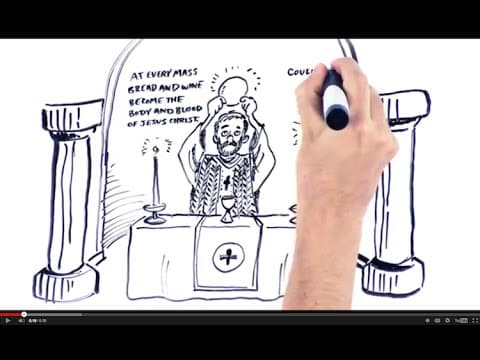
[0:14]At every mass, bread and wine become the body and blood of Jesus Christ. Could this really be true? Let's begin by looking at Jesus's words in scripture. In the sixth chapter of the Gospel of St. John, Jesus had a long conversation with his disciples in which he said, I am the living bread that came down from heaven; whoever eats this bread will live forever; and the bread that I will give is my flesh for the life of the world. Here, Jesus is telling us that he will give his body for us to eat. Many expressed disbelief and thought this teaching was absurd. Just as many do today, they struggled to accept what Jesus said is true. How can this man give us his flesh to eat? they asked. Jesus could have backed down when he saw their reactions. But he didn't. Instead, he reinforced what he said before. Unless you eat the flesh of the Son of man and drink his blood, you do not have life within you. The Bible tells us that as a result of this teaching, many of his disciples left and refused to follow him. This wasn't the only place in the Bible where Jesus spoke of offering us his body to eat. At the Last Supper, the final meal Jesus had with his apostles before his crucifixion. He celebrated the very first mass and transformed bread and wine into his body and blood. He told the apostles, take this, all of you, and eat of it, for this is my body, which will be given up for you. And then he took the cup of wine and said, take this, all of you, and drink from it, for this is the chalice of my blood. Do these words sound familiar? They're the same words the priest uses today when celebrating mass in your parish. At the Last Supper, Christ made his apostles the first priests and commanded them to follow his example and celebrate mass for all Christians. That's why when you attend mass today, you hear the priest say the same words Jesus said 2000 years ago. When Jesus said, this is my body, did he mean that he was literally offering his body and blood? Absolutely. Christ could not have been more clear in the words he chose. And the belief that the Eucharist was his body and blood went unquestioned for more than 1,000 years. But why would he give us his flesh to eat? Why ask us to do something that seems so strange? To understand, we have to go back to Adam and Eve. They chose to listen to Satan rather than God when they ate fruit from the one and only tree God had told them not to eat. When Adam and Eve used their free will to turn their back on God, which is called original sin. They broke the unity between heaven and earth. Man lost his familiar and intimate relationship with God. Disease and death crept into the world and we became inclined toward sin. Justice demands that punishment follow every crime. And the only fitting punishment for man's offense was hell. Eternal banishment from God. What a sad story this would be if it ended here. Although man offended God, God's mercy never faded. He began a plan to save us from our sins and bring us back to union with him. So that people could experience the forgiveness of sin. God asked man to sacrifice animals in their place. When the animal was killed, it suffered the punishment meant for men. In the Passover, the ancient Jews sacrificed and ate an unblemished lamb at God's command. The lamb did not deserve to die, but it took the punishment men deserved and kept them in God's favor. But these sacrifices on their own were not sufficient. They could never pay the ultimate offense man gave to God. An offense that deserves eternal banishment from God. God, in his mercy, desires union with man. But if only man can pay the price and that price ends in death, how does man have any chance of reaching heaven? There's only one way.
[4:17]God became man and took the punishment we deserved. In order to pay man's debts and to conquer death, God came down from heaven, became man, and paid the price for our sins on the cross. Jesus is the Lamb of God.
[4:36]His life, death, and resurrection are the only reason heaven is open to us. He told his apostles at the Last Supper, No one comes to the Father except through me. So now we know why Jesus had to die, but why do we have to eat his body? Why does he say that unless you eat the flesh of the Son of man and drink his blood, you do not have life within you? One reason is that we live by eating and drinking. If this is true of our natural life, it makes sense that the Lord would communicate eternal life to us in this way. Also, if original sin was committed by eating, it makes sense that the remedy for sin would come to us through eating. Ultimately, Jesus teaches you to eat his flesh because he wants to be united with you, and he wants you to be united with him. Through holy communion, you and I receive God's own life. His own strength and power called grace, to resist sinful tendencies and to become what we are truly meant to be. Perfect. Just as God the Father is perfect. The only way to become holy is to do exactly what Christ told you to do in the Gospel of John. Whoever eats my flesh and drinks my blood has eternal life, and I will raise him on the last day. Adam and Eve walked in the garden alongside God. But now you and I can physically be with Jesus. God in the flesh, united with him at each holy mass.


