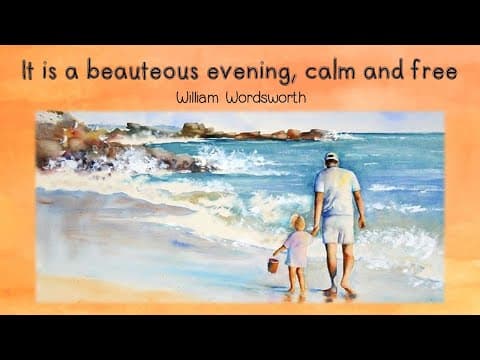
[0:02]Hello everyone. The following presentation is on the poem It is a beauteous evening, calm and free by William Wordsworth. The poem is the 10th poem of the Grade 12 English Home Language Literature syllabus.
[0:21]William Wordsworth was born in 1770 and he died in 1850. He is still one of the most notable poets in English, and during his lifetime from 1843 to 1850, he served as Britain's Poet Laureate, meaning he was appointed by the Queen to compose poetry. He created the school of literature called the Romantic Movement. Romantic poets, painters and writers embraced nature as their source of inspiration. As we will see in this poem. This particular poem was written after walking with his nine-year old daughter along a beach in France.
[1:10]Let us read through the poem. It is a beauteous evening, calm and free. The holy time is quiet as a Nun breathless with adoration. The broad sun is sinking down in its tranquility. The gentleness of heaven broods o'er the Sea. Listen! the mighty Being is awake, And doth with his eternal motion make A sound like thunder - everlastingly. Dear child! dear Girl! that walkest with me here, If thou appear untouched by solemn thought, Thy nature is not therefore less divine: Thou liest in Abraham's bosom all the year; And worshipp'st at the Temple's inner shrine, God being with thee when we know it not.
[2:05]The following is a brief summary of the poem. Wordsworth was fascinated by the way children experienced nature. In this poem, the speaker's daughter is not as affected as he is by the beauty of the sun setting over the sea. He believed that children are already connected to nature, and that beauty is a part of who they are. This is why nature's beauty doesn't amaze them or seem unusual. Wordsworth believed that this natural connection is lost when we become adults. In the poem, the speaker is in awe of the beautiful evening, but his daughter is not. And for him, seeing such beauty is like having a religious experience. Line one reads, It is a beauteous evening, calm and free. The word beauteous simply means beautiful. The time of day is the evening, which we can say is the most peaceful and quiet time of day. This particular evening is also described as calm and free, which creates an atmosphere or mood of tranquility, in other words, free from stress and worries.
[3:31]This time of the evening is referred to as the holy time, suggesting that the evening and the spiritual world have been brought together, giving the idea that this is the time of evening prayer. The holy time, or the evening, is described as quiet as a nun, breathless with adoration. Here we have an example of both simile and personification. The evening is compared to a quiet nun, but also, the time of sunset is personified as a quiet nun whose love of God's creation has taken her breath away. In other words, the speaker is in awe at the beauty of nature and he links nature to God.
[4:24]In lines three and four, the broad sun is sinking down in its tranquility. We get an image in our minds of a large sun setting across the horizon. The idea that the sun is sinking creates an image of the sun settling with a slow, gentle movement. The sun is described as sinking down in its tranquility. The word tranquility means peacefulness, and thus a serene and peaceful atmosphere or mood is created. In line five, the gentleness of heaven broods o'er the Sea. In the phrase, the gentleness of heaven, we have personification. Here, heaven or the sky is given the human quality of being gentle. The sky or heaven is described as brooding over the sea. The word brood means to sit on or cover, like a bird that would sit gently on its eggs. In other words, heaven or the sky gently covers or rests above the sea. Heaven in this context might also refer to God, and how he watches over the world from a perch in the clouds.
[5:49]In line six, the speaker exclaims to his daughter that she needs to listen, because the mighty being is awake. The exclamation in the word listen interrupts the quiet. In this context, the speaker wants his child to share and experience the beautiful scene.
[6:12]The speaker's reference to the mighty Being could have two interpretations. Literally, the mighty being might simply mean the sea or the ocean, while figuratively, the mighty being might refer to God. The idea that the mighty Being is awake, simply means that either the ocean or God himself is alive and present. And in line seven and eight, the ocean or God doth with his eternal motion make a sound like thunder - everlastingly. Let's break these two lines down. The word doth is simply an old-fashioned word that means 'does'. The phrase eternal motion refers to endless movement. Here it can be said that God's eternal or endless presence is just like the movement of the waves in the sea that never come to an end. In line eight, God's eternal presence or the eternal movement of the sea makes a sound like thunder everlastingly. In the phrase a sound like thunder, we have a simile in which the sound of the waves crashing or God's presence is as loud as thunder in a storm. The word everlastingly simply means for eternity. God's presence, like the movement of the ocean, is fully present and will be for eternity.
[7:53]In line nine, the speaker addresses his daughter again. This time he says, dear child, dear girl. The use of the word dear suggests that the speaker has affection and love for his daughter. The repetition emphasizes this love he has. The speaker says to his daughter who walks with him on the beach, in line 10, If thou appear untouched by solemn thought, The word thou means you. The word untouched in this context means unaffected, not in awe, and not inspired. The word solemn thought refers to this awe-inspiring, magnificent, and splendid experience of the sunset over the ocean. In other words, the speaker says to his daughter, that if she seems to be unfazed, or if she has no sense of wonder about the magnificent scene of the sun setting across the ocean, that thy nature is not therefore less divine.
[9:05]Thy nature means who you are. Not therefore less divine, simply means you are not any less pure or any less spiritually worthy.
[9:18]In basic terms, lines 10 and 11 state that just because the young child is not filled with wonder and inspiration for nature's beauty, does not mean she is worth any less in the eyes of God. Note the colon at the end of line 11. This colon will introduce the explanation or conclusion of why the speaker's daughter is still abundantly divine and spiritually worthy.
[9:54]In line 12, the speaker explains of his daughter, Thou liest in Abraham's bosom all the year. Thou liest means you are situated in Abraham's bosom. Abraham is an important figure in the Old Testament of the Christian Bible. Abraham's bosom can be likened to the Old Testament's version of heaven. All you need to understand here is that Abraham's bosom is a place of spiritual comfort where purity and divineness are ever present. The speaker's daughter is described as being situated in Abraham's bosom for all the year. Instead of only experiencing the divine and pure nature of God's presence in heaven when she dies, the speaker's daughter, because she is still an innocent child, is already always enveloped in God's presence.
[11:02]The speaker also states in line 13 that his daughter worshipp'st at the Temple's inner shrine. A temple is a building for religious worship, and a shrine is a sacred holy space. In Christianity and Judaism, a temple's inner shrine is considered one of the most sacred locations, only accessible to the highest of priests. We can therefore say that the speaker believes that his daughter has the closest possible connection with God because she is still a child. And children have automatic access to Abraham's bosom and a temple's inner shrine. The speaker says to his daughter in line 14, the last line of the poem, God being with thee when we know it not. In other words, God is with you when we as adults no longer feel the divine presence of God all the time, but only in select moments. This is why the speaker states in the last line, God being with thee when we know it not. The presence of God is in the child always, because children live in a natural state of wonder, and they live for the present moment. However, adults don't feel the divine presence of God all the time anymore, but only in certain moments, when an adult consciously chooses to be present and to stop to appreciate nature and God's creations, like observing and appreciating a beautiful sunset over the ocean while taking a walk along the beach.
[13:00]The themes present in this poem include the following: the connection between nature and God, the beauty of nature, the connection that children have to God,
[13:17]and a father-daughter relationship. The tone or the speaker's attitude towards the subject matter throughout the poem include feelings of tranquility, admiration, and respect. Lastly, let us consider the form and structure of this poem. This poem is a sonnet as it has 14 lines. The lines are divided into an octave, which is the first eight lines, and a sestet, which make up the last six lines of the poem. There is a shift or what we call a volta in the subject matter that takes place from line nine. In the first eight lines, the speaker focuses on the description of the sunset over the ocean. However, in the last six lines, the speaker comments on his daughter's connection to nature and God. The rhyme scheme is unconventional to that of a sonnet, as you can see by the pattern on the right-hand side of the poem. Thus, it can be said that in the context of this poem, the poet has followed the traditions of a sonnet, however, with some variations.
[14:39]Thank you for watching this presentation on the poem It is a beauteous evening, calm and free by William Wordsworth. Keep your eye out for the last two poems that form part of the Grade 12 English Home Language poetry syllabus.


