[0:00]If you're having trouble sticking with your habits, this video is going to change everything. It doesn't matter what the habit is, working out, adopting abandoned baby hamsters, or kissing your grandma on the cheek. This system will make it so that you never miss another day again. In fact, I will warn you, if you adopt this system, you may even get addicted to your habits. Because I basically analyzed the most addictive machines humans have ever built, reverse-engineered them, and then stacked those same principles together in a habit system that tickles the deepest parts of your brain's reward centers. And I'm going to show you how to build one for yourself. There's a series of experiments on the science of behavior that go back as far as the 1930s. They did it with all sorts of animals: rats, pigeons, monkeys, and it's always the same result. A light turns on to let them know this button is now active. If you press it, you get a reward. Over time, the light triggers this huge craving, which, biochemically speaking, are these huge dopamine spikes. Because dopamine is the molecule for motivation, the mouse becomes very motivated to press this button. But how do you supercharge this motivation to the utmost maximum? Common sense would say just give them larger rewards, but that's not what the scientists found. The actual way to supercharge motivation is to introduce the concept of a maybe. If the mouse only gets the reward some of the time, it will work far longer, harder and with more obsession. Biochemically, a maybe gets you on the biggest natural spikes in dopamine possible, just shy of sniffing cocaine. A guaranteed reward on the other hand, gets stale. It becomes whatever, you take it for granted and neurologically speaking, it loses value. It's like the mouse is talking to his mousey friend and saying things like, Bob, I could have sworn it was working before, you have to believe me. And then he goes and keeps on pushing it because he's like, oh God, please don't make me look like an idiot in front of Bob. Which makes sense because deep down we all fundamentally just want a Bob's approval. Either way, the research is clear, if you want to max out your dopamine and make your cravings as powerful as possible, you want to make the rewards as unpredictable as possible. This is the concept of intermittent reinforcement. And so, that's basically what I tried to do too. I wanted to do more burpees, right? My queue was walking up the stairs. Before I could use the stairs, I had a toll I had to pay, which was 15 burpees. That was my button. My reward was this addicting phone game, but instead of rewarding myself 100% of the time every time I did 15 burpees, I flipped a coin. Tails no reward, heads I get to play. And boy, did it work? I think over the course of the week, I did hundreds of burpees a day just to have a chance to play. The more I thought about it, the more I realized, holy crap, this pattern is actually in literally everything. When you see it, you can't unsee it. Why do you think the phone is so addictive? Everything about it is engineered with the same concept. That notification on your phone is just a light bulb in the experiment. The ping is that queue that immediately spikes your dopamine. The craving to want to check is almost impossible to ignore because who knows, that email could be your boss finally giving you a promotion. Oh, never mind, it was just him giving you more work to do. But maybe next time, you never know a huge maybe. That's why the pull to check is intoxicating. Apps borrow the same psychology and all their designs. The next swipe or scroll is another press of the button. It could be that insanely hot influencer you DM last week, or maybe it's just going to be an ad like this one. Henson, if you've been looking for the best shave, oh, just kidding. Would I honestly do that to you? Come on, you know me, I value your time. I would never stoop so Henson, never I shaved. My assumption was always the more blades the better. Three blades, that's weak sauce, let's stuff 10 blades in there. But when you stop to look at the engineering, most razors actually have a massive design flaw. It's not that they have too many blades, the real issue is stability. In most razors, those thin little blades aren't fully supported. As you drag them across your face, the blades actually flex, bend and vibrate. Instead of cleanly slicing the hair, they're chattering across your skin, scraping you up and giving you 100 microscopic paper cuts. That's why your skin feels so irritated and raw. Once I realized the problem was blade flex, I stopped using multi-blade razors and started looking for a better way. And that's when I found Henson. Instead of adding more blades, Henson machines their razors with controlled geometry, which holds a single blade perfectly rigid. Because there's zero room for the blade to flex or bend, it cleanly shears the hair without diving into your skin. A single stable pass is all it takes. Not only do you get a dramatically better shave, you eliminate irritation completely. Visit hensonshaving.com/spoonfedstudy, or just scan the QR code. Be sure to put in code spoonfedstudy at the checkout to get 100 free blades with the purchase of a razor. Just make sure both items are in your cart for the code to work. Anyway, this intermittent reinforcement thing is also found in dating too. It's why you're so single, right? You tell your friends you want to get serious and you're done playing games, but then you always fall for the same people who play games. One minute they're hot, flirting with you, and you think, wow, this could be the one. And then the next minute they're cold, your texts are left on read, and it's agonizing. Instead of walking away, you keep them around because you never know, could be the one, right? It's another big fat maybe. Their push and pull strategy gives you huge cocaine-like dopamine spikes, which keeps you hopelessly addicted. Companies do the same thing. You know those Monopoly stickers at McDonald's. Oh my God, could be 1 million cash. Nope, never mind, it's just another free drink. They do this even to kids. Those Pokemon card packs are genius. That huge spike in anticipation you get when you open one. I mean, I remember the feeling like it was the other day. I get a pack in my hands and I start shaking like crazy. Holy freaking butt monkeys, please let there be one of those holographic shiny cards. Please, oh please, same with La Booboo's, Loot boxes and even the news. What crazy insane thing am I going to read about today? But you know what the funny thing is? It's everywhere except in the one place that matters, your own habits, the stuff you actually care about. But that's when I realized, this is just an engineering problem. There's no reason why we can't engineer just as powerful of a dopamine craving for the behaviors we want. The coin flip was a good start, but there's a few problems with the coin flip technique. A 50% chance of rewards maxes out on certainty, but it doesn't max out engagement. Over the weeks of doing the coin flip, I noticed a few funny things. Whenever I hit tails and not get the reward, it was sort of a slap in the face. Like, what do you mean I don't get the reward? I just did 15 freaking burpees. Are you crazy? And then I do another set and another set, tails, tails, tails again. This is the part where you either rage quit or you convince yourself you deserve a reward anyway. Either way, the system falls apart. Psyche! That's not how casino works, right? A casino would never want you to rage quit. They're employing all these tiny little tricks to keep you engaged, even when you're hemorrhaging cash. Sure, you just paid $5 to play, but whoa, look at that, you just won $3. Let's put on some music, get some flashing lights going, and spit all these coins at you. You have no idea how many coins are coming out in the moment, but it sure looks like a lot, and it for sure sounds incredibly satisfying too, hearing them all clink, clink, clink into your bucket. Your brain's reward centers are going off like crazy, which masks the fact that you just lost $2. The other problem with the coin flip is that there's this predictability that starts to settle in over time. Mathematically, flipping a coin is basically the same as expecting one reward for every two completed habits. Casino doesn't want its games to be predictable. Predictability is boring, that's why they're constantly changing it up. New game modes, bonus rounds, double rewards, and then there's this concept called the near miss. You know when you get two sevens to line up and you're just one more seven away from the jackpot. As the spin slows down, it's like almost there, almost there, and then you land on a completely random thing like a cherry. The huge spike in dopaminergic anticipation was engineered. It was never in a million years going to give you that third seven, but visually it looked close. Didn't it? That's what the game wanted you to feel, that visual tease is how it gets you. There's a reason why slot machines are the most addictive machines ever created. They call it the crack cocaine of the gambling world. It's psychologically optimized to keep you going, and that's exactly what we're going to base our entire habit system on too. Instead of a coin flip, there are three levels to our system. Three levels of behavior with three levels of rewards. A spinning wheel is going to incentivize starting the habit. This bag of paper clips is going to incentivize keeping the habit, while these jars are going to ensure you never forget the habit, ever again. By the way, shout out to Flo in my level 100 community for showing me this free wheel spinner. Each time you do the habit you want, you do three things. One, you grab a paper clip from the paper clip bag. Two, you cash your paper clips in by throwing them into the jar. And three, you spin the wheels to see what rewards you earn. No matter what, you'll always get a reward when you spin, but how big that reward is depends on how many paper clips you've cashed in at the same time. Tier 1 is the default reward, which is always available. Tier 2 activates when you cash in two paper clips. Tier 3 activates when you cash in three. But here's the thing, to cash them in, they have to be of the same color. Unless you cash in the super rare golden paper clip, the moment you find one, it auto activates the entire wheel, which is awesome. But why are you collecting all these paper clips anyway? We'll talk about that in a little bit, but first, let's talk about how the rewards work. What you reward yourself is up to you. As long as it's not something like cocaine or hookers, you probably can't go wrong. Could be stuff like playing video games, scrolling on your phone, watching Netflix, eating your favorite snacks, or even Pokemon cards. But with that said, there are three important rules. One, the highly addicting rule. Even thinking about this reward should give you huge rushes of dopamine. Two, the time or money wasting rule. This reward should be something that you want to rein in because you either regret all the money you waste on it or you hate how much time this addicting thing kills, like scrolling on your phone or episodes of love is blind. Three, the naked rule. You can never do this reward naked ever again. Naked in this context actually means by itself. If my reward is this phone game, I never play the game naked unless it's specifically rewarded by the system. Playing it randomly outside of the system is what I call playing it naked. That's bad because if you know you can get the reward naked, the system becomes irrelevant. Just like a slot machine becomes irrelevant if there's a guy standing next to it literally handing out money for free. This is how I kill two birds with one stone. My casino gets powered by this phone game, and I waste way less time randomly playing it naked throughout the day. There are three tiers of rewards on the spinner. There's a 40% chance on landing on a tier one reward, a 30% chance of landing on tier two, and a 20% chance for tier three. There's a 2% chance of landing on a jackpot, an 8% chance of landing on a bonus round. If you haven't cashed in any paper clips, the only sections available during a regular spin are the tier one rewards, the bonus round, and the jackpot. Winning a tier one reward is getting to play one more game of Clash Royale, which lasts around three minutes, or landing on a jackpot for me earns me an entire 30 minutes of guilt-free play. Just like a casino, the system rewards you the more you play. Let's say you've done the habit twice today so far. Because you reached for a random paper clip each time you do the habit, this means you should have two paper clips now. They happen to be of the same color, they are cashable. Cashing them in before you spin activates tier two on your wheel. Cashing three paper clips of the same color activates tier three. But just because it's activated on the board doesn't mean you're going to get it, right? This is where the concept of a near miss comes into play. As the spinner starts to slow down, you can literally see the big reward you want slowly drift past. Just like what happens in a slot machine, the same psychology works the other way too. Let's say you didn't cash in any paper clips, but landed on a tier three reward for that spin. Since you didn't cash in any paper clips to activate it, it remains a tier one. These near misses and intermittent reward schedules keep your dopamine cravings as high as psychologically possible. What about the bonus round? Slot machines do this all the time to inject novelty into the game, to again keep you playing. Insert just one more coin, pull the lever, and whoa, look at all the extra stuff you could be winning. Landing on bonus means you automatically click whatever highest level tier you've activated with your paper clips, and you get to spin the bonus wheel. This bonus spinner gives you the opportunity to start a streak, which helps you win more paper clips. Let's say my habit is the 15 burpees, and I cashed in two paper clips before landing on bonus. That means I get a tier two reward and a chance to win another paper clip. This is when I spin the bonus wheel. Depending on what I land on, this bonus paper clip only costs maybe 10 burpees, or either six, or perhaps just three. Or if you get really lucky, you simply get a bonus paper clip for free. Remember, each time you earn a paper clip, you get to spin the main wheel again for another reward. But here's the catch, casino games love time limits, right? Same applies here. The moment you spin the bonus wheel, 10 minutes are on the clock. If I land it on 50% bonus, I had to do six more burpees within the 10 minute time limit to win my extra paper clips. This is the "just a little bit more" principle at play. It sort of tricks your mind because if you just did 15 burpees, what's six more, right? That actually sounds like a great deal. And all of a sudden you're doing 21 burpees to earn a second paper clip and potentially another bonus round. But wait, how does extra spin work? Landing here means you get two more bonus rounds. One to replace the first bonus spin to see what habit discount you earn for the first bonus round, and then a second bonus spin to see what your second discount is. This means you could potentially increase your streak to three total paper clips as long as you do the initial bonus burpees in the first 10 minutes and the second bonus burpees in the 10 minutes after that. Why is it fun to collect paper clips anyway? It's not just a fun little sound they make when you throw them in the jar, right? They add up to an even larger reward. On the side of this jug, I place three lines. If I get enough paper clips to hit this line, I get to buy a Playstation! That's around 3,000 paper clips or so. If I hit the next line, I unlock a Disney World vacation. 6,600 paper clips. If I can fill up this entire jar and get it right to the top, I unlock a Europe vacation. Heck yeah, 10,000 paper clips. You can even make it so that each time you earn a paper clip, you earmark $1 for your vacation fund. A person in my productivity community even bought realistic looking paper money to make it feel super real. You stuff this into a little fun money jar, and then you tell yourself this money can be spent guilt-free on anything. To make it even more fun, why not have three jars that represent three different habits you want to work on, each with its own prizes you ladder up to. Your jars basically become little progress bars you can keep track of, literally visualized in real life. You could have one jar, your fitness jar, you earn paper clips for different kinds of exercises, like 20 push-ups or two minute planks. Another jar could be your brain jar, paper clips from meditation, pages of a book read, emails cleaned out, flash cards finished. Their jar could be for that project you keep pushing off, like a side hustle you've been meaning to build, cold calls done or videos posted. Imagine earning 1,000 paper clips after posting 1,000 videos. If you actually did that and got 1% better each time you posted, do you think there's any chance you wouldn't succeed? You can even get creative with it. Earn paper clips each time you're kind to yourself, each time you smile at a stranger, or each time you ask someone out. Fundamentally, think about what you most want to change about yourself and break it down into the smallest bite-sized piece within your control, you can then gamify it. Each action then equals a reward. By the way, this spinner took me a while to set up. To save you time, you can download this exact setup in the link in the description. It's a file that you upload to the wheel of names site that gets you exactly what you see in this video. I'll also include a step-by-step guide that walks you through all the rules, reminds you of how this system works. This video was about figuring out good habits. If you want help destroying bad habits, I have a video about that coming out soon. I'll link it here when it's ready, or subscribe, so you don't miss out. See you next time, friends.
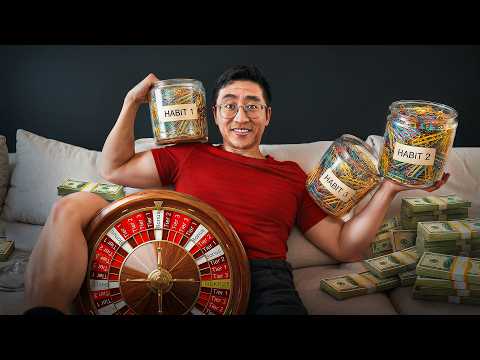
I built a habit system as addicting as a casino
SpoonFedStudy
16m 8s3,356 words~17 min read
Auto-Generated
Watch on YouTube
Share
MORE TRANSCRIPTS