[0:00]What if the next technology to become obsolete is language?
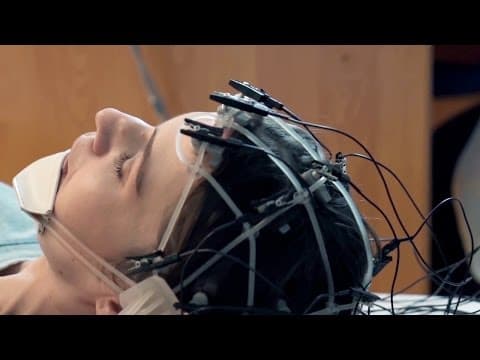
[0:11]Imagine if you will, a world where we don't need to use language to communicate with each other. Let's say I could just pluck a thought from my brain and magically insert it into your mind. Now, you might think that world would just be populated by a bunch of Professor X's. Which would be good news for me because I've already got the haircut. But what about things like science and art and fiction? What would they look like? Would they even exist in a world where we communicate directly with our brains? Now, these questions are largely philosophical at the moment, but they might not be forever because of technology. We've talked about brain computer interfaces before on this show, also known as BCIs. Now, this is technology that has allowed animals and humans to control everything from a computer cursor to a robotic arm to an exoskeleton using some technology and their thoughts. Oh, and this relationship goes both ways. We can also use technology like transcranial magnetic stimulation or ultrasonic emissions to stimulate parts of your brain directly. So, what if we use this kind of technology to allow people to communicate brain to brain instead of brain to machine? Recent experiments have shown that you can use this sort of technology to communicate basic information from one brain to another. Scientists at Harvard University set up an experiment where a human wearing an EEG cap would think. And those thoughts would be picked up by the cap, transmitted into signals that would be sent to an ultrasonic emitter that stimulated a rat's brain and caused its tail to move in a certain direction. Meanwhile, University of Washington researchers set up their own experiment, where two people played a single video game in a very special way. One person could only see the screen, and that person wore an EEG cap. The other person only held a controller, and they wore a transcranial magnetic coil over their left motor cortex. So when the person seeing the screen got a prompt to push a button, they thought about pushing that button really hard. And the EEG picked up those brain waves, sent a signal that was picked up by the transcranial magnetic coil, that stimulated the motor cortex, and the person holding the controller involuntarily pushed the button. Now these experiments are cool, particularly if you like to use animals and people as your own sort of digital puppets. But enough about my hobbies. Optimists think that we might be able to use the same sort of technology in the future to transmit actual thoughts or feelings or entire brain states from person to person. Now, I can already sense the paranoia rising up. Does this mean that in the future, we'll constantly be under mind reading surveillance and mind control attacks? The kinds of experiments we're seeing today aren't really about mind control. They're about sending very basic impulses from one brain to another. So basic, in fact, that some critics argue you can't even really call this brain to brain communication. However, our understanding of the brain is only going to increase from here on out, and that technology is only going to get more sophisticated. So, what does the future hold? Well, for people who have lost the ability to communicate verbally, it could be a real benefit. They might not be able to speak, but they could still communicate brain to brain, even being able to communicate intent with their message. And that's a big part of the future. You see, we often have communication moments where things are misunderstood, even within the same language. I'm sure you've had this happen. You're talking to a person, and they react negatively because they took what you said the wrong way. Well, with this technology, you could transmit not just your thoughts, but the feelings and brain state involved, so they really understand what you're trying to communicate, and there's no way to miscommunicate. And it would be amazing for education. I mean, you could read a half dozen books on how to fly a plane, but that's not going to give you the confidence you need to sit in a pilot seat and actually take off in an aircraft. For that, you might want to schedule a brain-to-brain communication session with an actual pilot. And she gives you what it's like to sit there at the controls and how to control a plane in the right way. And now you can do it yourself and, Whoa. I know Kung Fu. Sorry. Spaced out there for a second. Uh, I got a question for you guys. How would you use brain to brain communication? I want to hear your thoughts in the comments below. If you enjoyed this video, make sure you hit like, subscribe to the channel, and uh, hey, there are these other videos over here. I think you know what I want you to do.


