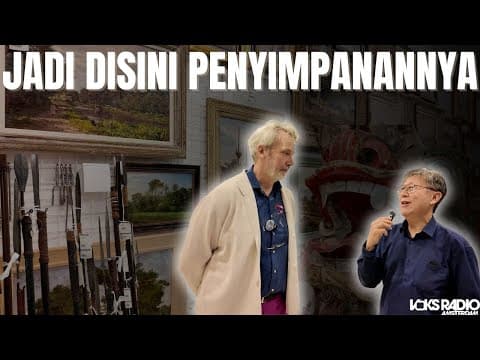
[0:00]Foksian, saat ini Navis, Vania dan saya sedang berada di Museum Bronbek kembali. Tapi kita kali ini akan meninjau yang namanya depo atau gudang museumnya. Luar biasa. Ini adalah kesempatan langka karena tidak semua orang boleh masuk ke depo di sini.
[0:28]kami sekarang berada di depot, depot of the director Bronbeek Museum in uh Arnhem. Wanneer is het uh opgericht, het eh depot? Hetzelfde tijd met eh museum of? Het museum is is al veel ouder, hè? Het is in 1862 eh begonnen. Maar het depot, dit gebouw waar we nu in staan is in 2005 eh gebouwd. Zo lang later. 20 jaar is 20 jaar. 20 jaar nu, ja. Misschien kunt u uitleggen waar de locatie is van het depot dan ten opzichte van het museum? Ja, het is op het achterterrein van van het landgoed gemaakt. eh in de grond gebouwd hier, dus eh heel goed geïsoleerd. En het is ook moeilijker om hier in te breken. Dat is maar één ingang, dus dat is wel fijn. En Uhm ja, we hebben 3 klimaatzones eigenlijk gemaakt voor voor de collecties. En die collecties bestaan dat is meestal eh musea hebben een eh verschillende klimaatzones nodig. Wij hebben eh een klimaatzone voor organisch materiaal. Daar is het 18 graden en 50% relatieve luchtvochtigheid. We hebben een ruimte voor metalen. Die moeten altijd wat droger zijn, omdat ze anders gaan corroderen. En we hebben een koelcel eh voor de fotocollecties. Dat we ons nodig en andere musea hebben vaak andere klimaatzones. Ik heb begrepen dat het eh geen publiek domein is, dus het is het is bij hoge uitzondering Ja ja, geen enkel museum eh stelt zijn zijn depots eigenlijk open. Er zijn een paar musea die hebben publieke depots. Een deel van de depots zijn achter glas opengezet. Maar wij eh ja, wij hebben teveel objecten. Die objecten proberen we zo goed mogelijk te houden. Uhm dus als daar publiek inkomt dan dan kunnen we dat niet garanderen. Bovendien moeten we daar heel de tijd toezicht op houden, dat is ook erg lastig. Dus dit is een eh een uitzondering om eh via de video eigenlijk te laten zien aan aan veel meer mensen hoe zo'n depot eruit ziet. Terima kasih untuk uh kehormatan dan jika eh ya kita masuk. Ja, we gaan naar binnen. Ja, we zijn nu in het in het eh organisch depot, zoals wij dat noemen. Ja, het is al het organische materiaal. Wat niet metaal is of niet foto en papier, dat komt hier terecht. En veel objecten zijn samengesteld noemen we dat. Dus er zit van allerlei materialen en textiel, metaal, eh plastic, eh van alles. Ja, dat kan je je dit is een beetje een gemiddelde depot, een gemiddelde temperatuur, gemiddelde vochtigheid waar de meeste objecten eh materialen zich wel prettig bij voelen. Ja, uh pertanyaan jebakan selalu seperti itu. Uh uh berapa objek? Ja, dat is dat kun je eigenlijk niet eh eh kan ik geen antwoord op geven. Dat wij kunnen wel eh het is de beste vraag die je kunt stellen in musea of in bibliotheek en archief is eigenlijk hoeveel records heb je in je databank zitten? We hebben er 118.000 nu in zitten. 118.000. Ja. in de loop der in de loop der dat is in 162 jaar verzameld. Ja. Ja, en dat zit dat gaat dan van van van een knoop of een een foto tot aan eh een heel huismodel of een of een opgezette beest. Dus je hebt soms hele grote objecten, dat is één record, maar soms heb je ook heel kleine records, objecten die één record maken. Hebben jullie de objecten eh gekocht aangevuld of eh Ja, dat is eh eh gekocht. Eh het meeste is een schenking. Eh dus gekocht eh gevonden. Komt ook al voor. Eh en legaten zijn verschillende manieren waarop objecten binnenkomen. Maar het meeste hier is eh schenking geweest. Wat is er perronstuk voorspel? Ja, dat is eh dat is heel persoonlijk altijd, alles. Nee, in principe voor onszelf is is alles is eigenlijk eh belangrijk en interessant. En de sommige objecten dat hangt dat is heel erg persoonlijk. En er zijn natuurlijk objecten die heel historisch van belang zijn geweest. In, maar dat ook dat wisselt door de tijd heen hè. Dus wij kijken 100 jaar geleden keken ze naar andere objecten dan wij nu zouden kijken. En ik denk de trend is nu dat we heel veel eh we echt persoonlijke verhalen vinden we eigenlijk interessant. Ja. Dus als een object van iemand geweest is, dan geeft dat een andere sensatie dan als het eh als het object an sich zeg maar verzameld zou zijn.
[4:43]Uhm dit is een eh een collectie van Indische schilders. Schilderijen van deze meneer. Die hangt hier. Willem Blackman. Dat is een zelfportret van hem. En hij is een hij is een belangrijke schilder, maar hij vond deze schilderijen Hij is geboren in Indonesië.
[5:03]Op Java en hij is ambtenaar geworden, maar hij was eigenlijk zijn hart lag meer bij de kunst eh bij schilderen. En hij heeft een opleiding gedaan in Amsterdam. En is toen teruggegaan naar Indonesië en heeft eh op het eind 19e eeuw heeft hij deze schilderijen gemaakt. En dit is eigenlijk hij heeft eigenlijk in de impressionisme geïntroduceerd in in Zuidoost-Azië. Oké. Dus hij is een hele belangrijke schilder, maar niemand kent hem bijna. Hoe komt dat? Ja, omdat hij, omdat hij eh vroeg gestopt is eigenlijk met schilderen. Hij is in 1900 rond 1900 naar Nederland gegaan en heeft daar allerlei bestuursfuncties nog gedaan. En hij heeft wel geschilderd, maar hij is hij heeft nooit veel verkocht, want zijn hele bijna zijn hele Indische collectie. Dus zijn Indonesische schilderijen die liggen hier in het depot. Die heeft hij altijd bij zich gehouden. Cool. Raden Saleh. Oh ja, we hebben een aantal Raden Saleh is, Ja, dit is een portret van generaal Kruse. Hij schilderde veel portretten ook, hè? Maar eh eh hij heeft ook wat landschappen gedaan. Eén landschap hangt in het eh het paleis in in Bogor.
[6:04]Dat hangt in het in de vaste tentoonstelling in het hoofdgebouw. Maar één? 2-1, ja. Dus we hebben twee Raden Saleh hier hangen. Dit is een portret van generaal Kruse en aan de andere kant hangt ook nog het portret van meneer Rossum, ook een militair. Ja, maar elk museum heeft eh veel grotere collectie dan wat zij kunnen tonen. Dus de bedoeling is natuurlijk dat we een archief zijn. Dus we bewaren de objecten zo lang mogelijk. En dit is voor beschikbaar voor iedereen om te lenen. Dus ieder Wij zijn een nationale instelling, dus eh musea kunnen dit eh lenen. Sommige doen dat ook. En zelfs Indonesië zou dit ook kunnen lenen hè? Dat kan. Dat is gewoon internationaal ruilverk hier, eh bruikleen verkeer. Dus dat kan. En maar wij kunnen nooit eh alles tentoonstellen. Dat gaat niet. We kunnen dat wel digitaal doen, dus alles staat wel online. Indonesië zou erover gesproken zijn. Eh worden deze objecten altijd eh teruggegeven? gerepatrieerd, heet dat tegenwoordig. Ja, dat kan, hè? Dat als eh de Nederlandse als de Indonesische regering een claim indient, dan wordt daarna gekeken door eh de Nederlandse overheid, de Nederlandse staat en dan dan wordt er gerepatrieerd, zeker. Maar eh we zien we hebben dat allemaal gezien, dat het is eh niet zomaar een eh huiskamer eh eh bewaarplaats met de gave hele eh circuleersysteem en eh temperatuur.
[7:29]Is er ook eh zo'n soort eh begeleiding of zo met de lokale stakeholders in Indonesië? Indonesië als ze gerepatrieerd worden. Ja, dat weet ik niet. Ik dat heb ik niet bijgeweest, maar dat zou eh dat zou kunnen. Er is wel een samenwerkingsband met Nederland en Indonesië. De en eh daar komen ook daar worden regelmatig cursussen gegeven in Nederland ook. En Uhm dus er komen Indonesische specialisten naar Nederland of specialisten van Nederland gaan daar naartoe en helpen daarbij. Ja, dat kan. Want de objecten zijn natuurlijk belangrijk, maar om het in stand te houden Ja, in standhouding is is eh dat kost veel veel tijd en veel geld dus ook. En veel kennis en kunde. Ja. Ja. Ja. Dus dat dat Uhm maar daar wordt al eh repatriatie is niet nieuw, hè? Dat is dat is al in de jaren 60, eigenlijk in die in 1949 al begonnen met de met de aanvragen. Eind jaren 60 zijn de eerste aanvragen ook wel gehonoreerd. En in de jaren 70 zijn er ook objecten van dit museum naar Indonesië gegaan. En daar zijn vanaf die tijd ook al samenwerkingsverbanden met er is geen probleem om om kennis uit te wisselen. Dat kan altijd. Ook Nederland zal dat altijd blijven doen. Het is wel zo dat in Indonesië zelf moet het ook wel landen, hè? Dus het moet wel mensen moeten daar ja, een carrière in kunnen maken en museum specialisten worden en blijven. Gimanapun, Jos.
[8:54]Kalau repatriasi eh untuk repatriasi barang-barang barang-barang itu. Ya, harus tidak terlantar. Kita sebagai bangsa yang menghargai pusaka, menghargai sejarah juga harus ada ranah-ranahnya atau norma-normanya yang harus kaidah yang kita juga bisa belajar dari Belanda. Eh tapi memang harus ada keinginan besar. Harus ada eh oh kita mendapatkan kembali seperti anak yang hilang terus pulang ke rumah. Nah anak ini kita apain gitu. Jadi bukan hanya dipertontonkan, tapi juga harus dijaga untuk anak-anak generasi berikutnya gitu.
[10:02]Teman-teman yang suka nari Barong, ini Barong asli dari eh belum tahu. Tidak tahu kapan dibawa ke sini. Tapi di ini tertulis dari tahun 1829. Jadi sebelum Pangeran Diponegoro ditangkap, ini sesudah sesudah sudah ada gitu. The What's this from? The Chinese uh It's not from Indonesia. It was used in Indonesia, I think, but it was from made in Hong Kong. Yeah, We can know it because we cleaned it and inside it's the producer stamp. And he's he's uh he's been in When did it arrive? It's been in our collection since 1925. So he's already 100 years old. And you also see that it's the body's made of silk and it falls apart. Besides that, we also can't fix it. So we really preserve it as best as we can, but it can't be used anymore, that's impossible. Yeah, but this will also be so, uh, It will be very bright gold, yeah, the color. This is a lion dance from the Chinese, so it's also made in Hong Kong. It's not from Indonesia. It has been used in Indonesia, I think, but it will come. It's made in Hong Kong. Yeah, we can tell that because we cleaned it and on the inside it's the producer's stamp. And he's he's uh he came in When did it arrive? It's been in our collection since 1925, so it's already 100 years old. And you also see that its body is made of silk and it's falling apart. Besides that, we also can't repair it. So we really preserve it as best as we can, but it can't be used anymore, that's impossible. This one will also be so uh It will be very bright gold, yeah, its color.
[11:24]what I'm asking is that uh of course there were no uh airplanes back then. Maybe in the early days it was only 25 years. Yeah, yeah, but it's all overseas. Yes. So, uh, with uh with uh it's usually brought by boat. Yes. Yes, people had full boxes with them. Uh, that happened. In the past, many uh models were collected. And of course, you can't uh, this is like, I think, a tiger case. You can't, of course, take it as a whole one-to-one. So models were made. It was just asked to the local population to make a model. And this is, I found this an interesting collection. These are objects that come from the colonial exhibition in 1883 in Amsterdam. It was a very big kind of world exhibition. Where, uh, lots of objects from Indonesia were also displayed and then such models were produced and brought to the Netherlands to show what it was like there, of course. Because not everyone could go like that. We also have a collection with krises, of course, and other weapons. Yes, with bladed weapons. Here, yes, these are We have a very diverse collection with krises. These are not all, uh, masterpieces, so to speak, but what ordinary people, uh, used and still, uh, used. Yes, there are also some good pieces among them, but this is a whole mix of, uh, different. And of course, we have weapons from all over the archipelago. So from, uh, Sumatra, Java, up to Bali, uh, Kalimantan, from everywhere. This is all Javanese. The holy kris, you just have to maintain it regularly. With a bath with jasmine flowers, so a ritual. Yes, rituals, but those rituals also differ, uh, per village or per island. Uh, so that's what we as a museum don't do anymore. No. And you also see that that tradition over time, that's the nice thing about having an archive, that you can record how, uh, how that happened in 1850 and how it would happen in 1950 or 2025. And you see that that changes over time and the interpretation changes. Yes, these are very old pieces. Okay, you can see. This came to Bronbeek in 1872. 1872, yes. Before our time, this was 1866. So that's the importance of the archive, that you know, okay, this is a dating. It must have been made before that. So I think those are important pieces. That's very important that, uh, the younger generation also, uh, is interested. Yes, we certainly think so, as old men, maybe, but thank you. Yes, I also think it's important, but you can't force people to find this interesting. What is possible is what we do. I think it's the task of a museum that if you want to know something, then you can go to the museum and then you know that here, yeah, we think that we can try to tell the truth. So this is a real object. And we give as much information as possible about it. So if you are still young and you want to know something, then you can go to a museum or to an archive or to a library and then you can get information there. Yes, we keep it as well as possible and we try to do it as fairly as possible. And the advantage of such things is that you can still here, yeah, a lot of, uh, decoration techniques, technical matters, you can research again. Because many of these things are no longer made. Uh, these are 160, 150 years old. Those techniques, the method. Yes, the method will be different material, but here you can really research how that, uh, 150 years ago went. Yeah, but this is, yeah, this is what we call beautiful Indies paintings. Uh, so many people took that with them. Say, tempo dulu. Yes, tempo dulu, uh, happened, but it's, yeah, Indonesia was a bit like that. Some places still are, uh. So the volcanoes in the sawa. That is, uh, beautiful memories of. They all became soft now, right? Yes, often, yes, yeah. Too bad, yes. Yes, Java has, of course, grown enormously. Uh, a lot of big population, so, yeah, all of that from previous years. So from before 1950, that is, uh, becoming rare, yes, certainly. It's all well, uh, well documented, all of it. Some are well documented, but far from everything is documented. Look, often people make donations and then they don't really know anymore what the origin is. So then it's known that it's Indonesia, but what the origin is, what already happened with it, we don't always know that. In some cases, yes. We put everything we know in the database. What we can see is, of course, the material used, the techniques and so on, we can all research that. But the historical background, we are now trying to record as much as possible. And also to do research on it. So sometimes we know that something has been donated by so-and-so. And that person, we also know where he has all worked. And then we can, oh, that must come from there or from that period. Yes, this is a flag of the KNIL from the 19th, early 19th century. This is, of course, these are military masterpieces. So it's not that interesting for the public, but for, yeah, the historical aspect, it is important. And you see, these are very, these are made of silk, uh, once, but you see that it's very poorly preserved. All the pieces here, that's all pasted on. Yeah, that's all reconstructed. Where are we now? This is the, this is, uh, the cool cell where we keep the collection of a photograph and a part of our archive, uh, paper material. So maps, but many photos. So here you see, uh, photo albums. We have many of them. It's a bit fresh in here. It's very cold here, it's 13 degrees. Uh, and that's for the one so that the pictures stay good. So this is a photo album. Yes. And they are all provided with a barcode. Otherwise we can't, of course, locate them well. Uh, so that's, uh, important. And the numbers that refer to our database. Okay. So in the database there is information from who it originated from, what can be seen and you can also see all the digital files. That's all online. How many photos are there here? Uh, very many, 10,000. Yes, even maybe more. It's all online. No, no, not everything is information, but not digital yet. We are still working on that. That will take years. But here, for example, there are almost 300,000 photos. These are aerial photos from Indonesia. Topography. Yes, from 1942 to 1962. And that's here in this kind of oil fields, maybe, uh, at your home. How is this? So these are aerial photos. Uh, these are strips that they, uh, crossed. Uh, the pieces are just forest. But the important thing here is that you get a picture, for example, of the deforestation. How did it look in 1950? And and and and compare that with now. That would be very good. Yes. But these are actually military photos. Uh, that were made for, uh, World War II and after. Uh, yeah, maps. So this is Java, Madura. This is printed in 1942, but copied from a map from 1933. And this is from World War II. Uh, so, of course, America intended to launch an invasion in Indonesia and needed many maps. But they were mainly used after '45. That's really from that propaganda to '45 to '49. Banyak eh bedankt for de rondleiding. Ik vond het persoonlijk eh indrukwekkend. En nogmaals bedankt voor de gelegenheid dat we zomaar naar binnen mogen komen. Iedereen is altijd heel erg welkom bij ons ook. Indonesische bezoekers. Niet in het depot. Nee, depot niet. Maar je kunt wel onderzoek doen hier, hè? Dat kan je wel. Dus je kan wel aanvragen doen, ook in Indonesië kunnen aanvragen doen om eh om dingen te onderzoeken. Dat kan. Maar we zijn natuurlijk we hebben weinig personeel dus het is gelimiteerd wat er allemaal kan. Maar de tentoonstelling is natuurlijk ook interessant genoeg om te bezoeken. Ik denk voor Indonesië heel graag. En ook als mensen iets gezien hebben in de depot of in onze website. Uhm en als ze daar extra informatie over hebben, dat horen wij heel graag. Oké. Ja. Nogmaals bedankt, ja. Graag gedaan.