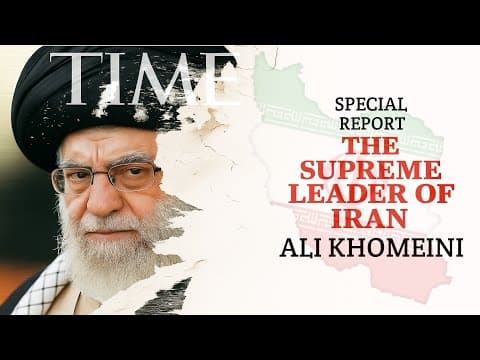
[0:00]Ayatollah Ali Khamenei has ruled Iran longer than any other leader since the 20th century. From a young cleric in Mashhad to the helm of a theocratic republic, his life mirrors the evolution of modern Iran itself, an arc of revolution, resistance, and rigid ideology mixed with political maneuvering. While Ayatollah Khomeini was the charismatic founder, Khamenei has been the strategic consolidator, shaping Iran into a hybrid system of Republican institutions controlled by clerical oversight. His leadership has survived wars, sanctions, uprisings, and international isolation. As Iran stands at a crossroads, facing generational shifts, economic woes, and geopolitical pressure, Khamenei's shadow looms large over the future. Whether his vision of the Islamic Republic endures will depend on how the next Supreme Leader and the Iranian people interpret his legacy. Early life and religious roots. Ali Hosseini Khamenei was born on July 17, 1939, in Mashhad, one of Iran's holiest cities. He was the second son in a deeply religious family of modest means. His father, Sayyad Javad Khamenei, was a respected but not prominent cleric of Azerbaijani heritage, and his mother, Khadija Murtadi, came from a family with deep religious ties in northeastern Iran. From a young age, Ali Khamenei was immersed in the world of Sure scholarship. He began formal religious education at age five, studying the Quran, Persian literature, and basic Arabic grammar. By his teenage years, he had enrolled in the Mashhad seminary, studying under prominent scholars and quickly establishing himself as a promising young cleric. His deep voice, intense demeanor, and sharp intellect earned him the attention of teachers and peers alike. Unlike many clerics who stayed within traditional theology, Khamenei had a strong interest in political and revolutionary thought. He read works by anti-colonial thinkers and Islamic revivalists, especially those who opposed Western imperialism and monarchy. The life of Imam Hussein, the Sure martyr, became a symbolic template for resistance in his worldview. Political awakening and activism against the Shah. Khamenei's political consciousness began to blossom in the late 1950s. After completing early studies in Mashhad, he traveled to the holy cities of Qom and Najaf, the centers of Sure theology, to study under some of the most renowned scholars of the time. These included Ayatollah Hussein Borjerdi, the leading Marja of Sure Islam, and the fiery revolutionary cleric Ruhala Khomeini. Khamenei was deeply influenced by Khomeini's sermons denouncing the Shah's regime and opposing Western domination. He became an early disciple of Khomeini's anti-imperialist teachings and began delivering political sermons in mosques, drawing the attention of SAVAK, the Shah's secret police. In the early 1960s, he returned to Mashhad and began preaching against the Shah's White Revolution, which included land reforms and women's suffrage. Khamenei argued these policies were Western inspired and aimed to weaken Islam and clerical authority. In 1963, after Khomeini's arrest following his anti-Shah sermon during Ashura, Khamenei participated in protests that erupted nationwide. These were brutally suppressed. Arrests, imprisonment and exile. Khamenei became a marked man in the eyes of the Palavi regime. From 1963 until the Revolution in 1979, he was arrested six times and spent multiple years in prison or internal exile. During his imprisonments, he was subject to harsh interrogations and solitary confinement, which only heartened his resolve. He continued to write and teach in secret. He translated revolutionary and Islamic works into Persian, including the writings of Sayed Qutb, an Egyptian Sunni Islamist thinker. Despite the theological differences, Khamenei admired Qutb's anti-Western and anti-authoritarian ideology. He also helped build underground clerical and student networks across Iran, particularly in Mashhad and Tehran. Khamenei was seen as a bridge between the older clerical generation and younger revolutionaries, combining deep religious credentials with revolutionary fervor. By the late 1970s, Iran was on the brink of upheaval. As protests intensified and the Shah's authority crumbled, Khamenei emerged as one of the key lieutenants in Ayatollah Khomeini's movement, organizing rallies, spreading Khomeini's tape messages, and maintaining coordination between clerical groups. The 1979 Revolution and entry into power. On February 11th, 1979, the Shah's regime collapsed. Ayatollah Khomeini returned from exile and assumed leadership of a broad-based revolutionary movement. Khamenei quickly rose in prominence. He was appointed to the Council of the Islamic Revolution and soon became a trusted advisor and cleric in the newly formed Islamic Republic. He played a crucial role in shaping Iran's post-revolutionary institutions. Khamenei supported the concept of Vilayati Fakhi, guardianship of the Jurist, which positioned the Supreme Leader as the highest authority. He was appointed Friday prayer leader of Tehran in 1980, a powerful religious and political post, and became a symbol of revolutionary purity. Later that year, Khamenei narrowly survived an assassination attempt by the Mujahidin E Khalk, MEK. A tape recorder rigged with explosives blew up while he was giving a speech, injuring his right arm and vocal cords permanently. This incident further elevated his status as a living martyr. Presidency of Iran. Following the assassination of President Mohammad Ali Rajai in August 1981, Khamenei was elected as president of Iran, serving two terms from 1981 to 1989. He was the first cleric to hold the office, though he initially opposed clerics holding executive roles. During his presidency, Iran was embroiled in the brutal Iran-Iraq war. Khamenei played a central role in maintaining internal unity and advocating for total resistance against Saddam Hussein. He worked closely with Prime Minister Mir Hussein Musavi, though their relationship was sometimes tense. Internationally, Khamenei remained a hardliner. He promoted the concept of neither east nor west, La Sharq, La Garb, seeking to maintain Iran's independence from both the Soviet Union and the United States. He advocated support for Sure movements abroad, including Hezbollah in Lebanon. Despite being president, Khamenei did not have full control over military or intelligence affairs, which were still firmly under Khomeini and the Islamic Revolutionary Guard Corps, IRGC. Yet, he gained the trust of the Supreme Leader and the conservative clergy. Supreme Leader of Iran. When Ayatollah Khomeini died in June 1989, the Assembly of Experts faced a difficult task, finding a successor. The ideal candidate, Ayatollah Montazeri, had been dismissed by Khomeini months earlier. Khamenei, though not a recognized Marja, source of emulation, was elected as Supreme Leader by the assembly in a controversial but decisive vote. The Iranian constitution was amended to allow a Supreme Leader without the highest clerical rank. Khamenei gradually consolidated his position, appointing loyalists to key positions in the military, judiciary, and clerical establishment. Over the next three decades, he built a complex power structure centered around his office. He appointed heads of the judiciary, the IRGC, and state broadcasting. He became the final arbiter of all state matters, from foreign policy to economic strategy. Foreign policy and that access of resistance. Khamenei's foreign policy has been guided by a blend of Sure ideology, anti-imperialism, and Realpolitique. He positioned Iran as the leader of the axis of resistance, supporting groups opposed to U.S. and Israeli influence. Hezbollah in Lebanon. Hamas and Islamic Jihad in Palestine. Sure militias in Iraq. The Assad regime in Syria. The Houthis in Yemen. While this expanded Iran's regional influence, it also brought economic and diplomatic costs. Khamenei has consistently mistrusted the U.S., calling it the Great Satan. Though he allowed President Hassan Rohani and Foreign Minister Javad Zaraf to negotiate the 2015 nuclear deal, JCPOA, with world powers, he remained publicly skeptical. When the U.S. withdrew from the agreement in 2018 under President Trump, Khamenei said it vindicated his position. Economic and social challenges. Iran under Khamenei has faced multiple economic crises, caused by international sanctions, corruption, mismanagement, and over-dependence on oil. Despite ambitions for a resistance economy that reduced reliance on foreign trade, Iran remains vulnerable. Khamenei promotes Islamic economics and self-sufficiency, but privatization and modernization have been uneven. The IRGC controls large swads of Iran's economy from construction to banking. On social issues, Khamenei supports conservative values. He has opposed liberalization of dress codes, gender equality initiatives, and Western cultural influence. He views social liberalism as a threat to Islamic identity. Ayatollah Ali Khamenei, Iran's Supreme Leader, holds a strongly anti-Israel position. He refuses to recognize Israel as a legitimate state, calls it a fake and cancerous regime, and supports armed resistance against it, especially through groups like Hezbollah and Hamas.
[10:00]He also leads Iran's annual Kuds Day rallies to denounce Israel and support Palestinian liberation.


