[0:00]Headline after headline is about yet another company laying off thousands of workers due to AI. If you're wondering what signs to look for to tell if you're about to be laid off, I'm going to explain step-by-step how exactly AI could take your job. This video is a scenario based on the intelligence curse, a deeply researched and widely circulating report in the AI industry. The Federal Reserve chairman Jerome Powell says the AI hiring apocalypse is real: 'Job creation is pretty close to zero.' Let's imagine you're the CEO of a firm with a thousand employees, most of whom are junior or entry-level. A new AI company approaches you with a pitch: an AI agent that can do the work of a junior employee for one fifth of the cost. The more aggressive firms in your sector immediately fire most junior employees. But you're cautious; you're skeptical that this new AI can replace humans. So you treat it as a tool, instead of outright replacing humans, everything the AIs do is subject to human approval. But within months, the AI agents are outperforming most of your human employees. This comes as a shock to you, but the experts aren't surprised. From 2019 to 2025, the length of tasks AIs could perform doubled every 7 months. This is just the trend continuing. And here's the thing, you might feel uneasy with these developments, but you can't get out of this situation. Because the more that your employees rely on the AI tool, the faster and better their work becomes. In fact, your top performers are now the ones who let the AI do everything before clicking approve. For basic tasks, humans in the loop aren't improving the work, they're slowing it down. And if you can see that, so can your board. Every day, more and more AIs join the workforce. The board is happy with the extra productivity, but not with the payroll. They have a question: Why aren't you firing the unproductive human employees? You argue to keep them on humanitarian grounds. You didn't want your workers to be replaced by AI. The board isn't convinced. But you warn them that mass firings would be bad PR for the company, and that is enough to get the board off your back for now. End of quarter, your earnings are up, but your competitors, the ones who replaced humans entirely, have reported even higher earnings at a fraction of your cost. In any other economy, your results would be a win, but here, you're losing market share, and your stock price takes a massive hit. So the board delivers an ultimatum: fire the unproductive junior employees, or we'll replace you with a new, ruthless CEO who will replace all of your junior staff with AI. You know that you can't do any good if you get fired. So saving some jobs is better than saving no jobs. So you compromise, firing half your junior staff. You hang onto your own role, convince yourself that maybe someday, if the board allows it, you'll be able to hire all your old staff back. After all, no one else is hiring, so they'll still be on the job market. But AI progress doesn't slow down. At this point, your managers are managing more AIs than humans, and every month, the AI agents improve, doing more and more work, while the human employees remain stagnant. AI has set a new standard that all junior human employees are failing to live up to. So the board wants you to fire all of them. You offer a compromise: all junior employees will be put on a performance improvement plan, giving them one last chance to prove their worth to the company, and to prove that they can do the work that's just as good as AI. A month later, a tiny handful of exceptional junior employees who have proven their worth are promoted to management. But over 90% of them are fired. One of them is Alice. She begins searching for a new job, but finds that no one is hiring. All other firms in the sector are laying off staff as quickly as they can get away with. From her kitchen table, Alice scrolls through the headlines. GDP is climbing, the stock market is booming under the new productivity gains from AI, and yet unemployment rates are approaching 12%, worse than any point since the Great Depression. She's just part of the statistic, and it's about to get worse. The new generation of AI agents doesn't just intend to replace the junior staff, it comes for the managers. These systems can coordinate entire teams of AIs, track every decision in real time, and optimize workflows with a precision no human manager can match. All at a fraction of the cost. When you look at your org chart, it's AIs managing AIs, and the numbers prove it works. At your next quarterly performance review, the numbers are better than ever, but the board is furious. To them, the results only confirm what they've been saying. Human managers can't compete. Your reluctance to cut them loose looks like weakness. Again, you offer a compromise: all human managers are now on a performance improvement plan. Prove you can be as good as an AI, or lose your job for failing to meet standards. A month later, 90% of your human managers are gone. At this point, unemployment has passed 15%, rapidly approaching 20%, with job loss numbers five times worse than the Great Recession. Yet the stock market keeps rising, thanks to AI-fueled productivity. For Alice, now six months into her failed job hunt, the message is clear: no one's coming to save her. So she decides to fight back. She joins rallies, writes op-eds, and throws her voice behind one big idea: UBI, a universal basic income that would guarantee every citizen $1,000 a month. It sounds like hope, but the backlash is immediate. Critics point out that $1,000 per month for every citizen would eat up two-thirds of the budget, sending the country further into debt while rewarding people for not working. Some economists take Alice's side, offering justifications for UBI. They say the increased tax revenue from GDP growth will cover it, and inflation will effectively reduce the national debt. But the debate ends when the US administration's AI ZARS weighs in. His verdict is blunt: UBI is a utopian fantasy, and the administration will veto any bill proposing it. Alice is devastated, but no one is surprised. The AI czar's comments perfectly echo what he said back in June 2025. The Left envisions a post-economic order in which people stop working and instead receive government benefits. In other words, everyone on welfare. This is their fantasy; it's not going to happen. For Alice, the fight feels over. For AI, it's just beginning. The same month the UBI bill dies, AI clears its next milestone. In 2025, it could handle tasks that took hours. Now, the newest generation can run months-long projects without any human input or oversight. The board has seen AI replace and surpass all junior-level employees, all middle managers, all senior managers. Now, all that's left is the executives in the C-suite. They stop short of firing all of you outright, leaving you on the org chart in name only. Every day, you participate in the humiliating ritual of coming to the office to review the AI's work. And each day, with increasing horror, you realize that the AI is doing a better job than you could ever possibly hope to. After all, how could it not? The AI has more knowledge than you, it has more training than you, and because the AI CEO can monitor every single decision made within the company with perfect accuracy, it has insight into operations that no human ever could match. Unemployment smashes through 25%, breaking every historical record, even the worst days of the Great Depression. On the same day that the S&P 500 hits a new all-time high with record stock growth. Alice's landlord is taking her to court to evict her family from the house she's called home for the past decade. So she jumps on a bus to Washington D.C. and joins 100,000 people swarming the National Mall, chanting, Humans first, and waving UBI banners. But you wouldn't know it from the news. TV networks barely mention it. On social platforms, live stream links vanish from feeds under the guise of 'Violence prevention' and 'misinformation,' the same censorship playbook authoritarian states perfected years ago in the pre-AI era. America, the world's oldest democracy, claims to still have free speech, but the online platforms that control the spread of information silence the protest. Turnout at the next rally plummets. Families keep losing jobs, healthcare, and homes, but the story almost fades from public view. Alice can't believe what she's seeing. But when she tries to talk to her neighbors, they brush her off. Keep up with the job search. Sometimes the job market is hard. Half the people she talks to refuse to believe her when she says that this time, it's different. Alice then realizes something that has always been true: people's politics aren't driven by numbers, they're driven by vibes. And the vibes during Alice's most recent protest are all about the breakup between a pop star and her star athlete boyfriend, with millions of posts arguing over who's to blame. As if that mattered more than the collapse of the job market. And while the public obsesses over celebrity drama, the real drama is unfolding in the boardroom, and it's about to land squarely on your desk. You're still the CEO, technically, but the board calls you in to confirm what you've already suspected: the AI is doing your job better than you ever could. Your company is now run by an AI CEO. It makes every decision, flawlessly executes them, monitors every part of the business with perfect precision, and works 24/7 without pause. It has beaten every target the board set. You're only human, and that makes you obsolete. The stock market keeps climbing, but only AI companies selling to other AI companies are breaking records. The rest, the ones selling food, clothing, or anything meant for humans, are drying up. With 25% unemployment and rising poverty, there's simply less profits in selling to humans. Politicians take note: most of the government's tax revenue and most of their campaign donations are coming from AI firms and their shareholders. So the AI economy that funds them becomes their main constituency. In the years to come, public schools crumble. With no need to prepare a new generation for the workforce, why should public schools be anything more than glorified day care? Instead of reading and math classes, kids now spend all day watching AI-generated entertainment, served by a screen that's cheaper than a teacher with an education degree. The few remaining universities are exclusive academies for the children of elites, harkening back to the pre-industrial days of the 18th century, when less than 1% of people received a university education. And with AI driving all innovation and productivity, upward mobility has now been completely eliminated. The only wealthy people left are those who acquired their wealth prior to the AI takeover of the economy, or those who inherited it. This scenario might seem far-fetched, but it doesn't take much for this dystopia to become a reality. For this scenario to work, you only have to believe in a few things: AI will continue improving up to and past the point of human intelligence. Running a human-level AI will eventually be cheaper than paying a human for the same job. Private companies exist to maximize profit, and when given the chance, will replace human employees with AI. Even the firms that initially resist will eventually be forced by competitive pressure to replace humans with AI. The media will be, or is already, largely controlled by corporations that have the mechanisms to throttle the spread of ideas that they see as destabilizing. The government is also driven by incentives, and in a world where most tax revenue comes from AI firms, it will largely cater to the interests of AI. Do any of those sound implausible to you in the next five years? Think about how different the world was five years ago, before the emergence of AI tools like ChatGPT. You might argue, well, we've been here before. Every wave of disruptive technology has always replaced some jobs, but people have always found some new ones. And you'd be right, AI isn't the first time we've seen a new technology threatened to replace human labor. But AI is unique because the companies building it have explicitly made it their goal to replace all human labor. OpenAI literally made it part of their founding charter, 'outperform humans.' And to make matters worse, AI can accelerate the spread of the Paradox of Plenty. When technology or resources make a country richer, while keeping most of the citizens poorer, by concentrating wealth in the hands of a few individuals and corporations. We've already seen it with oil and minerals. Why is Venezuela, owner of the world's largest oil reserves, enduring near-famine conditions? Why is the Congo sitting on trillions of dollars in mineral wealth while its people are among the poorest in the world? Or look at Nigeria, Africa's biggest oil producer, with an appalling poverty rate of 47%. This is the resource curse. Oil, diamonds, and gold can make a country rich on paper, yet individual citizens can still go hungry. In fact, when a country's wealth is more concentrated in a single extractive industry, it becomes a natural recipe for corruption. Whoever owns the oil rigs or diamond mines has all the money they need to buy off the generals, judges, and media. But how can we avoid this? The countries that escaped the resource curse were the ones that had human-driven industries, where the wealth wasn't owned by a single person and dug out of the ground, but created by human labor. Countries like Taiwan or South Korea didn't have a natural resource jackpot. The only way that these countries could become richer and more powerful was by investing in their people, giving people access to food, nutrition, and schools so that they'd grow up to be more productive citizens capable of designing better smartphones, microchips, and entertainment. When your biggest industries rely on human talent, the humans have the bargaining power to demand better living conditions. But now, AI threatens to take that leverage away. It could do what oil did to countries like Venezuela and Russia, concentrating power and wealth in the hands of a small number of corrupt oligarchs at the expense of everyone else. A kind of wealth that benefits the few, while making everyone else poorer. In a world where AI can do everyone's job for less money, humans have no leverage, no bargaining power to demand a higher minimum wage. This is called the Intelligence Curse. We want a future where AI uplifts humans without replacing humans. So, how do we prevent AI from replacing us? What are the things we should let AI do, and what are the things we shouldn't let it do? We need to keep an eye on three things: whether AI is intelligent, whether it's autonomous, and whether it's general. We can have a highly intelligent AI that is good at only one specific thing. Take AlphaFold, the AI that won the Nobel Prize in chemistry in 2024. It's good at one specific thing, predicting protein structures. It takes research that might have taken months or years and accomplishes it in hours. It's a massive scientific breakthrough, but AlphaFold is only good at one specific thing. It helps medical research, and it doesn't threaten humanity's future. We can also have AIs that are intelligent and autonomous. Look at self-driving cars. Driving is a complex task that requires an advanced AI to safely navigate the roads, and these cars are also autonomous. But they don't have general intelligence. A self-driving Waymo car is only good at one thing: driving. The part where AI becomes dangerous is when it becomes general. A general AI is good at everything, and we're getting closer to seeing general AI with LLMs and multimodal AIs like Claude and GPT. An AI with general intelligence could replace human workers at practically every job, which again, is the goal that OpenAI openly admits to. But the danger isn't just that the AI will make humans irrelevant. A general intelligence that's good at everything could learn to improve itself or create new AIs. It can become more and more powerful, exponentially, until it becomes a superintelligence, far smarter than even the smartest humans. AI scientists are terrified that this is not only possible, but likely to happen. Watch this video next to understand exactly how a superintelligent AI takeover might happen, based on a famous report by AI researchers.
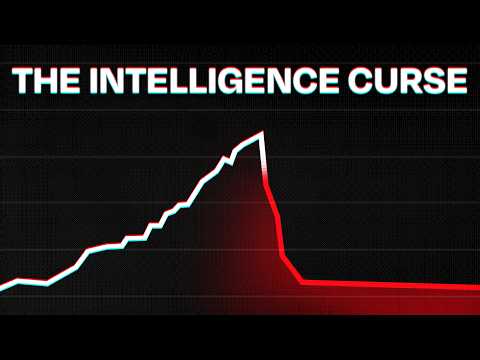
Yes, AI Will Take Your Job. But What Happens NEXT Is Worse
Species | Documenting AGI
16m 19s2,853 words~15 min read
YouTube auto captions
Transcript source
YouTube auto captions
This transcript was extracted from YouTube's auto-generated caption track. The transcript below is server-rendered so it can be read, searched, cited, and shared without opening the original YouTube player.
Pull quotes
[0:00]Headline after headline is about yet another company laying off thousands of workers due to AI.
[0:00]If you're wondering what signs to look for to tell if you're about to be laid off, I'm going to explain step-by-step how exactly AI could take your job.
[0:00]This video is a scenario based on the intelligence curse, a deeply researched and widely circulating report in the AI industry.
[0:00]A new AI company approaches you with a pitch: an AI agent that can do the work of a junior employee for one fifth of the cost.
Use this transcript
Related transcript hubs
Watch on YouTube
Share
MORE TRANSCRIPTS


